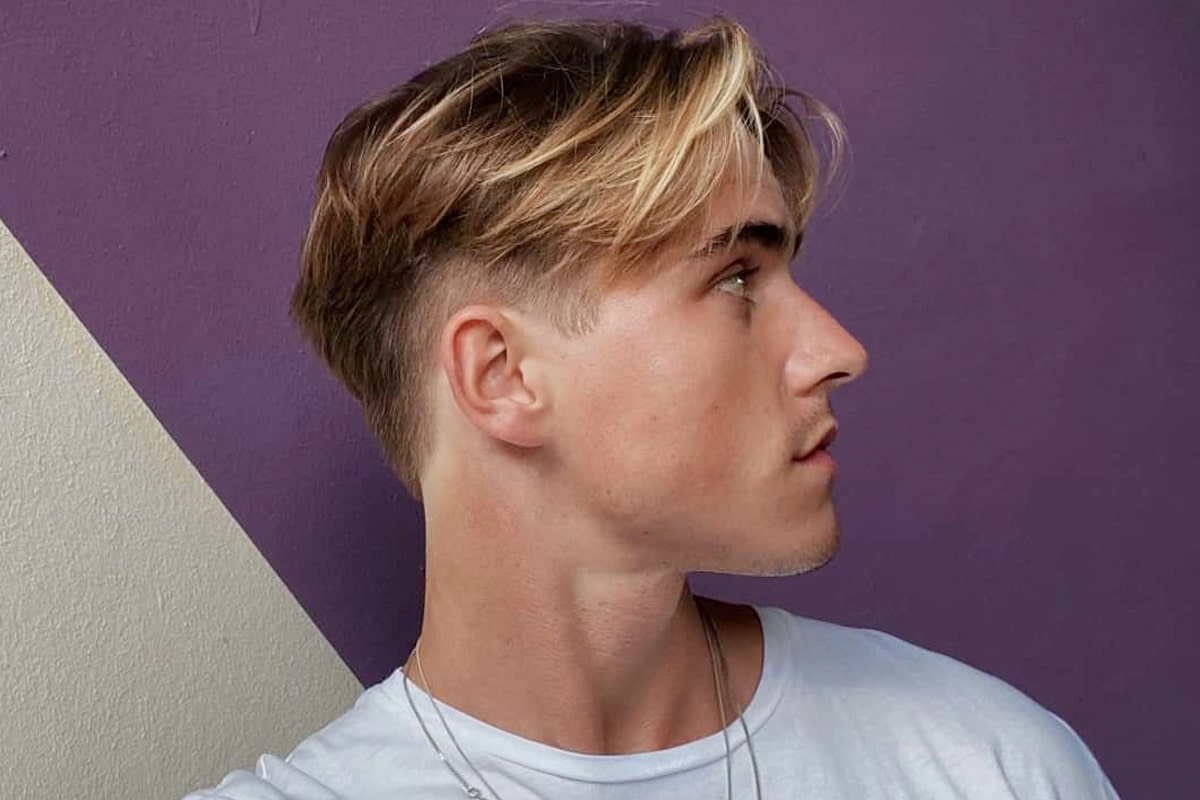
Middle parts are everywhere right now. If you scroll through TikTok or Instagram, you’d think the side part was a relic of the 2010s, buried alongside skinny jeans and chevrons. But here is the thing: long hairstyles parted on the side are actually the secret weapon for anyone who doesn't have a perfectly symmetrical face—which is basically all of us. It’s about balance. It's about volume. It's about not looking like a flat, center-split curtain.
Most people think a part is just a line. It’s not. It’s a structural pivot point for your entire silhouette. When you shift that weight to one side, you're essentially playing with physics and light. You’re creating an asymmetrical frame that draws the eye to your best features. It’s subtle, but it works.
The Geometry of Why Side Parts Work Better for Long Hair
Let’s get real about face shapes for a second. If you have a heart-shaped face or a strong jawline, a middle part can actually make your features look harsher. It’s too much symmetry. It highlights every tiny "imperfection." Long hairstyles parted on the side do the opposite. They soften the angles. By breaking up the horizontal line of the forehead, a deep side part creates the illusion of length and height.
Think about the "Golden Ratio" in aesthetics. We are naturally drawn to slight asymmetry. It feels more organic. When your hair falls heavily over one eye or sweeps across the brow, it adds a layer of mystery and depth that a "straight down the middle" look just can't touch. Plus, let's talk about cowlicks. Almost everyone has one at the front of their hairline. Forcing a middle part over a stubborn cowlick is a losing battle. A side part usually works with your natural growth pattern rather than against it.
There is also the volume factor. When hair lives in the same spot for years, it gets flat. It gets bored. Flipping your hair to the side forces the roots to stand up. You get instant lift without even trying. Honestly, it’s the cheapest "facelift" you can get.
Real Examples: From Old Hollywood to Modern Red Carpets
You’ve seen this look a thousand times, but you might not have noticed the technical precision behind it. Take someone like Margot Robbie or Blake Lively. They fluctuate between parts, but when they want drama? It’s always a side part.
- The Deep Side Sweep: This is where you part the hair almost directly above the outer corner of your eye. It’s classic. It’s what we see at the Oscars every single year. It creates a massive wave of hair that can be pinned back on the "weak" side to show off the ear and jawline.
- The Messy "I Just Woke Up" Part: This isn't a straight line. It’s jagged. It’s what you do when you’re on day three of a blowout. It adds grit.
- The Soft Curved Part: Instead of a ruler-straight line, you draw a slight "C" shape with your comb. This allows the hair to fall more naturally toward the back of the head, preventing that weird "shelf" effect that happens when long hair is too heavy.
Stylists like Chris Appleton or Jen Atkin often use these variations to change a client’s vibe without cutting a single inch. It’s a tactical move. If a client has a slightly larger forehead, a side part acts as a "curtain" that minimizes that space. If they have killer cheekbones, the side part acts as an arrow pointing right at them.
The Science of the "Flip" and Hair Health
Believe it or not, where you part your hair affects the health of your scalp. If you keep a middle part for a decade, that strip of skin is constantly exposed to UV rays. It’s prone to sunburn and, eventually, thinning. By switching to long hairstyles parted on the side, you’re giving that specific area of your scalp a break.
Also, tension matters. If you always pull your hair back from a center point, you’re putting consistent stress on the same follicles. Moving the part redistributes that weight. It sounds minor, but over years, it helps prevent traction alopecia at the hairline.
Does it actually make hair look thicker?
Yes. Absolutely. When you stack 70% of your hair on one side of your head, the density looks doubled. This is a massive win for people with fine hair. Instead of having two thin wisps hanging on either side of your face, you have one substantial, luxurious-looking mane.
How to Actually Execute the Perfect Side Part
Don't just grab a comb and hope for the best. There is a process. First, you need to find your "natural" side. Look at your crown. See where the hair spirals? That’s your guide. If you fight the spiral, you’ll end up with a bump that won't go away no matter how much hairspray you use.
- Wet styling is king. You have to set the part while the hair is soaking wet. Once it dries, the hydrogen bonds have set, and you’re stuck with whatever shape you have.
- The "Nose Bridge" Rule. For a standard side part, align the start of the part with the bridge of your nose or the inner corner of your eye.
- For a "Power Part," go further out. Align it with the peak of your eyebrow arch. This is the look that screams "I am the CEO of everything."
You’ll need a rat-tail comb. Nothing else gives you that clean line. But once you have the line, use your fingers to soften it. A razor-sharp part can sometimes look a bit too "schoolgirl." You want it to look lived-in.
Addressing the "Millennial" Stigma
Gen Z famously "cancelled" the side part a few years ago. They claimed it was a tell-tale sign of being old. But fashion is a pendulum. We’re already seeing a massive swing back. The "Mob Wife" aesthetic and the return of 90s supermodel volume have brought the side part back into the mainstream.
It turns out that the middle part is actually quite difficult to pull off. It requires a level of facial symmetry that most humans just don't possess. The side part is democratic. It’s for everyone. It’s forgiving. It’s the haircut version of a wrap dress—it just works on every body.
Honestly, the whole "part war" was always a bit silly. Your hair should serve your face, not a trend. If a side part makes your eyes pop and your hair look like it has more life, why would you do anything else?
Products That Make the Difference
You can't just flip and go. Long hair is heavy. Gravity is the enemy of the side part. To keep that "lift" at the root, you need a volumizing powder or a dry texture spray. Brands like Oribe or Living Proof make "dry volume" sprays that act like invisible scaffolding for your hair.
Apply the product directly to the root on the side with more hair. Massage it in. This prevents the hair from falling flat against your forehead halfway through the day. If you have particularly stubborn hair, try "training" it at night. Part your hair to the side while it's damp, put in a flat clip to hold the base, and let it dry.
Maintaining Balance
One mistake people make with long hairstyles parted on the side is neglecting the "short" side. Don't just let it hang there. Tuck it behind your ear. Use a decorative bobby pin. Or, better yet, do a small flat twist or braid to keep it tight to the head. This emphasizes the volume on the other side by creating a contrast in width.
Also, watch your layers. If your hair is all one length, a deep side part can feel bottom-heavy. Ask your stylist for "face-framing layers" that start at the chin. This ensures that when you flip your hair, the shorter pieces create a nice "cascade" effect rather than just a heavy block of hair.
Actionable Next Steps for Your Best Look
- Identify your better profile. Everyone has one side of their face they prefer. Part your hair so the "heavy" side is opposite your favorite profile. This leaves your best side "open" and framed.
- Switch it up tomorrow. If you’ve been a middle-part devotee, just try the side part for one day. Don't overthink it. Use a bit of dry shampoo for grip and see how it feels.
- Adjust your makeup. A side part changes how light hits your face. You might find you need a bit more bronzer on the "open" side of your face to balance the shadow cast by the hair on the other side.
- Invest in a silk pillowcase. Since a side part involves more "lifting" at the root, you want to avoid crushing that volume while you sleep. Silk prevents the friction that leads to flat, messy morning hair.
Forget what the trends say for a second. Look in the mirror and move your hair around. Notice how the shape of your chin changes when the hair moves. Notice how your eyes look brighter when they aren't being squeezed by two vertical lines of hair. The side part isn't a throwback; it’s a classic for a reason.