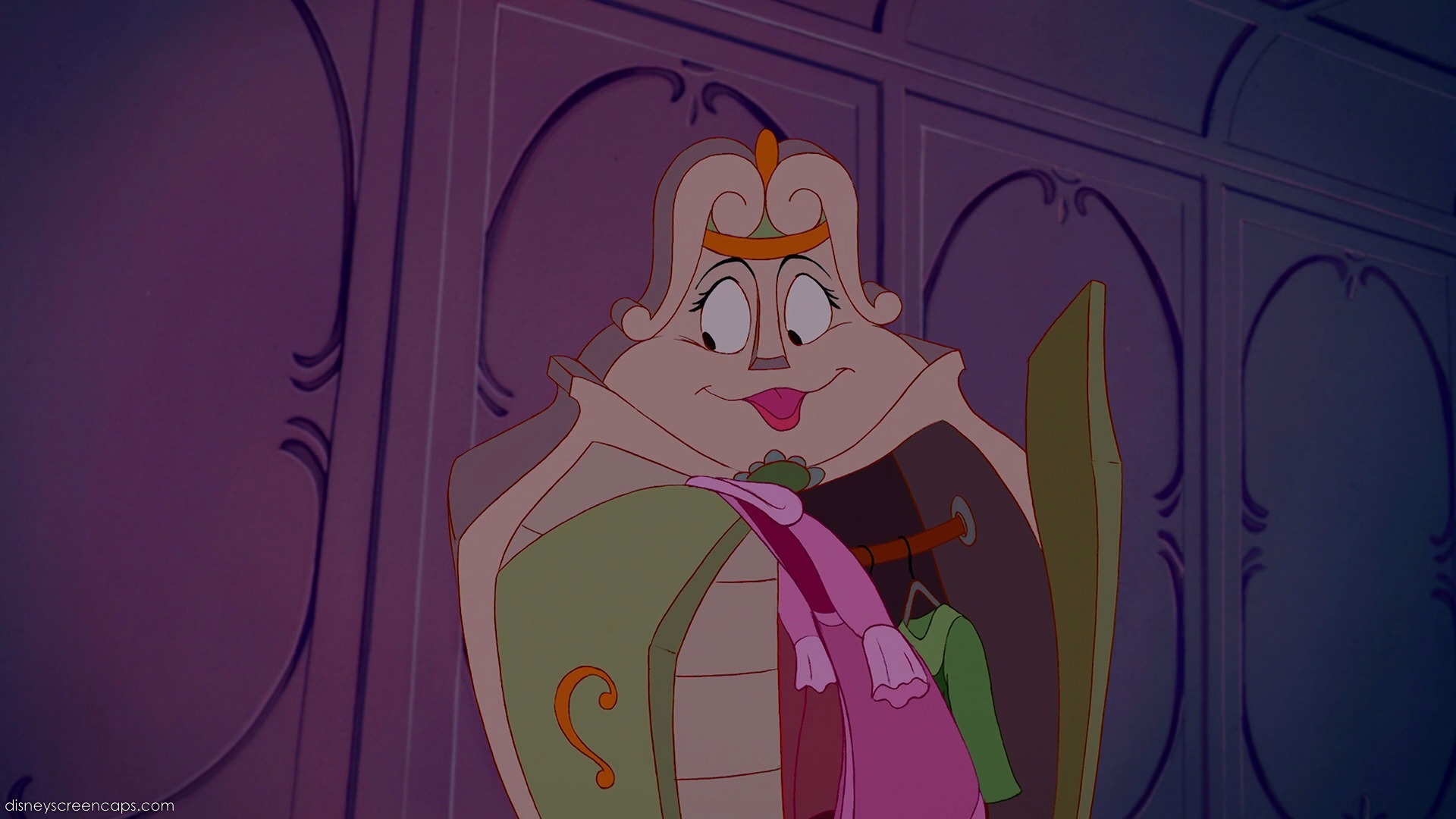
She’s loud. She’s theatrical. Honestly, she's probably the only person in that entire cursed castle who actually looks like she’s having a good time. Most people just call her the dresser from Beauty and the Beast, but Disney buffs know her as Madame de Garderobe. Whether you grew up with the 1991 animated masterpiece or the 2017 live-action spectacle, this singing piece of furniture is a masterclass in how to build a supporting character out of literal wood and fabric.
It’s easy to write her off as comic relief. But if you look closer, she’s actually the emotional anchor for Belle’s transition from prisoner to guest. Think about it. Belle is locked in a room, terrified, and the first thing she encounters isn't a scary beast—it's a wardrobe who wants to dress her in something fabulous. That's a vibe.
The Evolution of Madame de Garderobe
Back in 1991, the dresser from Beauty and the Beast was voiced by the legendary Jo Anne Worley. Worley brought this manic, vaudevillian energy to the role that made the character instantly iconic. She wasn't just a closet; she was an opera singer who happened to have drawers. Her design was heavy, baroque, and felt grounded in that 18th-century French aesthetic, even if she did have a face made of molded wood.
Then came 2017.
Audra McDonald—a literal Broadway titan with six Tony Awards—took over the role. Suddenly, the dresser wasn't just funny; she was tragic. In the live-action version, we see her as a human opera singer before the curse hits. She’s performing at the Prince's ball, hitting these glass-shattering notes, only to be transformed into a massive, gilded piece of furniture. It adds this layer of "oh, wow, she’s trapped in there" that the cartoon didn't quite lean into as hard.
The design changed too. Instead of a cartoonish face, the 2017 version used the carvings of the wardrobe to create a facial structure. It was more subtle. Kinda creepy if you stare at it too long, but beautiful in a "this cost Disney a fortune in CGI" sort of way.
Why Her Name Actually Matters
The name "Garderobe" isn't just a fancy French word the writers picked out of a hat. In historical context, a garderobe was originally a small room or a large piece of furniture used for storing clothes. But it also had a darker, more practical origin in medieval castles as a latrine. Yeah, really.
By the time we get to the Rococo period where Beauty and the Beast is set, the term had shifted toward high-end furniture. Calling her "Madame de Garderobe" elevates her. It gives her a title. It reminds the audience that she wasn't just a servant; she was an artist of the court. When she’s talking about "dressing the part," she’s speaking from a place of professional expertise.
The Wardrobe’s Role in Belle’s Journey
Let's get real for a second. Belle is a mess when she first arrives. She's just traded her freedom for her father's life. She’s in a dark, damp room. Then, this wardrobe literally bursts open and starts tossing silk at her.
The dresser from Beauty and the Beast acts as a bridge. She’s the one who insists on dignity. While Cogsworth is worrying about the rules and Lumière is worrying about the food, Garderobe is worried about how Belle feels. Or at least, how she looks, which in her world is the same thing.
She provides the "wardrobe montage" moment that is a staple of every princess movie, but she does it with a theatrical flair that masks the underlying horror of being turned into a household object. She's the ultimate hype woman.
A Quick Look at the 1991 vs. 2017 Designs
- 1991 Animation: Bright teal and purple colors. She’s squat and wide. Her drawers act as her "hands" and mouth. She’s incredibly mobile, even jumping around the room during the battle with the villagers.
- 2017 Live-Action: Off-white and heavy gold leaf. She’s massive—like, floor-to-ceiling massive. Her "face" is integrated into the scrollwork at the top. She’s much less mobile because she’s meant to look like an actual piece of museum-quality furniture.
- The Broadway Musical: This is where it gets tricky. On stage, the actress usually wears a giant boxy costume that makes her look like a wardrobe while still allowing her to sing like a diva. It’s a feat of costume engineering that usually wins awards.
The "Human Again" Cut
One of the biggest tragedies for fans of the dresser from Beauty and the Beast is that her biggest musical moment was originally cut from the 1991 film. "Human Again" was a massive, sweeping number where all the objects sing about what they'll do when they're human.
Garderobe’s verses are some of the best. She talks about how she’ll be "lipstick and rouge and fashion" again. It gives her a motivation beyond just being a background character. She’s desperate for her body back. When Disney released the Special Edition IMAX version and the later Blu-rays, they re-inserted this sequence. If you haven't seen the version with "Human Again," you're missing the core of who she is. It changes her from a comic sidekick to a person with a ticking clock on her soul.
Why People Love the "Dresser from Beauty and the Beast"
It’s the relatability. We all have that one friend who is "too much" in the best way possible. She’s the person who tells you to put on a dress and get out of bed when you’re depressed.
Beyond that, the craftsmanship in her design—especially in the 2017 film—is a nod to 18th-century French craftsmanship. The production designers for the live-action film actually studied the work of Charles André Boulle, a famous cabinetmaker for Louis XIV. They wanted the wardrobe to look like something that could actually exist in a royal palace. That attention to detail is why these movies stay relevant. They aren't just "cartoons"; they are historical fantasies.
The Battle of the Wardrobe
Don't forget the fight scene. When the villagers storm the castle, everyone gets a moment to shine. But the dresser from Beauty and the Beast has one of the funniest kills in Disney history.
In the 1991 version, she literally jumps off a balcony and crushes a dude.
In the 2017 version, she dresses three of the village men in drag. Two of them run away horrified, but one of them looks in the mirror, smiles, and walks away happy. It was a small, blink-and-you'll-miss-it moment of inclusivity that people are still talking about years later. It showed that the wardrobe doesn't just "attack"—she transforms. She uses her nature as a fashion icon to win the fight.
Fact-Checking the Madame
There are a few myths about the character that circulate on Reddit and fan forums.
First, people often think she’s the mother of some of the other objects. She isn't. Mrs. Potts has Chip (and a dozen other kids), but Garderobe is a solo act. In the 2017 film, we find out she’s married to Cadenza, the grand piano played by Stanley Tucci. This was a new addition for the remake, giving her a romantic backstory that wasn't in the original.
Second, her name in the original credits of the 1991 film is simply "Wardrobe." The name Madame de Garderobe was popularized later through the musical and the live-action press kits.
Lastly, she isn't in the original fairy tale by Gabrielle-Suzanne Barbot de Villeneuve. In the 1740 story, the castle is full of invisible hands and spirit-like magic. The "talking furniture" was a pure Disney invention, created to give Belle someone to talk to so she wouldn't just be monologuing to a wall for 90 minutes.
How to Bring the Look Home
If you're obsessed with the dresser from Beauty and the Beast, you aren't alone. Collectors go crazy for the limited-edition jewelry boxes shaped like her. But if you're looking for actual furniture, you're searching for "Rococo Revival" or "Baroque Armoires."
Look for:
- Cabriole legs (those curved, elegant feet).
- Ornate "C" and "S" scrolls in the wood carving.
- Gold leaf or "ormolu" (gilded bronze) accents.
- Large crown molding at the top, often called a "pediment."
You probably won't find one that sings or throws dresses at you, but you can get pretty close to the aesthetic if you have a few thousand dollars and a lot of floor space.
What Most People Miss
The most profound thing about the dresser from Beauty and the Beast is what she represents: the loss of the physical self. Every character in the castle lost something. Lumière lost his touch. Cogsworth lost his heart (metaphorically). But Garderobe lost her voice—at least, her true voice as an opera singer.
When she sings in the castle, she’s literally a "voice in a box." It’s a metaphor for stifled talent. When the curse is finally lifted and Audra McDonald steps out of that wooden shell, that's not just a happy ending. It's a restoration of art.
Actionable Insights for Disney Fans:
- Watch the "Human Again" sequence: If you’ve only seen the theatrical 1991 cut, go find the Special Edition. It changes your perspective on the Wardrobe’s desperation.
- Compare the voice work: Listen to Jo Anne Worley’s "theatrical" take versus Audra McDonald’s "operatic" take. It’s a masterclass in how different vocal styles change a character's "weight."
- Study Rococo furniture: If you’re into interior design, use the Wardrobe as a jumping-off point to study 18th-century French armoires. The level of detail in the 2017 film is historically significant.
- Look for the "Easter Egg" husband: Next time you watch the 2017 version, pay attention to the interaction between the Wardrobe and the Piano (Cadenza) during the final battle. Their "reunion" is one of the most underrated parts of the finale.
The dresser from Beauty and the Beast isn't just a place to store yellow ballgowns. She's a reminder that even when we feel "stuck" or "boxed in," we can still hit the high notes. She’s fabulous, she’s loud, and honestly, she’s the heart of the castle's bedroom wing.