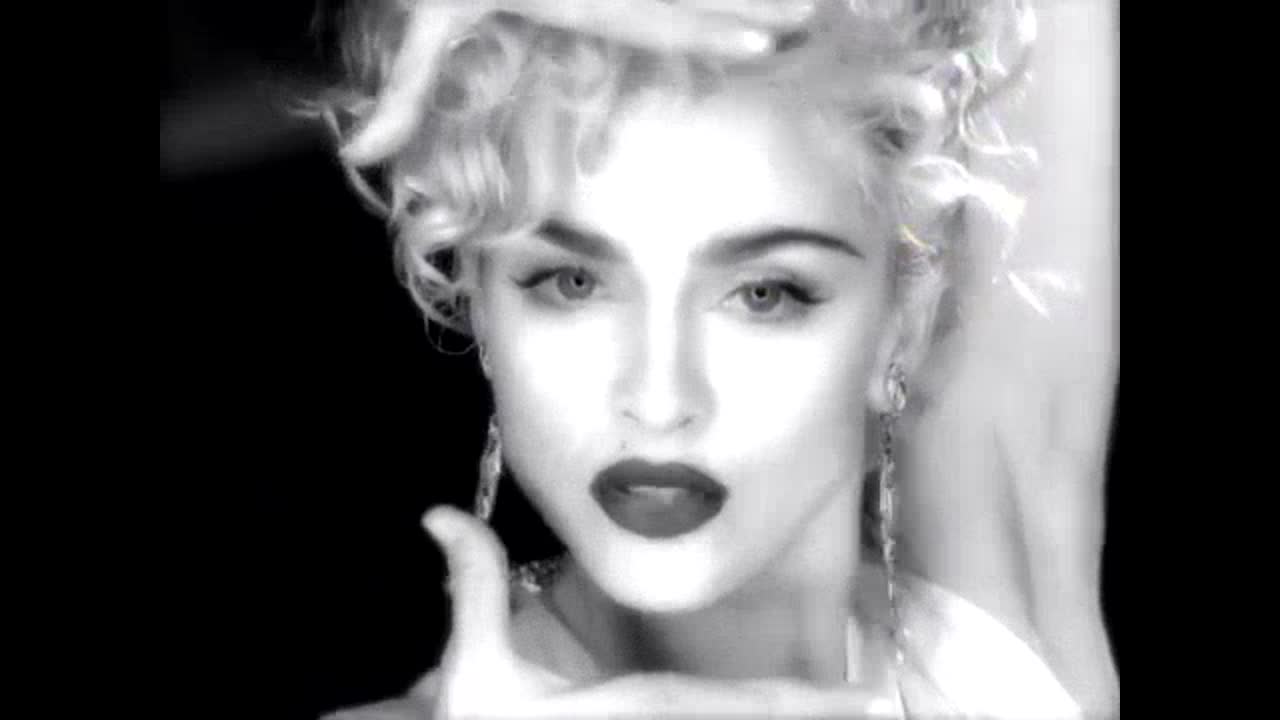
It’s 1990. The bass drops. A flick of the wrist, a sharp tilt of the head, and suddenly, the entire world is trying to frame their faces with their hands. When you hear Madonna strike a pose, you aren’t just hearing a lyric from a pop song; you’re hearing the moment an underground subculture was catapulted into the mainstream, for better or worse.
Most people think Vogue was just a clever fashion anthem. Honestly, it was much more complicated than that. It was a calculated, brilliant, and slightly controversial heist of Harlem’s ballroom scene.
Where the Pose Actually Came From
Madonna didn't invent voguing. She didn't even "discover" it in the way some history books claim. The movement was already breathing, sweating, and evolving in the basement clubs of New York City, specifically within the Black and Latino LGBTQ+ communities.
I remember watching the documentary Paris Is Burning. If you haven't seen it, stop what you're doing and find it. It documents the "houses"—like the House of Extravaganza or the House of LaBeija—where dancers competed in categories that mimicked high-society tropes. Voguing was a way for people who were marginalized by society to reclaim power. They took the stiff, geometric poses of models in Vogue magazine and turned them into a fluid, rhythmic battle language.
By the time Madonna walked into Sound Factory and saw Jose Gutierez Xtravaganza and Luis Xtravaganza dancing, voguing was already a polished art form. She was smart enough to know a hit when she saw one. She didn't just borrow the moves; she hired the creators. That’s a nuance often lost in the "cultural appropriation" debates. She put the originators in the video and took them on the Blond Ambition Tour. She gave them a global stage, even if she was the one holding the microphone.
The Recording Session That Almost Didn't Happen
Here is a wild fact: Vogue was supposed to be a B-side.
Warner Bros. needed a filler track for the single "Keep It Together." Madonna teamed up with producer Shep Pettibone, and they knocked the track out in about two weeks on a tiny budget of $5,000. She recorded her vocals in a basement apartment in New York. The legendary "rap" section, where she lists off old Hollywood icons like Greta Garbo and Marilyn Monroe, was written on the fly.
Think about that. One of the most iconic moments in music history—the Madonna strike a pose command—was basically an afterthought.
The song was so good that the executives realized it would be a crime to bury it on the back of a 12-inch single. They pushed it as its own release, and it went to number one in over 30 countries. It became the best-selling single of 1990. It shifted the sound of radio from the hair-metal hangover of the 80s into the house-inflected 90s.
The Music Video: A Masterclass in Monochrome
You can’t talk about the song without the visual. Directed by David Fincher—yes, the Fight Club and The Social Network David Fincher—the music video for Vogue is a masterpiece of lighting and choreography.
It’s shot in black and white, paying homage to the 1920s and 30s Hollywood glamour. But the real magic is the precision. When Madonna tells the listener to "strike a pose," the editing matches the beat with surgical accuracy.
There was a lot of tension on set. Fincher was a perfectionist. Madonna was a perfectionist. The result was a video that looks like a moving painting. It’s elegant, but it has this underlying grit that came from the club scene. It wasn't just about looking pretty; it was about the attitude of looking pretty.
The Names She Dropped
The spoken-word section is a roll call of Golden Age cinema:
- James Dean
- Grace Kelly
- Fred Astaire
- Marlon Brando
By linking herself to these legends, Madonna was effectively canonizing herself. She was saying, "I belong on this list." It was a bold move for a girl from Michigan, but it worked. Today, most people under the age of 40 probably know those names specifically because of this song.
The Controversy: Erasure or Elevation?
This is where it gets tricky. If you talk to dancers from the original ballroom scene, you’ll get mixed reactions.
On one hand, the "Strike a Pose" era brought massive visibility to a community that was being ravaged by the AIDS crisis. It humanized people who were being ignored by the government and the general public. On the other hand, once the trend faded for the mainstream, the mainstream moved on. The dancers didn't all become superstars. Many struggled.
Critics like bell hooks have argued that Madonna used these subcultures as "flavoring" for her own brand. It's a valid point. But Jose Gutierez Xtravaganza has often defended her, noting that she paid them well, treated them as peers, and gave them a platform they never would have had otherwise. It’s a messy, grey area. It’s not a simple story of "theft," nor is it a simple story of "heroism." It’s both.
Why We Still Care Decades Later
Why does "Vogue" still play at every wedding, every pride event, and every fashion show?
Because the message is universal. "It makes no difference if you're black or white, if you're a boy or a girl." In 1990, that was a radical thing to say on a global pop hit. The song is an invitation to escape. It’s about the fact that life is hard, the world is "a place where you don't want to be," but for four minutes on a dance floor, you can be a superstar.
The command to Madonna strike a pose is really an invitation to self-actualize. It’s about posture. It’s about the "look" as a shield.
Technical Legacy: The Sound of the 90s
Musically, Vogue was a bridge. It took the underground "Deep House" sound—think Larry Heard or Marshall Jefferson—and polished it for Top 40.
The track uses the Korg M1 piano sound, which became the definitive sound of 90s dance music. It’s that bright, percussive piano stab you hear in everything from Robin S to Crystal Waters. If you’re a producer, you know that sound instantly. It’s the sonic equivalent of a neon sign.
Pettibone’s production was incredibly clean. There isn't much clutter. You have the kick drum, the finger snaps, the bassline, and that insistent "Vogue" whisper. It’s a lesson in "less is more."
Putting It Into Practice: How to Strike the Pose Today
If you’re looking to channel that energy, whether for a photo shoot or just for your own confidence, you have to understand the mechanics of the movement. It isn't just about moving your hands; it's about the angles.
- Frame the Face: The classic move involves using your hands to create a "frame" around your jawline or eyes. It’s meant to draw focus to your features.
- Geometric Precision: Think in 90-degree angles. Your elbows and wrists should create sharp lines.
- The "Click": Dancers call it "hitting" the beat. Every pose should feel like a camera shutter just went off. Stiff, then move. Stiff, then move.
- Facial Neutrality: Look at the Vogue video again. Madonna isn't smiling. She's giving "face." It’s a look of haughty indifference.
Actionable Insights for the Modern Creative
Whether you’re a marketer, a dancer, or just a fan, there are real lessons to be learned from this era of pop culture:
- Collaborate Up and Down: Madonna didn't just hire big-name directors; she hired the kids from the clubs. Real authenticity comes from the source, not from a boardroom.
- The Power of the B-Side: Don't throw away your "filler" ideas. Sometimes the thing you create in two hours as an afterthought is the thing that will define your career.
- Visual Consistency: The Vogue era worked because the hair, the clothes, the lighting, and the music all told the same story of icy, high-fashion glamour.
- Acknowledge the Roots: If you’re drawing inspiration from a subculture, name them. Show them. Pay them. Madonna set a template for this that was imperfect, but far ahead of its time.
The next time you hear that iconic opening, remember that it's a piece of history. It's a reminder that beauty is where you find it, and sometimes, the best way to handle the "heartache" the song mentions is simply to stand up, look the world in the eye, and strike a pose.