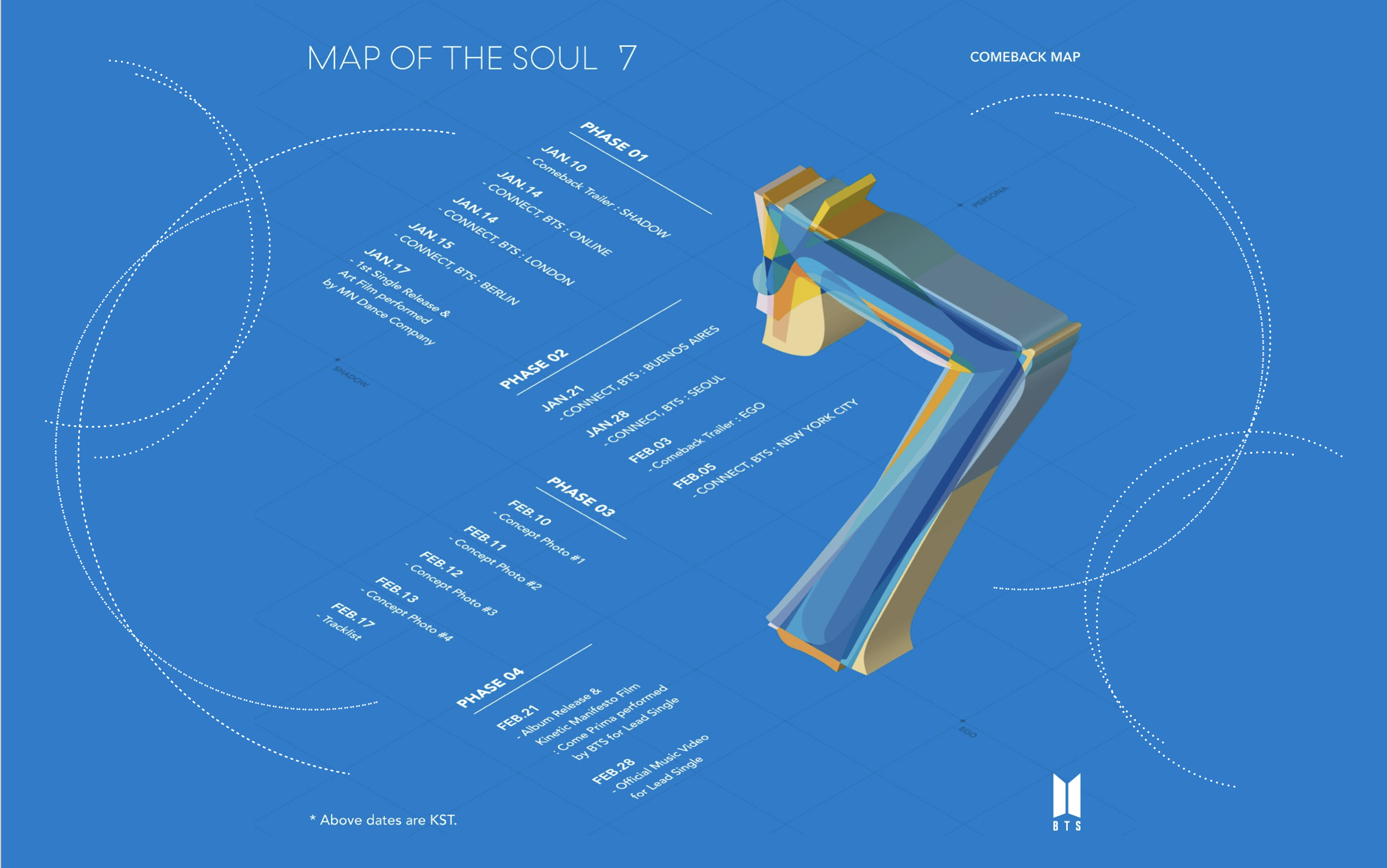
It’s been years since the world first heard the thunderous drums of "ON," yet the cultural footprint of Map of the Soul: 7 hasn't actually faded. If anything, it’s become the definitive blueprint for how a global phenomenon handles the weight of its own shadow.
The album didn't just break records. It broke the fourth wall of pop stardom.
When BTS released this project in early 2020, the timing was, honestly, pretty tragic. They were gearing up for a massive stadium tour that never happened because the world shut down. But looking back, that forced pause actually made us listen closer to what they were saying. They weren't just singing about being famous. They were using Carl Jung’s analytical psychology to dissect their own identities. That’s a pretty heavy lift for a "boy band," right?
Why Map of the Soul: 7 Matters More Than You Think
Most people see the big numbers—the four million pre-orders, the Billboard 200 debut at number one, the literal dozens of Platinum certifications. Those are cool. But the real meat of Map of the Soul: 7 is in the narrative structure. It’s a sequel and a conclusion all at once.
The album serves as a 20-track confession. It takes the "Persona" concept from their previous EP and drags it into the dark. If Persona was the mask they wore for the world, 7 was the stuff underneath—the "Shadow" and the "Ego."
Think about "Black Swan."
It’s not just a catchy track with some cool strings. It’s a song about the literal death of an artist. It’s about the terrifying moment you realize the thing you love—music, dancing, creating—might not make you feel anything anymore. Suga has talked about this fear before, but hearing it articulated over a trap beat was a different kind of vulnerable. It’s rare. You don't usually see artists at the peak of their commercial power admit they’re scared of losing their passion.
The Psychology Behind the Tracks
They didn't just pick the name "Map of the Soul" because it sounded deep. It’s a direct reference to Murray Stein’s book Jung's Map of the Soul.
Basically, Jungian psychology suggests we have different layers to our psyche.
- The Persona is the social face we present.
- The Shadow contains the repressed, darker parts of ourselves.
- The Ego is the conscious mind trying to balance it all.
In the track "Interlude: Shadow," Suga confronts the dizzying heights of fame. He literally says, "I'm afraid, flying high is terrifying." Then you flip to J-Hope’s "Outro: Ego," which is bright, upbeat, and celebratory. It’s the resolution. It’s saying, "Yeah, I have these scars and these fears, but they’re part of me, and I’m moving forward anyway."
It’s a journey.
The Solo Tracks: A Breakdown of Individual Identity
This album was massive because it gave every member a moment to stand alone while still staying tethered to the group's "7" identity. The number seven is everywhere. Seven members. Seven years together at the time of release.
Take Jimin’s "Filter." It’s smooth, Latin-pop influenced, and incredibly clever. He’s talking about how he can change himself to suit what the fans want, but there’s a subtle underlying question: Who is he when the filters are gone? Then you have Jin’s "Moon." Most singers write songs for their fans, but Jin flipped the perspective. He called the fans the Earth and himself the Moon, revolving around them. It’s a beautiful sentiment, but it also reinforces that "Persona" theme—his existence is defined by the gaze of others.
V’s "Inner Child" is a total shift. It’s a stadium-rock anthem where he’s literally talking to his younger self back in Daegu. He’s telling that kid that the struggles were worth it. It’s nostalgic but not sappy.
- RM’s "Persona" – The Introduction.
- Suga’s "Shadow" – The Conflict.
- J-Hope’s "Ego" – The Resolution.
These three tracks act as the pillars of the whole project. Without them, the album would just be a collection of hits. With them, it’s a psychological study.
The Production Was Way Ahead of Its Time
We have to talk about the sound. Map of the Soul: 7 is a chaotic, beautiful mess of genres. You’ve got the high-energy marching band vibes of "ON," the emo-rap influences in "Louder than bombs," and the gospel-tinged "Make It Right."
Troye Sivan helped write "Louder than bombs," and you can really hear his influence in the atmospheric, moody production. It’s one of the most haunting tracks in their discography. It deals with the collective pain of the group and their fans.
And then there's "We are Bulletproof: the Eternal."
If you want to understand the relationship between BTS and their fanbase (ARMY), this is the song. It’s a direct callback to their debut days when they were just "bulletproof scouts" trying to survive the industry. They admit they were "only seven" back then, but now, with the fans, they are "heaven." It’s the kind of song that makes sense why people are so fiercely loyal to them.
Misconceptions People Still Have
A lot of critics at the time tried to say the album was "too long" or "unfocused." Honestly? They missed the point.
The length is the point.
Life isn't a tight 30-minute pop EP. It’s long, it’s repetitive, and it’s full of different moods. By including songs like "00:00 (Zero O'Clock)"—a track about the small hope that comes when the clock resets at midnight—they were capturing the mundane parts of the human experience alongside the superstardom.
Another big misconception is that this was just "manufactured" K-pop. The members have extensive writing and production credits across the board. RM, Suga, and J-Hope aren't just performers; they are the architects of this narrative. They worked with guys like Pdogg and Hiss Noise to craft a sound that felt global but remained distinctly Korean.
How to Actually Experience This Album Today
If you’re just getting into them or if you haven't listened to the full record in a while, don't just shuffle it.
The tracklist order matters.
Start from the beginning and follow the descent into the shadow. Watch the "Kinetic Manifesto Film" for "ON." The choreography there isn't just dancing; it's a display of power and resilience. It shows what happens when you embrace your shadow and use that energy to fuel your "Ego."
Actionable Takeaways for Listeners
- Listen to the lyrics while reading the translations: If you don't speak Korean, you're missing 70% of the depth. Use reputable translation sites like Doolset Lyrics to understand the wordplay and cultural nuances.
- Watch the solo performances: Each member performed their solo track during the "MOTS ON:E" online concert. Seeing the visual representation of "My Time" vs. "Inner Child" adds a whole new layer of meaning.
- Connect the dots: Listen to their debut album 2 Cool 4 Skool right after Map of the Soul: 7. You’ll see exactly how far they’ve come and how many "Easter eggs" are hidden in the newer lyrics.
- Explore the Jungian roots: If you're really feeling nerdy, grab a copy of Murray Stein’s book. It makes the "Shadow" and "Ego" concepts click in a way that makes the music feel like a soundtrack to a philosophy lecture.
The legacy of this album isn't just about the charts. It's about the fact that seven guys from South Korea managed to make millions of people around the world look at their own reflections and ask, "Who am I?"
That's the real power of Map of the Soul: 7. It’s not just an album; it’s a mirror.
Next Steps for Deepening Your Understanding:
- Research the "Interlude: Shadow" music video's visual metaphors, specifically the use of hands and cameras.
- Compare the "Black Swan" Art Film (performed by MN Dance Company) with the official music video to see how contemporary dance interprets the lyrics.
- Analyze the lyrical parallels between "ON" and their 2013 track "N.O." to see their growth in perspective on societal pressure.