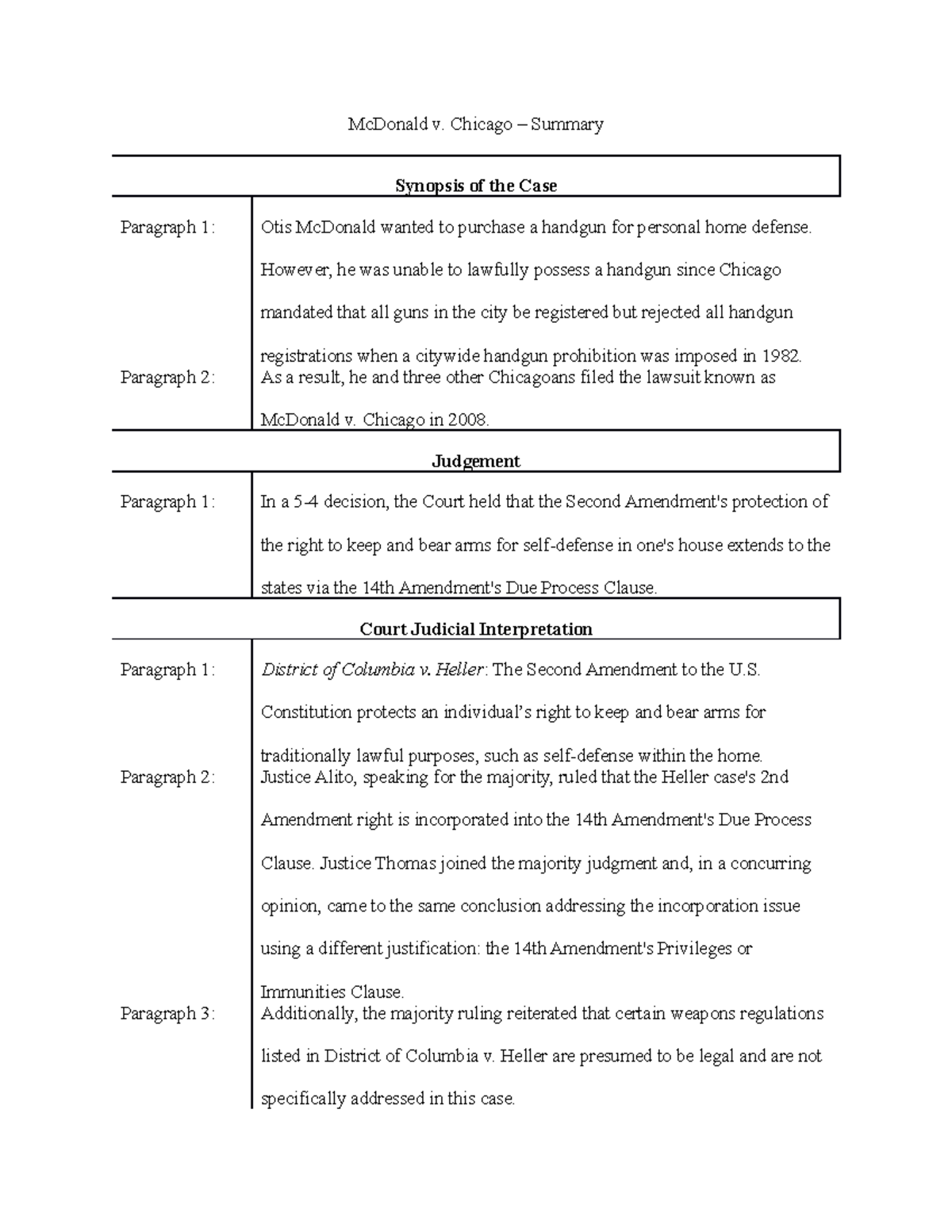
Otis McDonald just wanted to feel safe in his own house. A retired maintenance engineer living in Chicago’s Morgan Park neighborhood, he’d watched his community slip away into a haze of gang violence and drug deals. His garage was broken into five times. Refuse littered his lawn. He was 76 years old and a hunter, so he knew his way around a shotgun, but let’s be real—trying to swing a long-barreled shotgun in a cramped hallway during a break-in is basically a nightmare. He wanted a handgun for home defense.
There was just one massive problem. Chicago had effectively banned them.
Since 1982, the city had a law that required all firearms to be registered, but then they simply refused to allow any new handgun registrations. It was a catch-22 that left law-abiding folks like Otis in the lurch. So, he sued. That lawsuit, McDonald v. Chicago, eventually landed on the steps of the Supreme Court in 2010, and it fundamentally changed how we understand the Bill of Rights today.
Why the Second Amendment Was "Stuck" for 200 Years
A lot of people think the Bill of Rights always applied to everyone, everywhere in the U.S. That’s actually a huge misconception.
Originally, the first ten amendments only limited the federal government. If Congress tried to take your guns or shut down your newspaper, the Bill of Rights stopped them. But if your state government or your local mayor did it? For a long time, the Supreme Court basically said, "Not our problem."
This started to change after the Civil War with the 14th Amendment, but the process was painfully slow. This process is called selective incorporation. The Court would pick a right—like freedom of speech or the right to a fair trial—and "incorporate" it through the 14th Amendment so that states had to respect it too.
By the time Otis McDonald’s case came around, most of the Bill of Rights had been applied to the states. The Second Amendment was one of the last big holdouts.
The 5-4 Split: A Legal "Voting Paradox"
When the ruling finally came down on June 28, 2010, it was a nail-biter. A narrow 5-4 majority ruled in favor of McDonald. Justice Samuel Alito wrote the main opinion, arguing that the right to self-defense is "fundamental to our scheme of ordered liberty." Basically, if you have a right to defend your life, and the handgun is the "quintessential self-defense weapon," then a city can’t just ban them outright.
But honestly, the way they got there was kinda weird.
Legally speaking, it was a mess. Four of the justices wanted to use the Due Process Clause of the 14th Amendment to apply the right to the states. But Justice Clarence Thomas, while agreeing with the outcome, hated that reasoning. He wanted to use the Privileges or Immunities Clause instead—a part of the Constitution that had been legally "dead" since the 1870s.
Because of this split in logic, we ended up with what scholars call a "voting paradox." A majority of justices agreed the Second Amendment applies to states, but they couldn't all agree on why.
What the Dissenters Were Worried About
It wasn't a total win for gun rights activists, and the dissenters didn't hold back. Justice Stephen Breyer, joined by Ginsburg and Sotomayor, argued that there’s nothing in the Constitution that says "private armed self-defense" is a fundamental right that should override local safety laws.
They were worried about the body count. Breyer argued that guns are different from, say, the right to a jury trial. Guns kill people. He felt that local judges and politicians were better suited to decide if a handgun ban was necessary for public safety than nine people in robes in D.C.
Justice John Paul Stevens even issued a dissent on his very last day before retirement. He felt the Court was playing fast and loose with history to reach a political conclusion.
The Reality on the Ground: Did Chicago Change?
If you think the city just threw its hands up and said "fine, everyone get a gun," you’ve got another thing coming. Within four days of the ruling, the Chicago City Council passed a new, incredibly strict ordinance.
They required a permit, a firearms safety course, and—here’s the kicker—at least one hour of practice at a firing range. Then, they banned all firing ranges within city limits.
It was a blatant attempt to follow the letter of the law while killing the spirit of it. That led to more lawsuits, specifically Ezell v. Chicago, which eventually forced the city to allow ranges.
Beyond Handguns: The Ripple Effect
The impact of McDonald v. Chicago wasn't just about Otis and his neighborhood. It opened the floodgates.
- State Constitutions: Before this, 42 states already protected gun rights in their own constitutions. McDonald forced the remaining eight (the "outliers") to fall in line.
- New Legal Standards: It shifted the burden of proof. Now, if a state wants to restrict guns, they have to prove the restriction doesn't violate a fundamental right.
- The "Sensible" Middle Ground: The Court was careful to say this doesn't mean "anything goes." Felons and the mentally ill can still be barred from owning guns. You still can't bring a Glock into a courthouse or a school.
Actionable Insights: What This Means for You Today
Understanding this case isn't just for law students. It affects how you interact with local ordinances and what you can expect from your state legislature.
1. Know your state’s "Preemption" Laws
Many states have passed laws that prevent cities (like Chicago) from making gun laws that are stricter than the state's laws. Check if your state has preemption; it’s the direct legacy of the battle Otis started.
2. Check Local Zoning, Not Just State Law
As we saw with the firing range ban, cities often use zoning laws to restrict gun rights when they can't use direct bans. If you're looking to open a shop or a range, the "where" is usually more contested than the "if."
3. Monitor the "History and Tradition" Test
Since the recent Bruen (2022) decision, courts are looking back at the era of McDonald v. Chicago and earlier to see if a gun law has a historical twin. If a law didn't exist in the 1700s or 1800s, it’s now much harder for a state to defend it in court.
Otis McDonald passed away in 2014, but his name is permanently etched into American constitutional history. He wasn't a politician or a lobbyist. He was just a guy who wanted to protect his home, and in doing so, he forced the Supreme Court to finally finish a conversation that started right after the Civil War.