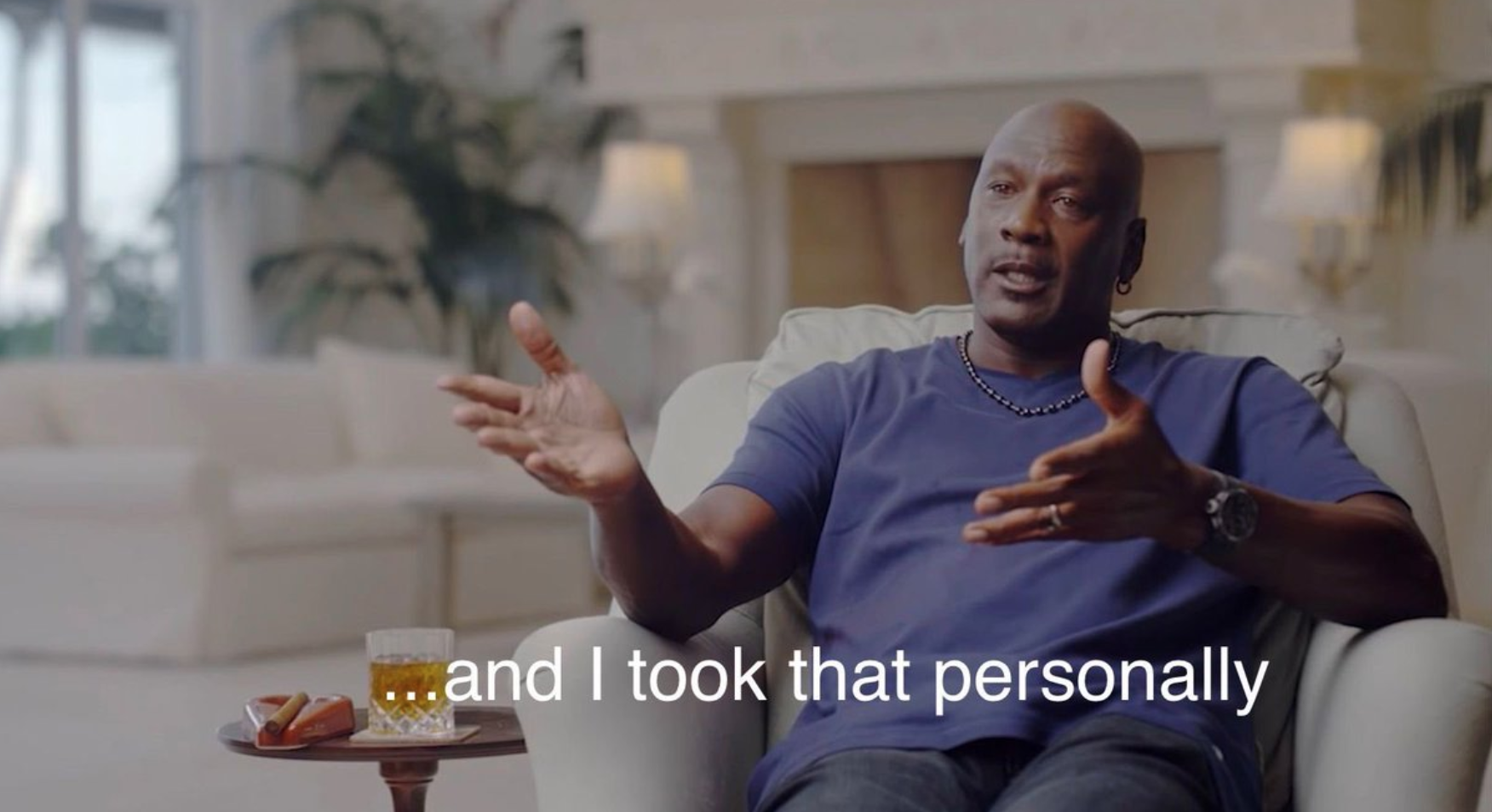
Everyone remembers where they were when the world stopped in 2020. No sports. No concerts. Just a lot of sourdough bread and Netflix. Then came The Last Dance. It wasn't just a documentary; it was a cultural reset that reminded us how terrifyingly competitive Michael Jordan actually was. But out of ten hours of footage, one specific phrase became the heartbeat of the internet: michael jordan i took that personally.
The funny thing? He never actually said those exact words in that order.
If you go back and watch the tapes, MJ usually says, "It became personal with me." The internet, being the chaotic creative force it is, smoothed those rough edges into the punchy "And I took that personally" meme we use today. It’s the Mandela Effect of the sports world. We’ve collectively agreed that this is the definitive Jordan quote because it perfectly captures his "petty GOAT" energy.
The Anatomy of the Grudge
Jordan didn't just play basketball. He hunted for reasons to destroy people. Most athletes need a coach to give them a pep talk or a crowd to cheer them on. Jordan just needed a guy to say "hello" the wrong way.
Take the 1993 series against the Washington Bullets. A young player named LaBradford Smith had the game of his life, dropping 37 points on the Bulls. As they walked off the floor, Jordan claimed Smith put his arm around him and said, "Nice game, Mike."
Jordan was livid. He told his teammates he was going to match Smith’s total in the first half of the next game. He nearly did, scoring 36 by halftime and finishing with 47. Years later, MJ admitted Smith never actually said "Nice game, Mike."
He made it up.
He literally hallucinated a slight just so he could find the "fuel" to embarrass a kid in a Bullets jersey. That is the essence of michael jordan i took that personally. It wasn't about the reality of the situation; it was about the narrative Jordan needed to tell himself to remain the most dangerous man on the planet.
Why the Meme Still Matters in 2026
It’s been years since the documentary dropped, but the phrase has evolved into a universal shorthand for "unreasonable levels of motivation." You see it in corporate Slack channels when a competitor wins a contract. You see it in gaming lobbies when someone gets tea-bagged in a shooter.
Why does it stick? Because it taps into a very human, albeit slightly toxic, trait. We all want to feel like the underdog even when we’re winning.
- The George Karl Incident: During the 1996 Finals, SuperSonics coach George Karl walked past Jordan at a restaurant without saying hi. Jordan used that "snub" to help fuel a title run.
- The BJ Armstrong Game: When BJ, a former teammate, celebrated a late bucket against the Bulls while playing for Charlotte, Jordan decided his friend had to be humbled.
- The Dan Majerle Obsession: Jordan reportedly targeted Majerle because Bulls GM Jerry Krause liked him. Jordan wanted to prove Krause’s talent evaluation was garbage.
The Psychology of the "Personal" Slight
Psychologists often talk about "intrinsic" versus "extrinsic" motivation. Most people are motivated by extrinsic factors: money, fame, or avoiding a boss's wrath. Jordan was different. He used "contrived" motivation.
If he didn't have a real enemy, he manufactured one.
Honestly, it’s a grueling way to live. The Last Dance showed us the toll it took. You could see it in his eyes during the interviews—that burning intensity hasn't faded even in retirement. When he talks about Jerry Krause or Isiah Thomas, he isn't reminiscing about the "good old days." He’s still in the trenches. He’s still taking it personally.
How to Channel Your Inner MJ (Without Being a Jerk)
You probably shouldn't go around punching teammates like Steve Kerr or making up fake insults from your coworkers. However, the michael jordan i took that personally mindset does have a practical application for high performance.
- Find your "Why" for the day. If you’re feeling sluggish, find a small challenge or a "rival" (even a friendly one) to outwork.
- Reframe setbacks as disrespect. Instead of being sad that you didn't get a promotion, view it as the universe doubting your capability. Then prove the universe wrong.
- Use the "First Half" rule. Like MJ trying to score 37 in two quarters, set an aggressive, near-impossible deadline for a task to force a flow state.
- Accept the pettiness. Sometimes, it’s okay to be motivated by wanting to be better than someone else. It doesn't make you a bad person; it makes you competitive.
Jordan’s legacy isn't just the six rings or the sneakers. It’s the proof that if you can control your mind, you can control the outcome. Even if you have to lie to yourself a little bit to get there.
Actionable Takeaways for Peak Performance
- Audit your "Fuel": Look at what currently motivates you. If it’s purely "not getting fired," you’re going to burn out. Find a personal mission that feels like a "statement" to the world.
- Study the "Nice Game, Mike" Fallacy: Realize that your perception of obstacles is often more important than the obstacles themselves. You can choose to see a critique as an insult or as a challenge to get better.
- Watch the Source: If you haven't seen The Last Dance recently, re-watch Episode 8. It’s the masterclass in how MJ processed "slights" from the media and his peers to maintain a decade of dominance.