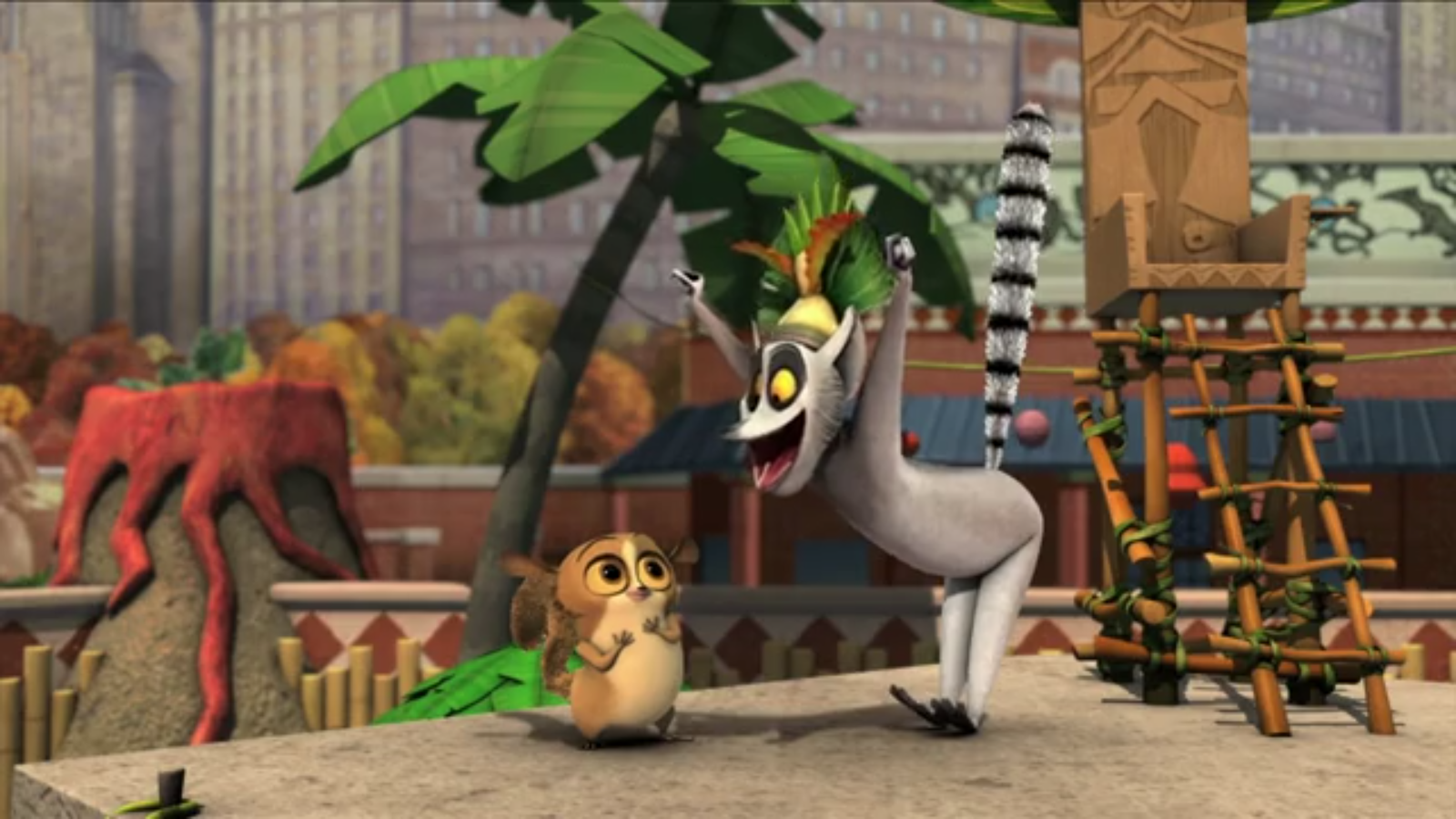
Mort is a nightmare. Honestly, if you grew up watching the original Madagascar movies, you probably remember him as that cute, big-eyed Goodman’s Mouse Lemur who just wanted to touch King Julien’s feet. He was the comic relief. The squeaky toy of the franchise. But then All Hail King Julien hit Netflix, and things got... dark. Really dark.
The writers of All Hail King Julien (AHKJ) decided to take this side character and turn him into a lovecraftian horror entity. It’s easily one of the most bizarre character arcs in animation history. We aren't just talking about a cute mascot anymore. We are talking about a soul-sucking, immortal, multi-dimensional being who has consumed his own ancestors.
If you haven't revisited Mort in All Hail King Julien recently, you’re missing out on a masterclass in "how much can we get away with in a kids' show?"
The Mort Multi-Verse is Canon (And Terrifying)
In the original films, Mort was just a dim-witted lemur. In AHKJ, specifically in the later seasons and the Exiled spin-off, we learn the truth. Mort is not one person. He is a vessel.
Inside Mort's mind—a place often referred to as "Mort-space"—live dozens of other Morts. There’s Smart Mort, Grumpy Mort, and even a female Mort. This isn't just a "Multiple Personality Disorder" trope used for laughs. The show explicitly states that Mort has absorbed these versions of himself. He is a biological vacuum. He literally sucks the essence out of other Morts from across the multiverse to sustain his own life force.
Think about that for a second. This is a show rated for children.
One of the most intense revelations comes when we meet Morticus Khan. He’s a ruthless conqueror version of Mort who tried to take over the world. Our "main" Mort eventually absorbs him too. The sheer lore density surrounding Mort in All Hail King Julien rivals some high-fantasy novels. It’s weird. It’s gross. It’s brilliant.
Why the Foot Fetish is Actually Darker Than You Think
We all know the gag. Mort loves King Julien’s feet. He’s obsessed. In the movies, it’s a slapstick bit where Julien kicks him away. But AHKJ adds a layer of psychological obsession that borders on the religious.
To Mort, Julien isn't just a king; he’s a deity. A fickle, golden-maned god whose approval is the only thing keeping Mort's fractured psyche together. The show plays with the idea that Mort’s obsession is actually a byproduct of his immense age and trauma. When you’ve lived for centuries and consumed your own family tree, you probably need a focal point to stay grounded. King Julien’s feet are that anchor.
It’s a bizarre choice for a character dynamic. It moves past "annoying fan" and into "unsettling devotee."
The Strange Anatomy of a Mouse Lemur
Mort is essentially immortal. Throughout the series, he survives things that would—and should—liquefy any biological organism. He’s been flattened, exploded, eaten, and turned inside out. He always pops back.
The show suggests he doesn't have bones in the traditional sense. Or maybe he just doesn't have a soul to lose? There’s an episode where he’s drained of all fluids and becomes a husk, only to bounce back once he gets a bit of moisture. He’s more like a tardigrade than a primate.
The "Mort-Horsemen" and Experimental Writing
The creators of AHKJ, including showrunner Mitch Watson, clearly had a blast deconstructing the Madagascar universe. They took the colorful, tropical aesthetic and injected it with political satire, drug metaphors (don't get me started on the "banana" episodes), and existential dread.
Mort became the avatar for this experimental writing.
- He represents the "Uncanny Valley" of cuteness.
- His backstory involves being a 50-year-old father of many, despite looking like a toddler.
- He is the only character who seems aware of the cosmic absurdity of their reality.
In the episode "The In-Stans," we see just how much the writers wanted to push the envelope. Mort’s interactions with the wider lemur community often highlight that he is an outcast not because he’s annoying, but because he’s wrong on a fundamental, molecular level.
Why Mort Still Matters in Animation History
Most spin-off shows play it safe. They take the "loud" character and make them louder. They take the "dumb" character and make them dumber. AHKJ took the "cute" character and made him an eldritch horror.
This matters because it proved that there is a massive audience for "weird" kids' animation. It paved the way for the surrealism we see in shows like Adventure Time or The Amazing World of Gumball to be applied to established movie franchises.
Mort in All Hail King Julien is a case study in character evolution. He went from a one-note joke to the most complex, terrifying, and hilarious part of the show. He’s a reminder that even the most commercialized "toy-friendly" characters can have depth—even if that depth is a dark, swirling vortex of consumed souls.
What Most People Get Wrong About Mort
People think Mort is a child. He isn't. He’s been married. Many times. In fact, he mentions his ex-wife Zora frequently. He’s a middle-aged man trapped in the body of a stuffed animal.
Another misconception? That he’s weak. Mort is arguably the most powerful entity in the Madagascar universe. If he ever truly lost his mind—or if the "Council of Morts" inside him decided to cooperate—King Julien’s kingdom wouldn't last a day. He stays because he wants to be there. He stays because the chaos of Julien’s rule is the only thing that distracts him from the voices in his head.
Actionable Takeaways for Fans and Creators
If you’re a writer or a fan of character design, there are a few things to learn from the madness of Mort:
- Subvert Expectations: Don't be afraid to take a one-dimensional character and give them a backstory that contradicts their appearance. The contrast between Mort's "kawaii" eyes and his "soul-eater" backstory is why he’s a cult favorite.
- Embrace the Weird: AHKJ was successful because it didn't talk down to kids. It assumed they could handle (and would enjoy) slightly creepy, high-concept humor.
- Lore Matters: Even in a comedy, consistent world-building (like the rules of Mort-space) makes the world feel "lived in" and rewards repeat viewers.
- Watch the "Exiled" Arc: If you want to see the peak of Mort’s power, skip to the Exiled season. It’s where the show fully embraces its identity as a weird, serialized epic rather than just a sitcom.
Mort is a testament to the idea that no character is too small to be interesting. He started as a background asset and ended up as a god. Just... maybe don't let him touch your feet.
To truly understand the trajectory of modern TV animation, you have to look at the risks taken with Mort in All Hail King Julien. It’s a blueprint for how to keep a franchise alive by making it absolutely, unapologetically insane.
Next time you’re scrolling through a streaming service, put on an episode from season 4 or 5. Look past the bright colors and the catchy theme song. Look at Mort. Look into those big, vacant eyes. There’s a whole universe in there, and it’s hungry.
To dive deeper into this, start by re-watching the episode "The Ultimate Crimson" to see Mort's grandmother's influence—it explains more about his "absorbing" trait than any other segment. Then, compare his behavior in the 2005 original film to the series finale; the shift in vocal performance by Andy Richter is subtle but brilliant, moving from high-pitched innocence to a scratchy, lived-in weariness that mirrors the character's internal decay.