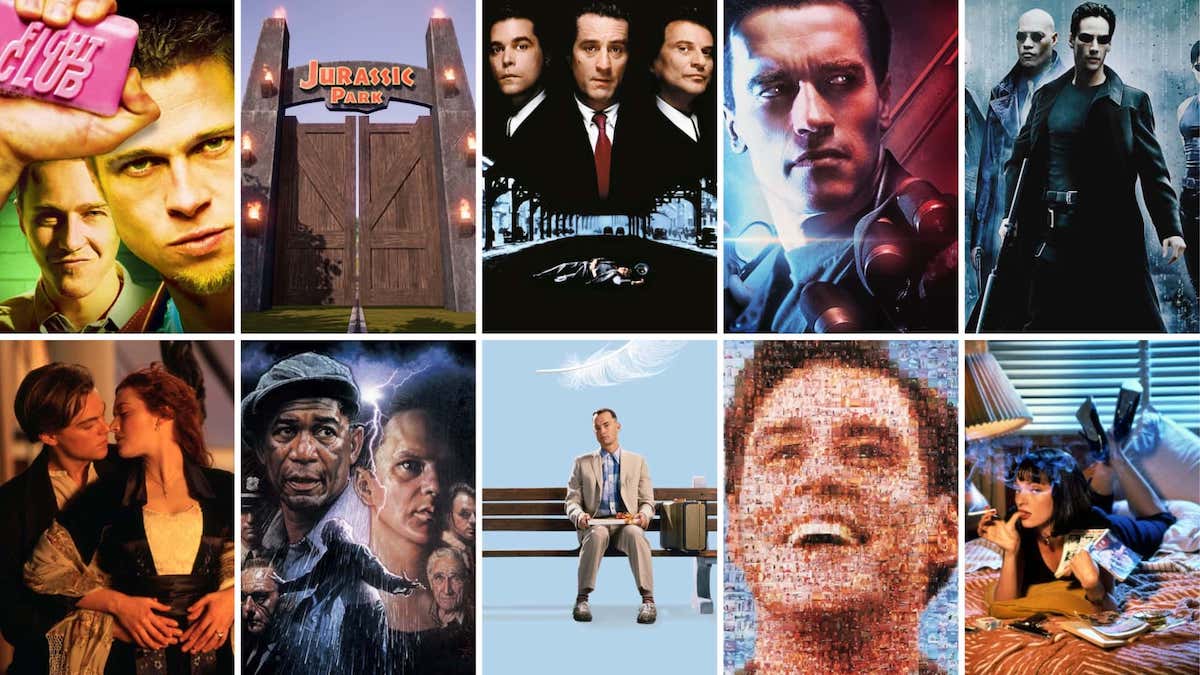
The 1990s were weird. Honestly, looking back at the box office charts from thirty years ago feels like looking at a different planet where a movie about a sinking boat or a guy running across America could basically stop the world for months. We didn't have streaming. You couldn't just "content-slop" your way through a weekend. If you wanted to see the most popular movies 90s kids were obsessing over, you had to actually physically go to a building, buy a ticket, and sit in the dark with 200 strangers.
It was a decade where Steven Spielberg made us believe a T-Rex could swallow a man off a toilet and James Cameron convinced the entire planet that a three-hour historical tragedy was the ultimate date movie. But beyond the blockbusters, the 90s were also about "slacker" culture, hyper-violent indies, and a very specific kind of "office angst" that predicted exactly how burnt out we'd all feel in the 2020s.
The Titans of the Box Office
Let’s talk about the heavy hitters. You can't mention the 90s without talking about Titanic (1997). It was the first movie to ever hit the billion-dollar mark. Before it came out, everyone—and I mean everyone—thought it was going to be a disaster. The production was over budget, Leonardo DiCaprio was just a "teen idol," and people thought a three-hour runtime was a death sentence. Instead, it stayed at number one for fifteen consecutive weeks.
Then you have Jurassic Park (1993). This wasn't just a movie; it was a religious experience for anyone under the age of 12. Spielberg used a mix of practical animatronics and early CGI that, frankly, still looks better than half the Marvel movies coming out today. It raked in $914 million during its original run. People went back five, six, seven times just to hear that T-Rex roar through the theater's surround sound.
But the 90s wasn't just about lizards and boats. It was the decade of the "star vehicle."
- Tom Hanks was untouchable. He won back-to-back Oscars for Philadelphia and Forrest Gump.
- Will Smith basically owned July 4th weekend with Independence Day (1996) and Men in Black (1997).
- Jim Carrey became the first actor to get paid $20 million for a single movie (The Cable Guy), though his 1994 run of Ace Ventura, The Mask, and Dumb and Bumber is probably the most impressive single year any comedian has ever had.
The Animated Renaissance
Disney was on a literal heater. The Lion King (1994) didn't just sell tickets ($763 million); it sold soundtracks, plushies, and Broadway shows. It was the peak of hand-drawn animation. But while Disney was perfecting the old way, a small company called Pixar was busy changing everything. Toy Story (1995) arrived and suddenly, the "hand-drawn" era felt like it was on borrowed time.
Why 1994 and 1999 Changed Everything
Ask any film geek and they'll tell you: 1994 and 1999 are the two greatest years in cinema history.
In 1994, you had Pulp Fiction. Quentin Tarantino didn't just make a movie; he created a new language. The non-linear storytelling, the "Royale with Cheese" dialogue, the sudden bursts of violence—it made everything else in the theater look old and dusty. That same year gave us The Shawshank Redemption, which actually bombed at the box office. Seriously. It only made $16 million initially. It wasn't until it hit the rental market and cable TV that it became the "greatest movie of all time" on IMDb.
Then came 1999. The "End of the World" vibes were everywhere.
- The Matrix told us we were living in a simulation.
- Fight Club told us to blow up our IKEA furniture.
- Office Space told us to stop caring about TPS reports.
- The Sixth Sense gave us the twist that defined a generation.
There was this collective "millennial angst" (referring to the turn of the millennium, not the generation) where filmmakers were obsessed with the idea that our comfortable, middle-class lives were a lie. The Matrix used "bullet time" to change action movies forever, but its real legacy was making everyone buy a leather trench coat and a Nokia phone.
The "Middle" Movie is Dead Now
The saddest thing about looking at the most popular movies 90s fans loved is realizing that the "mid-budget" movie is basically extinct.
In the 90s, you could have a hit that was just... a thriller? Think The Fugitive (1993). It’s a smart, well-acted movie about a doctor on the run. It made $368 million. Today, that script would either be a 6-episode Netflix miniseries or it wouldn't get made at all because it’s not a "franchise."
We had legal thrillers like The Pelican Brief, erotic thrillers like Basic Instinct, and "high-concept" comedies like Groundhog Day. These weren't indie darlings and they weren't $200 million sequels. They were just solid movies that people actually went to see in theaters.
The Indie Explosion
The 90s were also the era where "Indie" became a brand. Miramax (we can acknowledge the movies without the man) pushed Scream and Good Will Hunting into the mainstream. Kevin Smith made Clerks for $27,000 on maxed-out credit cards and became a hero to every slacker with a camcorder. It felt like anyone with a cool script and some 16mm film could become the next big thing.
Action Got Gritty (Then Really Loud)
Action movies in the 90s underwent a weird transformation. We started with Terminator 2: Judgment Day (1991), which combined heart with groundbreaking tech. Then we moved into the "Die Hard on a [Blank]" phase.
- Speed was "Die Hard on a bus."
- Under Siege was "Die Hard on a boat."
- Air Force One was "Die Hard on a plane."
By the end of the decade, Michael Bay had entered the chat. Armageddon (1998) was loud, orange, and scientifically impossible, but it made $553 million. It signaled a shift toward the "spectacle" era where the explosion was often more important than the dialogue.
What Most People Get Wrong About 90s Nostalgia
People think the 90s were "simpler." They really weren't.
If you look at the most popular movies 90s audiences gravitated toward, they were often incredibly dark. Se7en (1995) is a miserable, raining, bleak masterpiece about a serial killer, and it was a massive hit. The Silence of the Lambs (1991) won the "Big Five" Oscars—Picture, Director, Actor, Actress, and Screenplay—despite being a terrifying movie about a cannibal.
We weren't looking for "comfort" back then; we were looking for something that felt real or visceral. Even our rom-coms had a bit of bite. Pretty Woman (1990) is essentially a movie about class struggle disguised as a fairy tale. Jerry Maguire (1996) is about a mid-life crisis and the soul-crushing nature of corporate sports.
How to Do a Proper 90s Movie Marathon
If you want to actually understand why this decade still holds the crown, you can't just watch Titanic and call it a day. You need the full spectrum.
- The Tech Leap: Watch Jurassic Park followed by Toy Story. You'll see exactly when the "real world" and the "digital world" collided.
- The Indie Spirit: Watch Pulp Fiction and The Blair Witch Project. One redefined how we talk; the other redefined how we market movies (the "found footage" craze started here).
- The Existential Crisis: Watch The Truman Show and The Matrix. It's wild how both movies—one a bright comedy-drama and the other a dark sci-fi—are asking the exact same question: "Is any of this real?"
- The Teen Peak: Watch Clueless and Scream. The 90s perfected the "smart teen" movie. They weren't just caricatures; they were meta-aware, stylish, and actually funny.
The 90s didn't have the "Cinematic Universe" problem. Every movie felt like its own little island. When you went to see The Sixth Sense in 1999, you didn't need to have seen 14 other movies to understand it. You just sat down, watched Bruce Willis try to help a kid, and had your mind blown by the end.
That's the real magic of the decade. It was the last time movies were just... movies.
Take Action: Your 90s Watchlist
To truly appreciate the era, skip the "Top 10" lists on Netflix for a second. Go find a copy of The Fugitive or Heat (1995). Pay attention to the pacing—how they let scenes breathe without an explosion every three minutes. Notice the practical effects in Braveheart or Saving Private Ryan.
The best way to experience the 90s today isn't through a "reboot" or a "legacy sequel." It’s by watching the originals and realizing that, in many ways, we’re still just trying to figure out how to make movies that feel as big as they did in 1993.