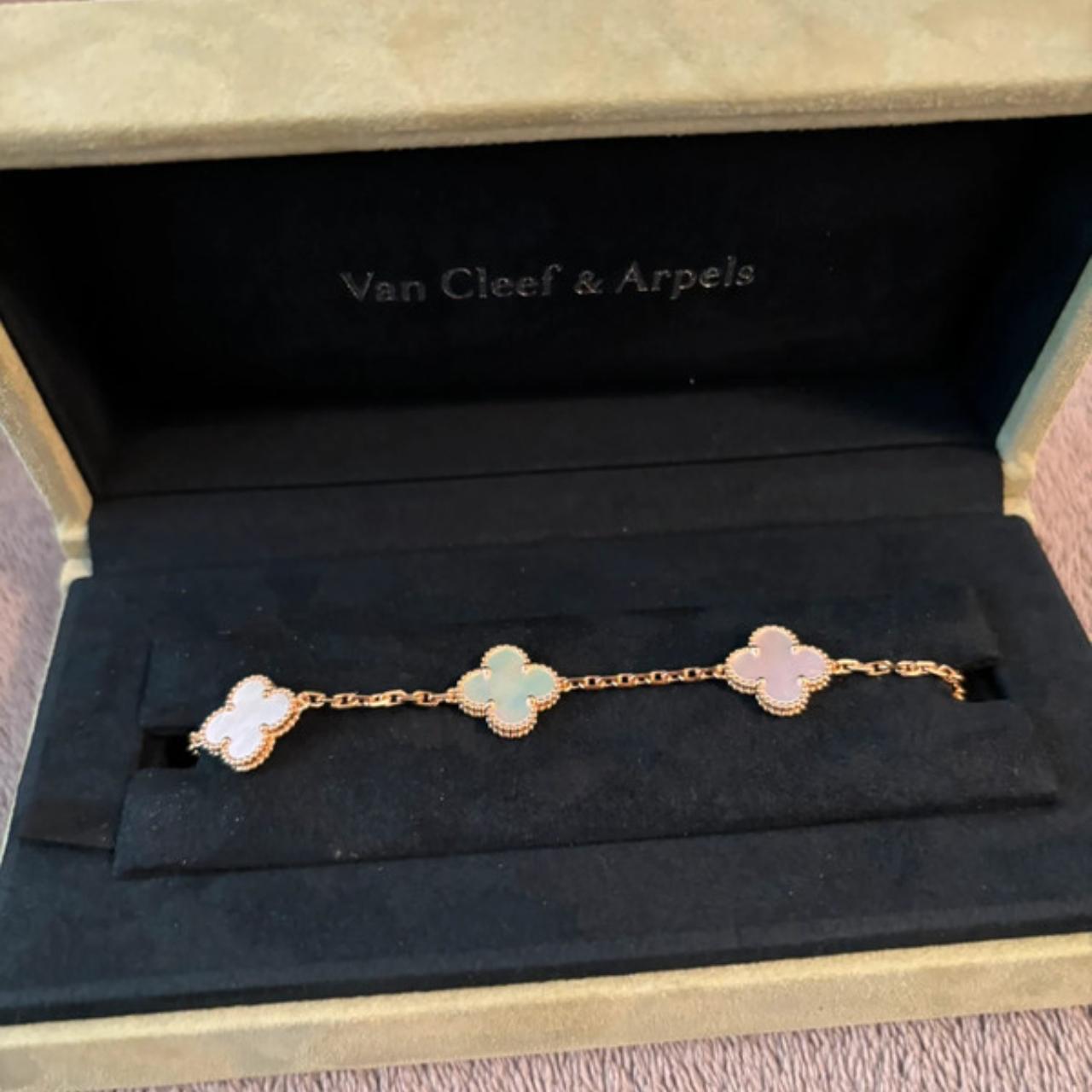
You see it everywhere. That milky, iridescent glow peeking out from a white gold or yellow gold clover. It’s the Mother of Pearl Van Cleef Alhambra—the "starter" piece for many collectors and a permanent fixture on the wrists of people who spend their weekends in the Hamptons. But here is the thing: most people treat this jewelry like a set-it-and-forget-it accessory.
Big mistake.
Honestly, mother of pearl is one of the most temperamental materials in the entire Van Cleef & Arpels catalog. If you’re planning to drop four or five figures on a 5-motif bracelet or a Vintage Alhambra pendant, you’ve got to know what you’re actually getting into. It isn't just a "pretty white stone." It’s an organic substance, literally the "nacre" lining of a mollusk shell, and it has more in common with a living thing than a diamond.
The Mother of Pearl Van Cleef Obsession
Why do we love it? Light. That’s basically it. Van Cleef & Arpels doesn't just grab any old shell from the beach. They source their white mother of pearl primarily from Australia and their grey variety from French Polynesia. They look for "orient"—that specific way the light dances across the surface, creating a rainbow effect that’s subtle but unmistakable.
It’s feminine. It’s classic.
But it’s also incredibly soft. On the Mohs scale of mineral hardness, mother of pearl sits somewhere between a 2.5 and 4. For context, a diamond is a 10. Even your fingernail is about a 2.5. This means if you let your mother of pearl van cleef necklace rub against a gold chain or a sapphire ring in your jewelry box, the shell is going to lose. Every single time.
The Science of the Glow
When you look at a piece of VCA mother of pearl, you're seeing microscopic layers of calcium carbonate. These layers are held together by an organic protein called conchiolin. Because it’s organic, it reacts to the environment.
It breathes. Sorta.
If it gets too dry, it can actually "craze" or develop tiny surface cracks. If it gets too wet, or stays wet, it can swell and then shrink as it dries, which eventually causes the stone to pop right out of the beaded gold setting. I’ve seen it happen. You look down at your wrist and there’s just an empty gold clover staring back at you. It’s a heartbreaker.
What Most People Get Wrong About Care
Let’s get real for a second. You’ve probably seen influencers wearing their Alhambra bracelets in the pool or at the gym.
Don't do that.
Mother of pearl van cleef jewelry hates almost everything you use in your daily routine. Hairspray? It’ll dull the shine. Perfume? The alcohol can literally eat away at the organic binder in the nacre. Even your own sweat is acidic enough to eventually turn that beautiful iridescent white into a chalky, matte mess.
- The "Wait 10 Minutes" Rule: Put on your lotion, spray your perfume, do your hair. Then, wait ten full minutes for everything to dry before you even think about putting on your jewelry.
- The Water Myth: Just because it came from the ocean doesn't mean it wants to go back there. Tap water has chlorine. The ocean has salt. Both are enemies of a polished finish.
- Storage is Not Optional: You cannot just toss this in a tray with your other rings. VCA gives you those nice suede-lined boxes for a reason. Use them. Each piece needs its own little apartment so it doesn't get scratched by harder stones.
Is the Grey Mother of Pearl Different?
Actually, yes. While the white is the classic "I’m a bride/socialite" look, the grey mother of pearl (often seen in the Magic Alhambra or combined with rose gold) tends to show scratches a bit more because of the darker background. However, it’s often considered more modern and slightly less "precious" looking than the white. Both require the same level of babying, though.
The Resale Reality
If you’re looking at your mother of pearl van cleef as an investment, you need to be careful. The secondary market—think sites like Fashionphile or Sotheby’s—is flooded with Alhambra pieces. A pristine white mother of pearl bracelet can hold about 85% to 100% of its retail value.
But.
If the stone is "dead"—meaning it has lost its luster and looks like a piece of plastic—the value plummets. Unlike gold, which can be polished, or a diamond, which can be cleaned, once the nacre on mother of pearl is chemically damaged or worn down, you can't really "fix" it. You have to send it back to Van Cleef & Arpels to have the stones replaced, which isn't cheap.
How to Spot a "Good" One
When you’re standing in the boutique (or looking at high-res photos online), don't just look for "white." Look for the "fire."
- Uniformity: In a 5-motif bracelet, the pieces should look like siblings, not necessarily twins. They should have the same general thickness and color, but since they are natural, slight variations are actually a sign of authenticity.
- The Glow: Tilt the piece under the light. You want to see flashes of pink and green. If it just looks like a flat, white slab, it’s either a low-quality shell or a fake made of resin.
- The Fit: The mother of pearl should be perfectly flush with the gold beading. There shouldn't be a gap where you can see the glue or the edges of the stone.
Actionable Steps for Owners
If you already own a piece or you're about to pull the trigger, here is your survival guide.
First, get a dedicated microfiber cloth. Every time you take the piece off, give it a quick, dry wipe. This removes the oils from your skin before they can sit and do damage overnight.
Second, check the "claws." Those tiny gold beads holding the stone in place can sometimes loosen. Give the stone a very gentle nudge with your fingernail once a month. If it moves at all, take it to the boutique. It’s much cheaper to tighten a setting than to buy a new stone.
Finally, embrace the patina. If you wear your mother of pearl van cleef every day, it will eventually lose some of that "fresh out of the box" mirror shine. That’s okay. It’s a sign of a piece that’s been loved. Just don’t speed up the process by wearing it in the shower.
To keep your collection in top shape, start by auditing your storage. Ensure each mother of pearl piece is in a separate soft pouch or its original box. If you've been wearing yours in the shower or during workouts, stop immediately to preserve the remaining nacre integrity. For pieces that have already become dull, contact an official Van Cleef & Arpels boutique to inquire about their stone replacement service—it's the only way to truly restore that signature iridescent glow.