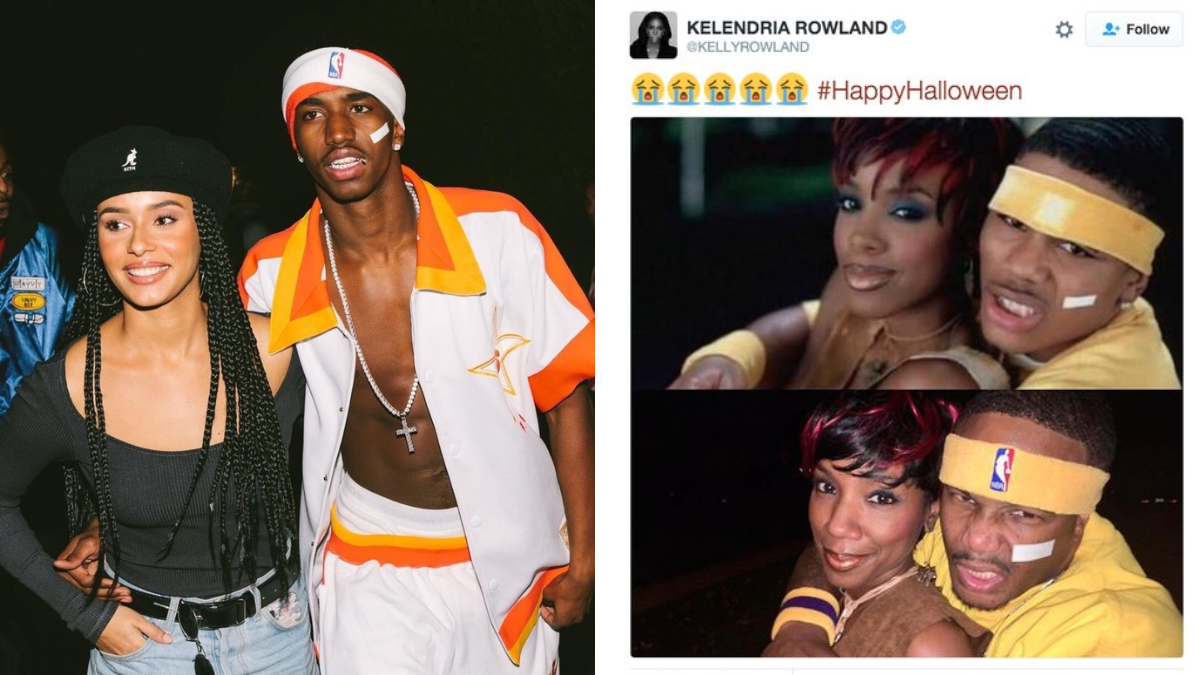
It was 2002. If you turned on MTV, you saw him. Nelly was everywhere, usually shirtless, definitely energetic, and always sporting a small strip of sterile adhesive under his left eye. It looked like a boxing injury. Or maybe a shaving mishap?
Honestly, the Nelly with a Band-Aid look became one of those weird cultural touchstones that defined an entire era of hip-hop. You couldn't go to a middle school dance without seeing at least three kids—who definitely didn't have facial lacerations—mimicking the style. But why did a multi-platinum global superstar decide to wear a first-aid supply as jewelry?
The answer is actually way more personal than a marketing gimmick. It started with a basketball game.
The Real Injury That Started It All
Most people think it was just a fashion statement from day one. It wasn't. During a casual game of hoops, Nelly took a hit to the face. It resulted in a legitimate cut. Like anyone else would, he slapped a Band-Aid on it to keep the blood off his jersey and his face.
Then things got weird.
He kept wearing it. Even after the skin had healed and the scab was long gone, the strip stayed. Fans started noticing it in the "Hot in Herre" music video. By the time Nellyville was dominating the Billboard 200, the Band-Aid was as much a part of his brand as his St. Louis accent or his Apple Bottom jeans line.
But the persistence wasn't just about vanity or "looking cool." It turned into a tribute.
City Spud and the Sacrifice Behind the Symbol
While the initial cut was real, the reason the Nelly with a Band-Aid look lasted for years was rooted in loyalty. Nelly was a member of the St. Lunatics, a rap collective out of St. Louis. One of his closest friends and a fellow group member, Lavell Webb—better known as City Spud—was sentenced to ten years in prison for first-degree assault right as the group was blowing up.
City Spud is actually the one rapping the hook on the hit "Ride Wit Me."
Nelly decided to keep wearing that Band-Aid as a visual shout-out to his incarcerated friend. It was a "free City Spud" campaign without the need for a t-shirt. Every time a camera flashed or a video rolled, Nelly wanted people to ask about the bandage so he could talk about his brother behind bars.
It worked.
The image became so synonymous with Nelly that it transcended the tribute. It became a logo. It’s hard to imagine now, in an age of face tattoos and designer masks, but a 50-cent piece of plastic-coated gauze was the most recognizable accessory in music for a solid three years.
Why It Actually Worked as a Trend
Fashion is usually about aspiration. We wear what the rich and famous wear because we want to feel rich and famous. But the Band-Aid was different. It was cheap. Anyone could go to a CVS and buy a box of 40 for three dollars.
That accessibility made it a viral sensation before "viral" was a digital term.
- It was asymmetrical, which creates visual interest.
- It hinted at a "tough" lifestyle (the "I just got into a fight" vibe).
- It was incredibly easy to replicate.
The St. Louis rapper didn't just sell records; he sold a look that cost pennies to maintain. You'd see professional athletes, suburban teenagers, and other rappers sporting the strip. It was the ultimate low-cost branding exercise.
The Evolution and Eventual Removal
Nothing lasts forever, especially not medical supplies worn as fashion.
By the mid-2000s, specifically around the release of his dual albums Sweat and Suit in 2004, the Band-Aid began to disappear. Why? Because City Spud was coming home.
The tribute served its purpose. When Spud was released from prison, the need for the symbolic reminder faded. Nelly eventually peeled it off for good, revealing perfectly clear skin underneath. There was no permanent scar, no lingering injury. Just a guy who had grown up and moved past the gimmickry of his early twenties.
Interestingly, Nelly has talked about this in later interviews, including a notable sit-down with Sway in the Morning. He acknowledged that while it started as a legitimate injury, it became a "bridge" to keep his friend's name alive. It’s a rare example of a rap trend that actually had some heart behind it.
What People Get Wrong About the Bandage
The internet loves a good conspiracy or a simple explanation. Some thought he was hiding a mole. Others thought it was a secret sign for a gang.
None of that was true.
It was a mix of accidental timing and deep-seated Midwestern loyalty. If Nelly hadn't been filmed for a major music video while that original cut was healing, it probably never would have happened. But because the video for "Batter Up" or "Hot in Herre" captured that specific moment, the world froze him in time with that bandage on his cheek.
The Legacy of the Look
If you look at the landscape of celebrity branding today, everyone is trying to find their "Band-Aid." Whether it’s Billie Eilish’s oversized neon clothes or Post Malone’s face tattoos, artists are desperate for a visual "sticky" factor.
Nelly stumbled into it.
He proved that you don't need a million-dollar stylist to create an iconic image. You just need a story and the willingness to commit to the bit—even if that bit involves adhesive residue on your face for three years straight.
It remains one of the most effective examples of "accidental branding" in history. It helped put St. Louis on the map. It helped keep a friend's memory alive during a dark time. And it definitely sold a lot of Johnson & Johnson products.
Actionable Insights for Modern Branding
If you're looking to build a personal brand or just understand how these cultural moments happen, here is what the Nelly with a Band-Aid phenomenon teaches us:
- Consistency is king. Nelly didn't wear it once; he wore it every single time he was in public. If you want a brand element to stick, you can't be wishy-washy about it.
- Authenticity matters. Because there was a real story (City Spud) behind the fashion, it didn't feel like a corporate gimmick. People connect with the "why" more than the "what."
- Simplicity scales. The best logos and brand marks are ones a child could draw from memory. The Band-Aid was the simplest logo in history.
- Don't be afraid to evolve. Nelly knew when to take it off. Hanging onto a trend for too long makes you a caricature of yourself. Recognize when the "tribute" or "style" has reached its natural conclusion.
The next time you see a celebrity doing something seemingly inexplicable with their appearance, ask yourself if there's a "City Spud" in their life. Usually, there's a story there. Sometimes, a bandage is just a bandage—but sometimes, it's a message to the world.