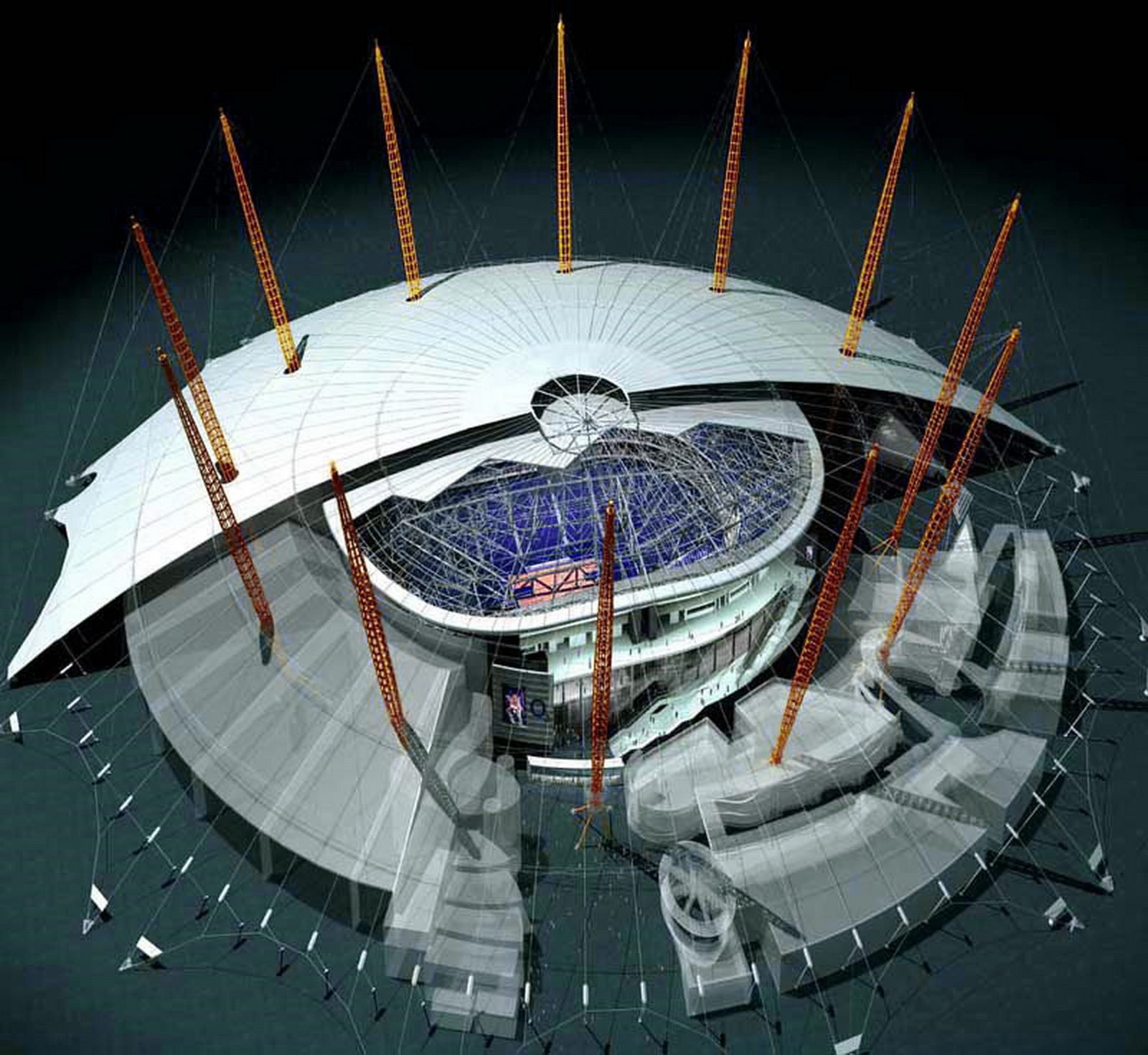
You're standing in the North Greenwich underground station. It's 6:00 PM. A sea of people, all wearing the same tour merch, is funneling toward that massive white dome with the yellow spikes. It looks like a giant upside-down birthday cake, doesn't it? But once you get inside, the scale changes completely. People talk about the O2 Arena London capacity like it’s a single, fixed number. It isn't. Not even close. If you’re trying to visualize how many people are actually crammed into that space during a sold-out show, you have to look at how the floor is set up, because that changes everything.
Honestly, the "official" numbers you see on Wikipedia or the venue's landing page only tell half the story. The O2 is a chameleon.
The Magic Number: Breaking Down the 20,000 Cap
Let's get the big stat out of the way. The maximum O2 Arena London capacity is generally cited as 20,000. That makes it the second-largest arena in the UK, trailing just slightly behind the AO Arena in Manchester (which can squeeze in about 21,000). But here’s the thing: you will rarely ever be in a room with exactly 20,000 other people.
Why? Production.
Think about the stage. If it’s a standard "end-stage" setup—the kind used by 90% of touring acts—the seats directly behind the stage are blocked off. They call these "obstructed view" or simply "kills." Depending on how massive the LED screens are or if the artist has a giant inflatable prop, you might lose 2,000 seats instantly. Suddenly, that 20,000-seat arena is a 17,500-seat arena.
However, when a band plays "in the round"—think Ed Sheeran or Metallica—they put the stage right in the middle. This is when the O2 hits its true peak. Because they can use every single seat in the 100, 400, and balcony levels, plus the standing floor, the capacity pushes right up against that 20,000 ceiling. It’s loud. It’s claustrophobic in the best way possible. It’s a total vibe.
Why the Floor Setup Changes Everything
The floor is where the real math happens. Usually, the O2 offers two main configurations for the ground level.
All-Standing Floor
This is the classic concert experience. You’ve got a massive open space where thousands of fans are packed together. In this setup, the O2 Arena London capacity feels its most intense. There’s no personal space. You’re navigating a sea of plastic beer cups and phone screens. This configuration allows for the highest number of bodies because humans take up way less room standing than they do sitting in a folding chair.
Fully Seated Floor
Then you have the "fancy" shows. Think Andrea Bocelli or a comedy special like Peter Kay. They bring out thousands of temporary chairs and line them up in numbered blocks (Blocks A, B, and C are usually the gold dust). When the floor is seated, the capacity drops. Chairs have legs. Chairs need aisles for fire safety. You can't pack 5,000 people onto a seated floor the same way you can with a standing crowd. Usually, a fully seated floor show caps out around 15,000 to 16,000 total attendees across the whole building.
Beyond the Music: Sports and Special Events
The O2 isn't just a music venue. It’s a sports cathedral. If you were there for the Nitto ATP Finals (before they moved to Turin), you saw a different beast entirely. Tennis requires a very specific court size and umpire chair placement, which cuts into the floor space.
Basketball is another one. When the NBA brings regular-season games to London, the O2 transforms. You have the "court-side" seats which are basically on the hardwood, but you lose a lot of the end-zone seating for cameras and media benches.
Then there’s the UFC.
The Octagon is small.
Because the "stage" (the cage) is so tiny compared to a rock concert stage, they can cram seats in everywhere. The atmosphere at a UFC event in the O2 is famously "cavernous yet intimate." You’ve got 17,000+ people screaming, and because of the way the O2 is banked, everyone feels like they are on top of the action. The 100-level seats at the O2 are some of the steepest in the country, which is terrifying if you have vertigo but amazing if you want a clear view of a submission over someone’s shoulder.
The Logistics of 20,000 People
Have you ever wondered how they get 20,000 people out of a tent in twenty minutes? It’s a masterpiece of engineering. The O2 isn't actually a building in the traditional sense; it’s a massive tent structure (the old Millennium Dome) with a separate, freestanding arena built inside it.
When the lights go up and the "thank you, London!" echoes out, the crowd splits.
- The 100 Level: These people exit down toward the main concourse.
- The 400 Level: These poor souls have to navigate the world’s longest escalators. Seriously, if you're afraid of heights, don't look down.
- The VIPs: They disappear into the AMEX lounge or the private suites that ring the arena between the lower and upper tiers.
The sheer volume of people impacts everything in the surrounding "Entertainment District." If you’re planning to eat at Nando’s or Five Guys inside the Dome before a 20,000-capacity show, forget it. Unless you're there at 4:00 PM, you aren't getting a table. The "leakage" of 20,000 people into the North Greenwich tube station is a choreographed dance managed by dozens of TFL staff with megaphones. It works, but it’s a slow shuffle.
Misconceptions About the "Dome" vs. the "Arena"
People get this mixed up all the time. They think the "O2 capacity" refers to the whole white tent. It doesn't.
The Millennium Dome structure itself is massive—you could fit the Great Pyramid of Giza under there if you really wanted to. But the arena is just one part of it.
The rest of the space houses:
- Indigo at The O2: A smaller, 2,800-capacity club venue.
- Cineworld: A massive multiplex.
- Outlet Shopping: Dozens of shops.
- Up at The O2: The walkway where you can literally climb over the roof.
So, on a Friday night, there might actually be 30,000 or 40,000 people inside the complex, even though the O2 Arena London capacity is capped at 20,000 for the main event. It’s a logistical mountain to climb.
The Sound Problem: Does Size Matter?
There is a long-standing debate among audiophiles about whether a 20,000-capacity room can ever sound "good." In the early days (around 2007-2008), the O2 had some echo issues. It’s a big, hollow space. But over the years, the acoustic treatment has become world-class.
Most sound engineers will tell you that the O2 is actually easier to mix in than the Wembley Arena (which is older and boxier). The oval shape of the O2 helps bounce the sound in a way that minimizes that muddy "stadium" reverb. But let’s be real: if you’re in the back row of the 400 level, you’re hearing the sound through a massive delay system. You’re watching the singer on a screen because they look like an ant, and the sound is reaching your ears a fraction of a second after you see the lips move. That’s just physics.
Is It the Biggest?
Not anymore. Or rather, it’s about to have some serious competition. For years, the O2 was the undisputed king of the London indoor scene. But with the Co-op Live in Manchester pushing the boundaries and various proposals for new London venues always floating around, the O2 has to work harder to keep its crown.
Still, for a touring artist, "Selling out the O2" is the benchmark. It’s the London equivalent of playing Madison Square Garden. If you can fill 20,000 seats in North Greenwich, you’ve officially "made it."
Actionable Tips for Your Next Visit
If you’re heading to a show and want to navigate the capacity like a pro, keep these things in mind.
Check the Floor Plan Early
Don't just look at the row number. Go to a site like "A View From My Seat" to see what the actual O2 Arena London capacity configuration looks like for your specific show. If it’s a "B-stage" show (where the artist walks down a long catwalk to a second stage), a "cheap" seat at the back of the floor might suddenly become the best seat in the house.
The "Side View" Hack
Often, when a show is "sold out," the venue releases tickets for the sections right at the side of the stage (like sections 101 or 112). These are technically "side view," but because of the O2’s curve, you are often closer to the artist than the people who paid £200 for front-row center. You might not see the backdrop perfectly, but you’ll see the sweat on the drummer’s forehead.
Timing the Exit
If you’re worried about the crush of 20,000 people hitting the tube at once, you have two choices. Either leave during the encore (which is a sin in my book) or head to one of the bars in the outer fringe of the Dome for 45 minutes after the show. Let the first three waves of the crowd hit the station. By the time you finish one drink, the queue for the Jubilee Line will have dropped from an hour to ten minutes.
Security is No Joke
With a 20,000-person capacity, security is tight. They use "Opengate" systems now, which are much faster than old-school metal detectors, but if you bring a bag larger than an A4 sheet of paper, you’re going to be sent to the bag drop. That bag drop is outside, it costs money, and the queue after the show to get your bag back is a nightmare. Travel light.
The O2 is a beast. It’s loud, it’s crowded, and it’s expensive. But there is something undeniably electric about being one person in a crowd of 20,000, all screaming the same chorus at the top of their lungs. Whether you're in the front row or the very last seat of the 400s, the scale of the place is what makes the experience. Just make sure you know which version of the arena you're walking into.