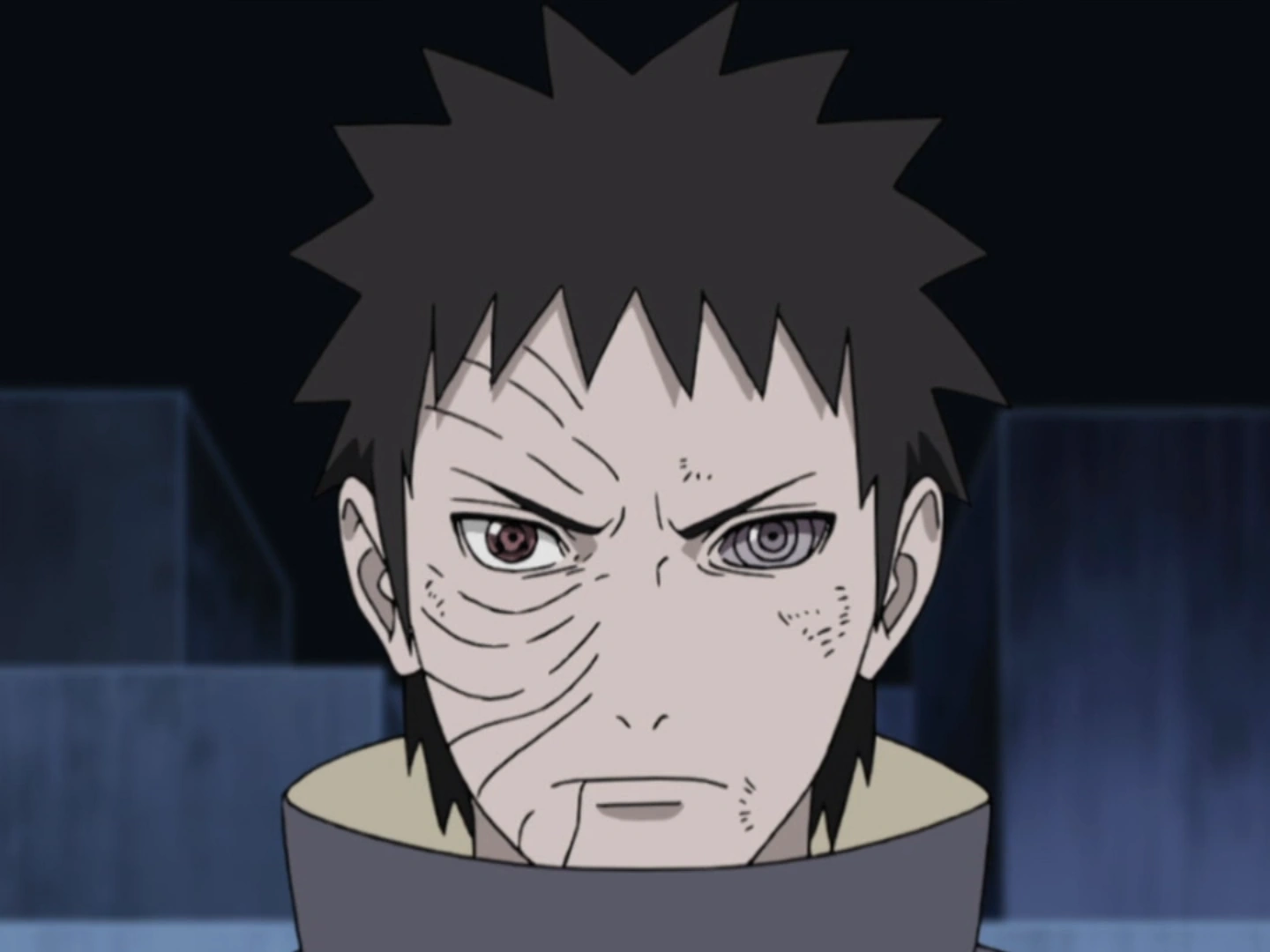
You know that feeling when a single image just sticks in your brain and refuses to leave? For most Naruto fans, it's that haunting shot of Kakashi’s hand passing straight through Obito Uchiha’s torso. It’s visceral. It’s brutal. Honestly, it’s one of the most heavy-handed metaphors Masashi Kishimoto ever drew, but it works so well because it isn't just about physical damage. When we talk about Obito’s hole in the chest, we aren't just discussing a medical impossibility in a world of ninjas; we are looking at the literal manifestation of a man who decided he no longer existed.
He’s empty.
Most viewers remember the reveal during the Fourth Shinobi World War. Kakashi uses Raikiri, the lightning blade he perfected, to pierce his old friend's heart. Or where the heart should be. But there’s a massive catch that a lot of casual watchers miss. Obito didn't just survive that because he’s "built different" or because of some vague Hashirama cell magic. He survived because he planned for it. He needed that hole.
The Reality of the Void
The scene in the Kamui dimension is peak storytelling. You've got two guys who grew up together, loved the same girl, and were shattered by the same war, finally throwing hands in a place where nobody else can interfere. When Kakashi lands that blow, the imagery is intentional. Obito leans into it. He doesn't dodge. Why? Because the Obito hole in the chest was a calculated move to remove the Forbidden Individual Curse Tag placed on his heart by Madara Uchiha.
Madara was always ten steps ahead. He didn't just save Obito from the rocks; he turned him into a puppet. By placing a seal on Obito’s heart, Madara ensured that Obito could never go against his will or become the Juubi’s jinchuriki without Madara's say-so. Obito knew this. He was trapped. To gain the power he needed to flip the table on everyone, he had to have his own heart destroyed.
It's sort of poetic, in a dark way. He had to let his best friend "kill" him to finally be free of his master's leash.
Why the White Zetsu Mattered
How do you even walk around with a gaping void in your sternum? If this were any other character, they’d be dead before they hit the floor. But Obito’s body by this point was barely human. After the accident at Kannabi Bridge, roughly half of his body was replaced with White Zetsu matter—which is essentially artificial genetic material derived from the First Hokage, Hashirama Senju.
This stuff is the ultimate cheat code in the Naruto universe.
It provides insane regenerative properties. It doesn't require a traditional circulatory system to function in the way we understand it. When Kakashi’s Raikiri blew through him, the Zetsu cells kept the rest of the structure intact. He wasn't bleeding out like a normal person would because he was more plant-man than human at that stage. This is why the Obito hole in the chest didn't result in an immediate funeral. He was already a walking corpse held together by experimental biology and sheer spite.
The Psychological Weight of the Empty Space
Kishimoto loves his symbolism. He really does.
Throughout the series, Obito repeatedly claims he is "no one." He tells Kakashi that there is nothing in his heart—literally and figuratively. The hole represents the "Hollow" (to borrow a term from Bleach) that Rin’s death left behind. When he shows Kakashi the literal sunlight passing through his torso, he’s trying to prove a point. He’s saying, "Look, I felt so much pain that I literally hollowed myself out so I wouldn't have to feel anything ever again."
It’s an edgy move. Definitely. But it’s also deeply human. We’ve all felt that "hollow" feeling after a loss, though usually, we don't have a lightning-wielding ninja around to make it literal.
A Technical Look at the Kamui Dimension Fight
If you re-watch that fight, notice the choreography. It’s one of the best-animated sequences in the series. The pacing is frantic. Then, it slows down. The moment the Obito hole in the chest occurs, the music drops out.
- Obito intentionally drops his defense.
- He manipulates Kakashi’s guilt to force an aggressive opening.
- He uses the Raikiri’s piercing power to incinerate the cursed seal.
The nuance here is that Obito used Kakashi. He used his friend's trauma to perform a high-stakes surgery. It’s incredibly messed up when you think about it. He forced Kakashi to relive the trauma of killing Rin by making him do the exact same thing to him. It was a psychological double-whammy.
Debunking the "He Should Be Dead" Theory
A lot of fans argue that even with Zetsu cells, losing a heart is game over. But remember, the Naruto world has different rules for the soul and the physical vessel. Since Obito was preparing to become the Jinchuriki of the Ten-Tails, he was already transitioning into a state of being that transcends normal mortality. Becoming the Ten-Tails' host later that day basically "reset" his physical form anyway, filling the void with the massive chakra of the Tailed Beasts.
The Legacy of the Wound
Ultimately, the Obito hole in the chest remains the defining image of the late-war arc. It tells us everything we need to know about his commitment to the Eye of the Moon plan. He was willing to be a literal shell of a man if it meant he could create a world where Rin was still alive.
It wasn't just a wound. It was an exit strategy.
If you’re looking to understand the deeper lore of the Uchiha, don't just look at their eyes. Look at what they’re willing to sacrifice. Obito gave up his heart—both the organ and the emotion—to chase a dream that was never going to love him back.
To truly grasp the mechanics of this scene, you have to look at the chapter titles around that era. Kishimoto was obsessed with the idea of "Holes in the Heart." He uses the same phrasing when talking about Naruto’s loneliness. The difference is that Naruto let people in to fill the hole, while Obito let the world pass right through him.
Next Steps for Naruto Lore Fans
To see the direct consequences of this injury, you should re-examine Chapter 629 of the manga. Pay close attention to the dialogue regarding the "Forbidden Individual Curse Tag." Many translations gloss over the specific mechanics of how Madara controlled Obito, but understanding that seal is the key to realizing why the hole in his chest was a victory for Obito, not a defeat. You can also compare this to the "Hell" scene earlier in the series to see how Kishimoto mirrored the visual of Rin's death with Obito's near-death at the hands of Kakashi.