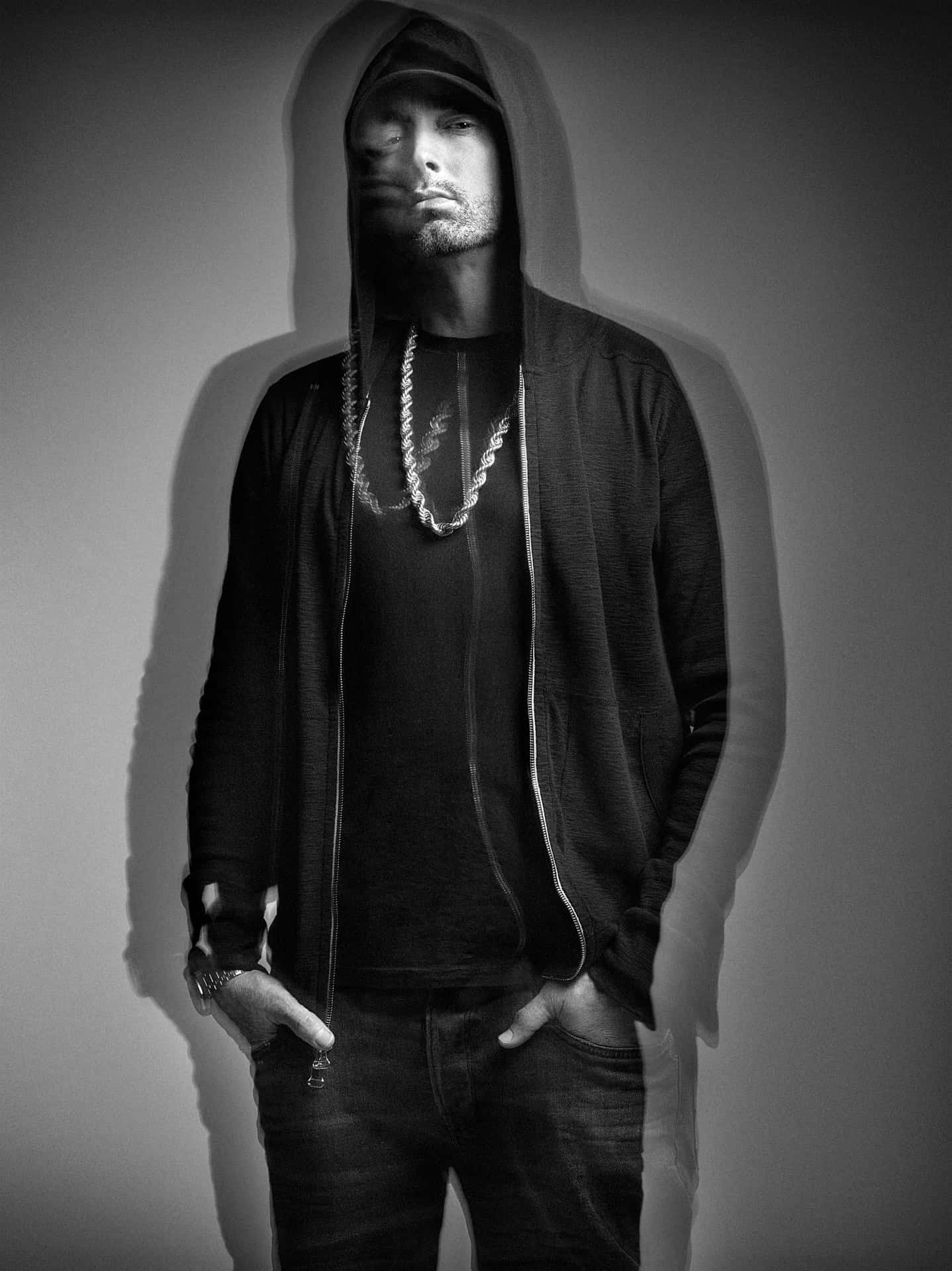
Ever looked at a grainy, 1990s polaroid of a skinny kid in a dirty hoodie and realized you were staring at the future biggest artist on the planet? It's weird. Seeing old pics of Eminem feels less like looking at a celebrity’s family album and more like studying a historical document of Detroit's underground grit.
Most people know the peroxide-blonde "Slim Shady" look that took over MTV in 1999. But there’s a whole universe of imagery before that. I’m talking about the Marshall Mathers who was just trying to pay rent on Dresden Street. Before the Grammys, before the beefs, and way before the beard.
Honestly, looking at these shots tells a story that the music alone can't quite capture.
The Brown-Haired Kid from Dresden Street
If you dig through the archives of Marshall's early life, the first thing that hits you is the hair. Long before he was the "White Gold" poster boy, Marshall was just a typical brown-haired kid. There’s one specific photo that often floats around Reddit—it’s him in a high school yearbook or perhaps just a casual school-age shot. He’s got this bowl-ish cut, a slight smirk, and eyes that look like he’s already seen too much for a teenager.
He grew up moving between Missouri and Detroit, rarely staying in one house for more than a year. If you see photos of the house at 19946 Dresden Street (the one on the Marshall Mathers LP cover), you’re looking at his home base from when he was 12. That house was eventually demolished in 2013, but the pictures of him standing on those porch steps remain legendary.
It wasn't a "staged" aesthetic. He was actually living there. He was flunking the ninth grade for the third time and spending his nights reading the dictionary to expand his vocabulary. You can see that hunger in the shots from his time with Soul Intent, his early rap group with Proof and Chaos Kid.
The 1997 Rap Olympics: The Turning Point
There’s a very specific set of old pics of Eminem from the 1997 Rap Olympics in Los Angeles. This wasn't a victory lap. In fact, it was one of the lowest points in his life.
He had just been evicted from his apartment. He flew to LA with practically nothing, hoping the $1,500 grand prize would save him. He came in second. He lost to a rapper named Otherwize.
The photos from that day show a Marshall who looks absolutely drained. He’s wearing a baggy t-shirt, usually a beanie or a cap, and he looks like he's at the end of his rope. But here’s the kicker: an intern from Interscope Records was in the crowd and grabbed a copy of the Slim Shady EP. That CD eventually landed on Jimmy Iovine’s desk, who played it for Dr. Dre.
"In my entire career in the music industry, I have never found anything from a demo tape or a CD. When Jimmy played this, I said, 'Find him. Now.'" — Dr. Dre
Without those grainy photos and videos of him losing a battle in a small LA venue, the Slim Shady we know might never have existed.
Why He Actually Went Blonde
Have you ever wondered why he suddenly turned into the "Real Slim Shady" we saw in the "My Name Is" video? It wasn't a corporate marketing meeting.
According to Wendy Adler Bass and Karen Pinegar (who worked at the studio where he recorded the Slim Shady LP), Marshall walked into the studio one day with red hair. He was trying to find a look. He wanted to "pop."
Pinegar told him he looked like Annie Lennox and suggested he cut it short and go platinum blonde. He did it on a whim. The photos of him during those 1998 recording sessions show the transition from the "brown-haired battle rapper" to the "blonde global icon." It was a total accident that became the most recognizable look in hip-hop history.
The Private Side: Marshall as a Young Dad
Some of the most humanizing old pics of Eminem are the ones featuring a tiny Hailie Jade.
Back in the mid-90s, before he was a millionaire, Marshall was working 60 hours a week as a cook and dishwasher at Gilbert's Lodge in St. Clair Shores. He was making minimum wage, trying to provide for a newborn.
There’s a photo of him holding Hailie where he looks genuinely happy—a rare sight for a guy who made a career out of being the "angry" rapper. These photos are reminders of what he was actually fighting for. When he raps about "97 Bonnie and Clyde," he isn't just playing a character; he’s a guy who felt like the world was closing in on his family.
Rare Gems You Should Look For
If you’re a real fan, you’ve probably seen the standard press shots. But if you want the deep cuts, look for these:
- The Soul Intent Photos (1991-1995): Marshall in oversized hoodies, often with Chaos Kid. He looks incredibly young, almost unrecognizable.
- The Gilbert’s Lodge Employee Photos: Rare shots of him in his work uniform before he quit to pursue music full-time.
- The "Infinite" Era (1996): This was his first independent album. The photos show a rapper trying to sound like Nas or AZ—very New York-influenced, very serious, and zero blonde hair in sight.
- Early D12 Group Shots: Before the "Purple Pills" fame, back when they were just the "Dirty Dozen" in Detroit.
What These Photos Teach Us Today
Looking back at these images in 2026, it’s easy to get nostalgic. But there's a practical lesson here. These photos show the process. They show the failures, the bad haircuts, the "salt-and-pepper" phase, and the moments of genuine desperation.
Eminem wasn't a "natural" star. He was a guy who obsessed over his craft until the world couldn't ignore him. The pictures of him in the 90s aren't just "old pics"—they are proof that you can come from a trailer on Dresden Street and end up in the Rock and Roll Hall of Fame.
Next time you see a grainy shot of him from 1996, don't just see a celebrity. See the work that went into becoming one.
If you want to track down these specific archives, I recommend checking out the "Detroit Free Press" archives from 1999 or diving into the deeper threads on r/Eminem, where fans still occasionally dig up "never-before-seen" scans from old Detroit zines.
Check out some of the early footage of his 1997 battles on YouTube—it’s the best way to see the "still-brown-haired" Marshall in his natural element.