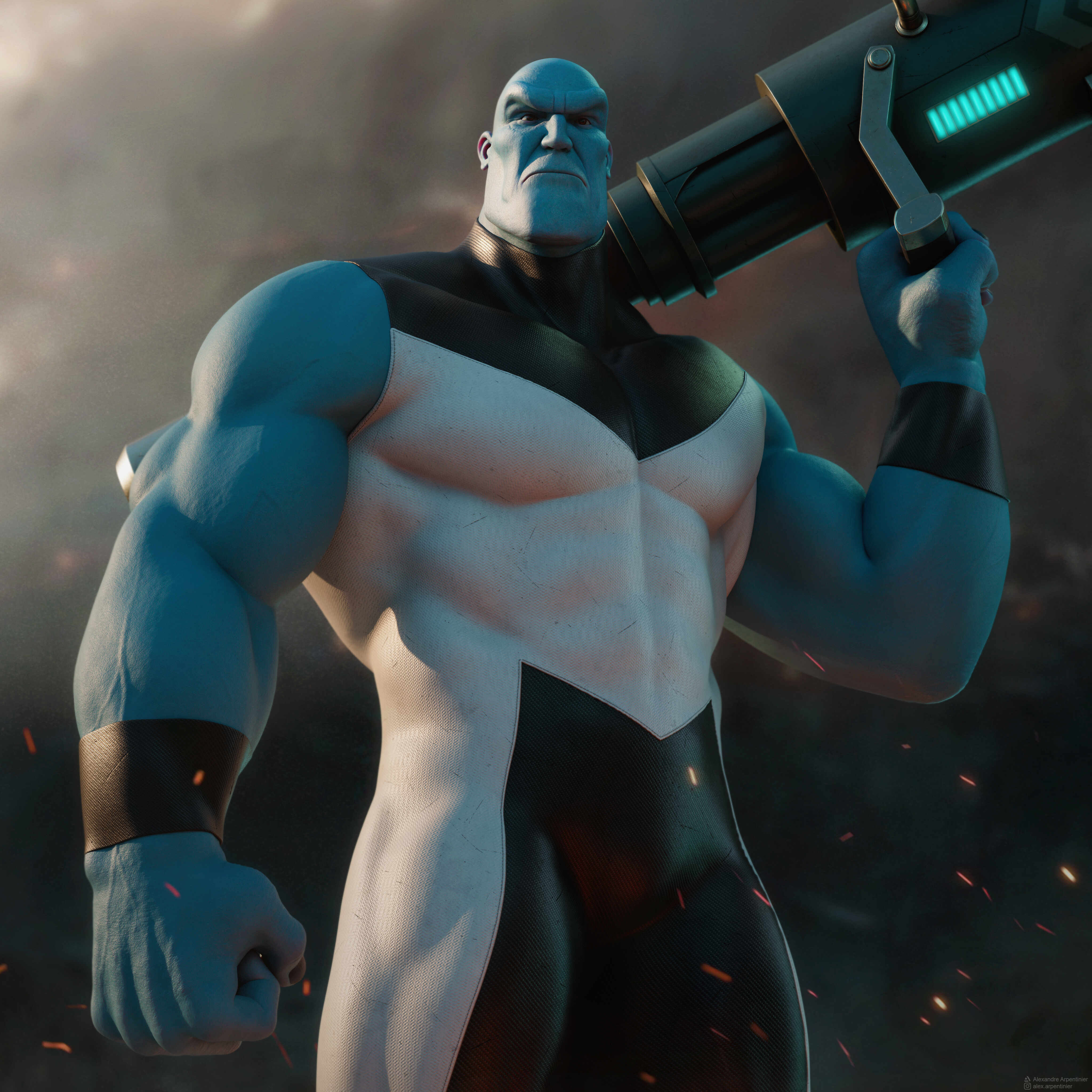
He didn't hesitate. Not for a second. While Mark Grayson spent the better part of two seasons agonizing over the morality of being a superhero, his little brother Oliver basically looked at the problem of recurring villains and decided to solve it permanently. When Oliver kills the Mauler Twins, it isn't just a gore-fest for the sake of shock value; it’s the moment the Invincible series stops being a coming-of-age story and starts being a cold, hard look at utilitarian survival.
If you've been following Robert Kirkman’s epic, you know the Mauler Twins are the ultimate cockroaches of the universe. They’re brilliant, sure. They’re strong, definitely. But mostly, they just keep coming back. Cloning, dying, cloning again—it’s a cycle. Oliver, being half-Thraxan and growing at a rate that would make a toddler look like a slow-learner, viewed that cycle with a level of logic that was honestly terrifying. He didn't see enemies to be redeemed. He saw a math problem.
The Day Oliver Kills the Mauler Twins and Why Logic Trumps Mercy
Let’s set the scene. The Maulers are doing what they always do: raiding a high-tech facility, trying to rebuild their empire, and bickering about who is the original and who is the clone. It’s almost comedic at this point in the story. We’ve seen them lose to the Guardians of the Globe, we’ve seen them lose to Mark, and we’ve seen them lose to their own hubris.
Then Oliver arrives.
He’s young, but in Thraxan years, his mind is already sharpening into something lethal. Mark is there too, trying to play the "good guy" role he learned from his mother and, ironically, the distorted lessons of his father. But Oliver? He hasn't been programmed with Earth’s specific brand of "thou shalt not kill" morality. He looks at these two blue giants and realizes that if they live, people die later. It’s that simple. When Oliver kills the Mauler Twins, he does it with a chilling efficiency that leaves Mark—and the audience—completely rattled.
It wasn't a long, drawn-out battle. It was a execution.
Why the Maulers Couldn't See It Coming
The Maulers are used to "the dance." They expect superheroes to punch them, throw them in a specialized prison, and then wait for them to escape. They have a script. Oliver threw the script in the trash. He used his Viltrumite-level strength to end the threat before the Maulers even realized they weren't fighting the "friendly neighborhood" version of Invincible.
Honestly, the speed of it is what sticks with you. One moment, they’re gloating. The next, they’re gone. This wasn't a heat-of-the-moment accident like when Mark accidentally killed Angstrom Levy (or thought he did). This was a choice. A premeditated, logical decision by a child who aged five years in a few months.
The Nature vs. Nurture Argument in the Grayson House
This moment serves as the ultimate litmus test for Omni-Man’s legacy. Is Oliver a killer because of his Viltrumite blood? Or is he a killer because he’s a Thraxan who lives his entire life in a fraction of a human lifespan, making him value "efficiency" above all else?
- The Viltrumite Side: Nolan taught Mark that life is fleeting and insignificant. Mark rejected it. Oliver, however, hears that and thinks, "If life is fleeting, why waste time letting bad people live?"
- The Thraxan Side: On Thraxas, you live fast. You don't have time for twenty-year prison sentences or rehabilitation programs. You act, you solve, you move on.
Mark’s reaction to the event is pure horror. He sees the shadow of his father in Oliver’s eyes. But if we’re being real, Mark has also seen the body count the Maulers have racked up over the years. This creates a weird tension for the reader. You’re supposed to be on Mark’s side, but a small, pragmatic part of your brain is nodding along with Oliver.
The Fallout: A Family Divided by a Body Count
After Oliver kills the Mauler Twins, the dynamic in the Grayson household shifts. It’s no longer about teaching a kid how to fly; it’s about whether or not Mark is raising a monster. Debbie, who has already dealt with the trauma of Nolan’s betrayal, is forced to watch another "son" embrace the very violence she tried to escape.
It’s messy.
There’s a specific nuance here that many casual fans miss. Oliver isn't "evil" in the traditional sense. He doesn't take pleasure in the killing. He doesn't laugh or taunt. He just finishes the job. In his mind, he’s being the best hero possible because he’s ensuring those specific villains will never hurt a single soul ever again.
Does It Actually Make the World Safer?
This is where the E-E-A-T (Experience, Expertise, Authoritativeness, and Trustworthiness) of the Invincible lore comes into play. If you look at the long-term trajectory of the comics, the death of the Maulers (in this instance) actually creates a power vacuum.
In the superhero genre, we often see the "Joker" problem—the idea that killing the villain just brings out something worse. But in Invincible, the consequences are more grounded. The consequence isn't a new "super-villain"; it’s the psychological erosion of the Grayson family. Mark starts to doubt his own methods. He starts to wonder if he’s being too soft.
- The Maulers represented a "predictable" threat.
- Oliver represents an "unpredictable" solution.
What Most People Get Wrong About Oliver's Decision
Many fans argue that Oliver was just being a "proper Viltrumite." That’s a bit of a surface-level take. If he were just a Viltrumite, he would have killed them because they were weak. Oliver killed them because they were inconveniently persistent.
He actually cares about people. That’s the twist. He kills to save. It’s the ultimate "trolley problem" played out with blue-skinned scientists. He sees the five people on the tracks and the one person on the lever, and he pulls that lever without a moment’s hesitation.
The Gore Factor: Why the Visuals Mattered
In the comic panels, the brutality is stark. Kirkman and artist Ryan Ottley didn't shy away from the visceral reality of what happens when a Viltrumite-level being decides to stop holding back. It’s not "cartoon violence." It’s bone-snapping, life-ending force. This visual choice reinforces the finality of Oliver’s actions. There’s no coming back from what he did.
Comparing Oliver to Other "Kid" Heroes
Think about Robin or any of the young sidekicks in DC or Marvel. They are usually the moral compass or the light-hearted comic relief. Oliver flips that trope on its head. He is the darkest element of the team because he lacks the "human" social conditioning that tells us killing is the absolute last resort. To Oliver, it’s just another tool in the belt.
The Long-Term Impact on Mark’s Morality
You can trace a direct line from the moment Oliver kills the Mauler Twins to Mark’s later, more controversial decisions. Mark eventually realizes that his "no-kill" rule is a luxury he can’t always afford, especially when the fate of the entire planet is on the line. Oliver was the catalyst for that realization.
He was the mirror Mark didn't want to look into.
Seeing his brother’s lack of remorse forced Mark to define his own boundaries. It forced him to ask: "If I don't kill, and people die because of it, is that my fault?" It’s a heavy question for a guy who just wanted to graduate college and date Eve.
Understanding the Brutal Logic of Invincible
If you’re looking to dive deeper into the themes of Invincible, you need to stop looking at it as a standard superhero show. It’s a political and philosophical drama masked by capes and alien invasions. Oliver’s actions aren't just there for a "whoa" moment; they are there to challenge your own ethics.
Next Steps for Fans and Analysts:
- Re-read Issue #52: This is where the ideological rift really starts to widen. Pay attention to the dialogue between Mark and Oliver immediately after the fight. The lack of "battle banter" is telling.
- Track the "Kill Count" Evolution: Watch how Mark’s stance on lethal force changes after this encounter. He becomes more cynical, and his fights become increasingly more desperate and violent.
- Analyze the Thraxan Physiology: Research how the rapid aging of Thraxans affects their brain development. It explains why Oliver can process complex moral dilemmas but lacks the emotional maturity to handle the "weight" of those choices.
- Compare to the Animated Series: As the Amazon Prime show progresses, look for how they seed Oliver's pragmatic nature early on. The show has a habit of making these moments even more impactful through voice acting and pacing.
The reality is that Oliver kills the Mauler Twins because he was the only one in the room willing to do what he thought was necessary. Whether he was right or wrong is something fans will be debating as long as the series exists. It’s not about being a "hero" or a "villain"—it’s about the terrifying efficiency of a child with the power of a god and the logic of a machine.