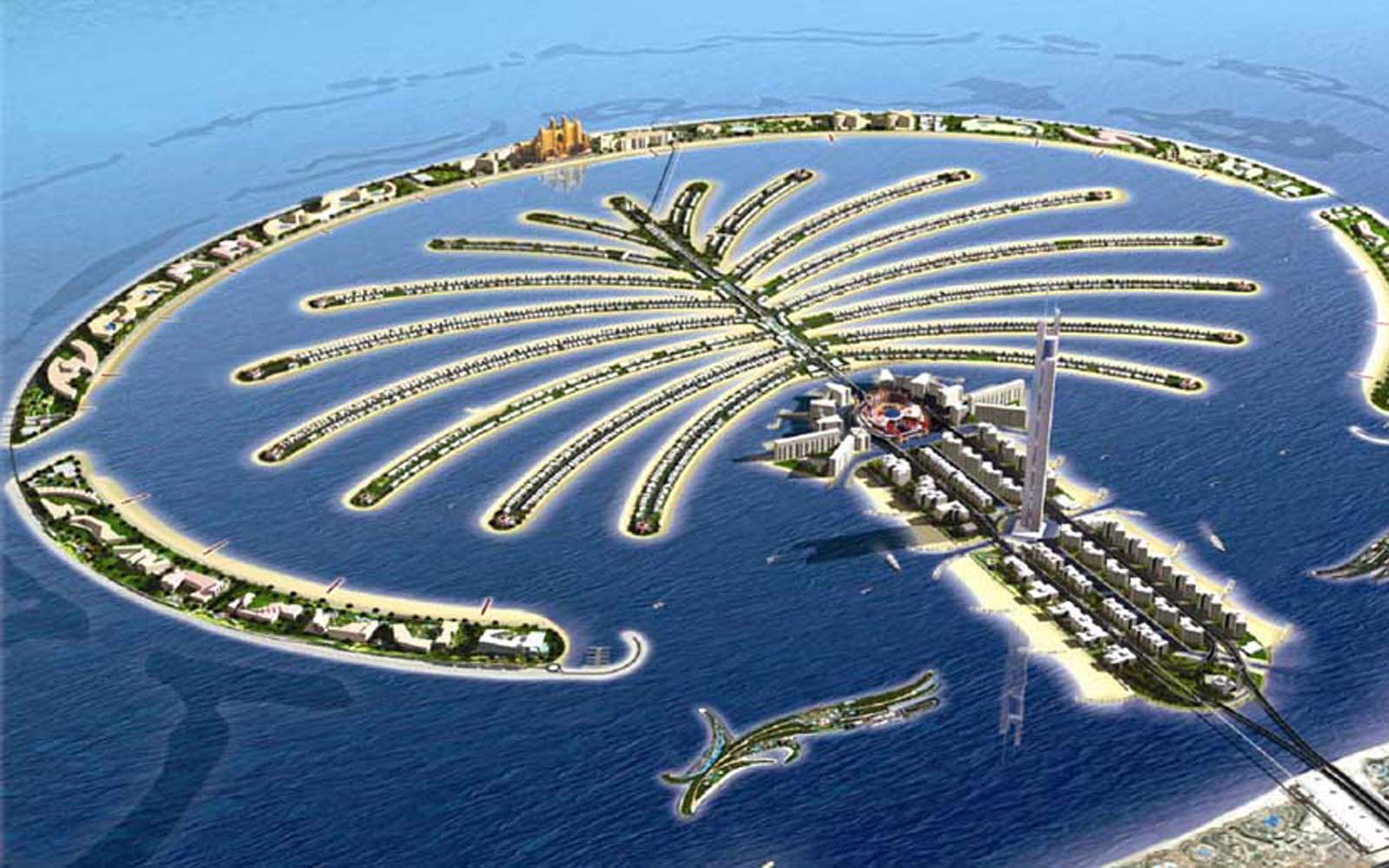
It’s visible from space. Seriously. When people talk about the Dubai palm tree island, they usually mean Palm Jumeirah, that massive, sprawling man-made marvel that looks like a geometric miracle from a helicopter but feels like a high-end suburban labyrinth once you’re actually driving on it. Most folks assume it’s just a playground for the ultra-wealthy—and honestly, it is—but the engineering reality behind those fronds is way more complicated than just dumping sand into the Persian Gulf.
Construction started back in 2001. Imagine the sheer audacity of it. The developers, Nakheel, didn't use concrete or steel for the base; they used 94 million cubic meters of sand and 7 million tons of rock. They had to deal with stagnant water issues, the constant threat of erosion, and the logistical nightmare of building a 1.2-mile bridge just to get people onto the thing.
The Engineering Chaos Behind Palm Jumeirah
You can't just throw sand in the ocean and hope it stays. It doesn't work that way. To keep the Dubai palm tree island from washing away, they built a massive crescent-shaped breakwater. This 11-kilometer long barrier is the only reason the villas on the fronds aren't underwater right now. It’s a literal shield. But that shield created a problem: water circulation.
Initially, the water inside the Palm wasn't moving. It was getting gross. To fix it, engineers had to cut two gaps in the breakwater. This allowed the natural tides to flush the system every few days. It’s a delicate balance of nature and brute-force human will. If you look at the satellite imagery, you can see those gaps—they’re small, but they’re the reason the beaches at the Atlantis aren't murky.
Then there’s the "vibro-compaction" thing. You’ve probably heard of it. Basically, they used massive vibrating probes to settle the sand so it could support skyscrapers without sinking. It sounds like science fiction, but it's the only reason the high-rises on the "trunk" haven't tilted over like the Leaning Tower of Pisa.
Living on a Frond: The Reality
Living on one of the fronds is weird. In a good way, mostly. Each frond is essentially a gated community within a gated community. You have your own private beach, sure, but you also have one way in and one way out. Traffic on the Palm is a real thing. If there's an accident on the main trunk, you’re stuck.
The villas themselves are diverse. Some look like Mediterranean mansions; others are ultra-modern glass cubes. But the "frond life" is mostly about quiet. It's a stark contrast to the chaos of Dubai Marina or Downtown. You trade the ability to walk to a coffee shop for the ability to walk into the ocean from your backyard.
The Dubai palm tree island isn't just one island, though. People forget about Palm Jebel Ali and Palm Deira. Jebel Ali is much larger but sat stagnant for years after the 2008 financial crash. It's finally seeing a massive resurgence as of 2024 and 2025, with new master plans being unleashed. It’s going to be twice the size of Jumeirah. Palm Deira, meanwhile, got rebranded into the Dubai Islands. It's less "palm-shaped" now and more focused on a massive cluster of connected hubs.
What Most People Get Wrong About the Palm
Everyone thinks the Palm is just for tourists staying at the Atlantis. Wrong. It’s a massive residential hub. Thousands of people commute off the island every morning for work. There’s a monorail that runs up the spine, which is great for views but, honestly, a bit impractical for daily commuting since it doesn't connect directly into the main Dubai Metro red line without a bit of a walk.
- The Crescent: This is where the big hotels live. The Atlantis, The Palm is the famous one, but the new Atlantis The Royal is the one everyone is talking about now. It looks like a giant game of Tetris made of marble and glass.
- The Trunk: This is the "downtown" of the island. It’s where you find the Nakheel Mall and high-end apartment complexes like Shoreline and Golden Mile.
- The Fronds: Purely residential. No shops, no cafes, just houses and sand.
One major misconception is that the island is "sinking." While there were some early reports and conspiracy theories about subsidence, the reality is that the island is heavily monitored. Recent geological surveys show the settling is well within the predicted safety margins for man-made landmasses. It’s not going anywhere anytime soon.
The Impact on Marine Life
We have to talk about the environment. Building the Dubai palm tree island definitely disrupted the local seabed. You can't dump that much rock without crushing some reefs. However, the breakwater itself has become a massive artificial reef. It’s now home to schools of fish, rays, and even some small sharks. It’s a weird trade-off where a man-made structure created a new, albeit different, ecosystem.
Navigating the Palm Like a Local
If you’re visiting, don’t just stay at the hotel. Go to The Pointe—wait, actually, The Pointe is undergoing a massive redevelopment right now. Instead, head to West Beach. It’s the place to be for sunset. You can walk along the promenade, grab a drink at one of the beach clubs like February 30 or Sante Ria, and look back at the Dubai Marina skyline. That view is arguably better than the view of the Palm itself.
- The Monorail: Take it once for the photos. Start at the Gateway station and go all the way to the Atlantis. It’s the cheapest "scenic flight" you’ll get in Dubai.
- The Boardwalk: There’s an 11km walkway along the outer crescent. It’s perfect for a morning run if you can handle the heat.
- Dining: Don't skip the restaurants in the Nakheel Mall or the fine dining at the Royal Atlantis. Dinner by Heston Blumenthal is pricey but genuinely mind-blowing.
The Future: Palm Jebel Ali and Beyond
Dubai doesn't stop. The success of the original Dubai palm tree island has paved the way for even crazier projects. Palm Jebel Ali is currently the "next big thing." It’s designed to be more sustainable, with a focus on "smart city" tech and a lot more greenery than the Jumeirah version.
The scale is hard to wrap your head around. Jebel Ali will add over 110 kilometers of coastline to Dubai. That means more hotels, more villas, and more space for the city to grow. If you think Dubai is crowded now, just wait until the "Second Palm" is fully operational.
Actionable Insights for Visitors and Investors
If you're looking at the Dubai palm tree island from a practical standpoint, here is the deal.
For travelers: Book your stay on the Crescent for the resort vibes, but spend your evenings on the Trunk or West Beach for the social scene. Use taxis or ride-shares; the island is much bigger than it looks on a map, and walking from the "base" to the "top" isn't really an option in 40-degree heat.
For investors: The secondary market for villas on the fronds remains one of the most resilient real estate sectors in the world. Even when the rest of the market dips, the "Palm Premium" stays. However, keep an eye on the new developments at Palm Jebel Ali. That’s where the high-growth potential is over the next decade.
The Palm Jumeirah changed the way we think about coastal engineering. It's a monument to "why not?" It's flashy, it's slightly inconvenient to drive on, and it's absolutely iconic. Whether you love the "over-the-top" nature of Dubai or not, you have to respect the sheer scale of the ambition here. It's a piece of the future built on a bed of ancient sand.
Next Steps for Your Trip:
- Check the monorail schedule before you go; it doesn't run as late as the Metro.
- Make dinner reservations at least a week in advance for any spot on West Beach or the Royal Atlantis.
- If you’re driving, use Waze. Google Maps sometimes struggles with the specific "rib" exits on the trunk.