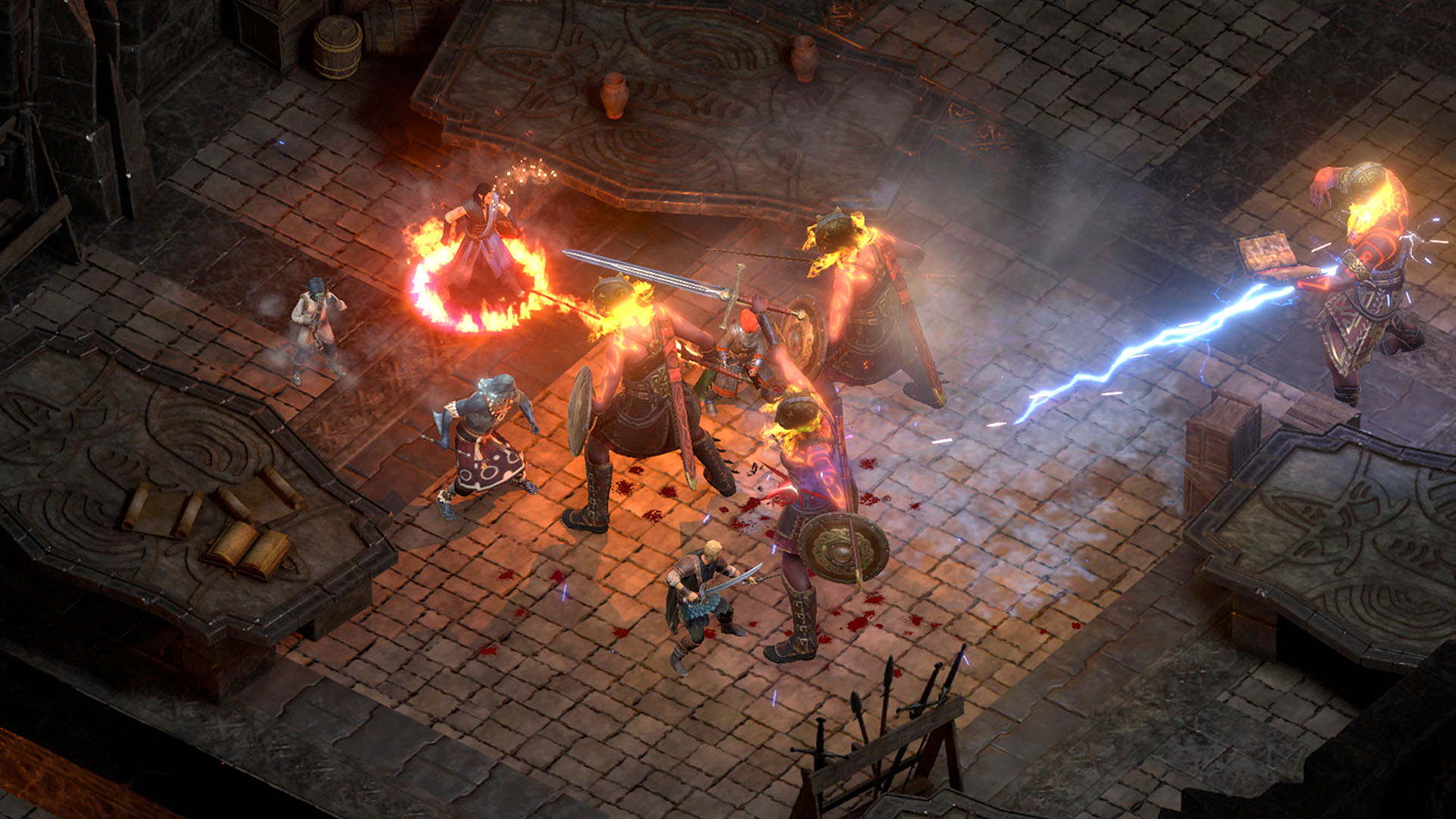
When Obsidian Entertainment dropped the news that Pillars of Eternity II: Deadfire was getting a full-blown turn-based mode months after launch, the CRPG community basically had a collective meltdown. It wasn't just a patch. It was a fundamental rewriting of how the game's engine, the "Versus" system, actually functioned. People often forget that Pillars of Eternity was built from the ground up to be a spiritual successor to Baldur's Gate and Icewind Dale, games that lived and died by Real-Time with Pause (RTwP).
Switching to pillars of eternity turn based mechanics wasn't just a "quality of life" update. It changed the math. Literally.
I've spent hundreds of hours in Eora. I’ve seen how a single initiative roll can make or break a fight against a Titan or a group of Naga. If you're coming from Baldur's Gate 3 or Divinity: Original Sin 2, you might think you know what to expect. You don't. Obsidian didn't just copy Larian’s homework; they tried to shove a square peg into a round hole, and honestly, the results are both brilliant and occasionally frustrating.
The Big Mechanical Shift: From Seconds to Rounds
In the standard RTwP mode, everything happens in "recovery time." You swing a sword, then you wait a few seconds based on your armor weight and Dexterity. It's fluid. It's chaotic. In pillars of eternity turn based play, that fluidity is gone. It's replaced by a strict initiative ladder.
Suddenly, your Dexterity stat—which used to be the most important thing for DPS—becomes a bit of a weird outlier. In turn-based, Dexterity mostly determines when you go in the round, not how often you go. Everyone gets one standard action and one move action. Period.
Why Action Economy is King Now
In the original real-time mode, you could kite enemies. You could micro-manage a rogue to dip in and out of combat every 1.5 seconds. You can't do that here. If you move, you're usually using your move action. If you're surrounded, you’re stuck unless you have a specific "Escape" ability.
This makes positioning infinitely more important. In real-time, if a fighter walks past your wizard, you might notice and pause. In turn-based, if that fighter goes before your wizard and gets into melee range, your wizard is likely getting interrupted or murdered before they even breathe.
The "Swift" Problem: What Happens to Your Stats?
Let's talk about the elephant in the room: Armor. In RTwP, wearing plate armor is a massive trade-off because it slows your attack speed to a crawl. In pillars of eternity turn based mode, that penalty is drastically reduced. Since you're guaranteed one action per round regardless of whether you're wearing a silk robe or a tank-sized suit of steel, why wouldn't you wear the heavy stuff?
Well, initiative.
If you're wearing Plate, you're going last. Every time. This creates a fascinating tactical layer that the original game lacked. Do you want your Priest to go first to buff the party with Blessing of Wael, or do you want them to go last so they can heal the damage taken during the round?
"The shift to turn-based changed the value of almost every item in the game. Speed-proccing weapons like Sungrazer or Sasha’s Singing Scimitar lost their 'per-second' dominance and became tools for specific turn-order manipulation."
It's a different game. It really is.
Free Actions and the Micro-Meta
One of the coolest things Obsidian did was categorize certain spells and abilities as "Free Actions." This is where the real power-gaming happens.
If you're playing a Wizard, you’ll notice that many self-buffs like Spirit Shield or Mirror Image don't end your turn. You can layer yourself in three different magical protections and still lob a fireball in the same breath. In real-time, those buffs would have taken 4-6 seconds to cast, during which you weren't doing damage.
This makes "buff-heavy" classes significantly more powerful in pillars of eternity turn based mode. A Chanter who can swap phrases and drop an invocation without waiting for a recovery bar to fill is a god on the battlefield.
It Isn't Perfect: The "Trash Mob" Fatigue
I have to be honest here. Deadfire was designed with a specific number of "trash" encounters—small fights against 6-8 weak enemies meant to drain your resources. In RTwP, these fights take 30 seconds. You select everyone, click "Attack," and wait.
In turn-based? These fights can take 10 minutes.
Watching eight low-level skeletons take their individual move and attack actions while you just want to get to the next story beat can be exhausting. This is the biggest criticism of the pillars of eternity turn based implementation. The encounter density wasn't adjusted for the slower pace. You have to be okay with a 60-hour game turning into a 100-hour game.
The Problem with "Cast Times"
This is the part that trips up new players. Some big spells have a "casting" period. You start the spell on your turn, but it doesn't actually go off until a later initiative count.
If the enemy moves out of the way before the count hits? You just wasted a high-level spell slot on empty floor. You have to predict where the AI will be. It requires a level of foresight that real-time players never really had to develop because they could just adjust the targeting reticle mid-cast.
Which Mode Should You Actually Choose?
There's no "correct" answer, but there are definitely "better" answers depending on what you like.
If you love the feeling of a chaotic, bloody skirmish where your success depends on quick thinking and "V" (the default pause key), stick to real-time. It’s how the game was originally balanced. The "Action Speed" mechanics feel more rewarding there.
However, if you want to see every single interaction—if you want to know exactly why your Paladin's Flames of Devotion missed or why your Druid's Relentless Storm is stunning everyone—choose pillars of eternity turn based. It brings the underlying tabletop math (which is heavily based on a D100 system) to the forefront. It’s transparent. It’s methodical.
- Go Turn-Based if: You prefer XCOM or Divinity. You like planning every single move. You hate the "bloody mess" of RTwP.
- Go Real-Time if: You're a veteran of Baldur's Gate 1 & 2. You want to finish the game this year. You enjoy the "flow" of combat more than the "math" of combat.
Expert Tips for a Turn-Based Playthrough
If you’re starting a new save today, keep these specific mechanics in mind to avoid getting flattened in the early game (looking at you, Gorecci Street).
1. Focus on Perception over Dexterity
In RTwP, you can miss an attack and just swing again two seconds later. In turn-based, missing an attack means you've done nothing for an entire round. Accuracy is everything. Pump your Perception. A character that hits 100% of the time but goes last is better than a character who goes first and whiffs.
2. Engagement is a Death Sentence
The "Engagement" mechanic means if you're in melee with an enemy and you try to move, they get a free Disengagement Attack. In turn-based, these hits are brutal because they can often trigger "On Hit" effects that mess up your entire turn. Don't move your squishies once they're locked down unless you have an ability that specifically ignores engagement.
3. The Power of "Wait"
There is a "Wait" button. Use it. If you have an AoE spell but your tank hasn't moved into position yet, tell your Wizard to wait until the end of the round. This allows the enemies to cluster around your tank before you drop the hammer.
4. Armor is your friend
Since the recovery penalty is basically non-existent for your action economy, put everyone in at least Medium armor. Even your casters. The extra survivability far outweighs the slightly later initiative.
Actionable Insights for Your Build
Don't just jump in blindly. The pillars of eternity turn based system favors specific multiclass combinations that feel lackluster in real-time.
- The Tactician (Fighter Subclass): This is arguably the strongest subclass for turn-based. You get Brilliant (resource regeneration) whenever you interrupt an enemy or they are flanked. In turn-based, controlling "Flanked" status is much easier.
- The Streetfighter (Rogue Subclass): Usually, being "Bloodied" or "Flanked" is dangerous. But in turn-based, you can precisely control your positioning to ensure you get the massive Recovery speed and Crit damage bonuses without getting instantly deleted.
- Single Class Casters: Because of how "Power Level" scaling works, single-class Wizards or Druids get access to those massive, round-ending spells faster. In turn-based, one Maelstrom or Wilting Wind can end a fight before the second round even starts.
If you are looking to start a run, I highly recommend checking out the "Community Patch" on the Nexus. Even though Obsidian stopped official support, the community has balanced some of the weirder turn-based bugs, especially regarding how certain "per-hit" abilities interact with the round structure.
The most important thing to remember is that you cannot change the combat mode once you start the game. You're locked in. Choose wisely, because Eora is a long road, and how you walk it changes everything.