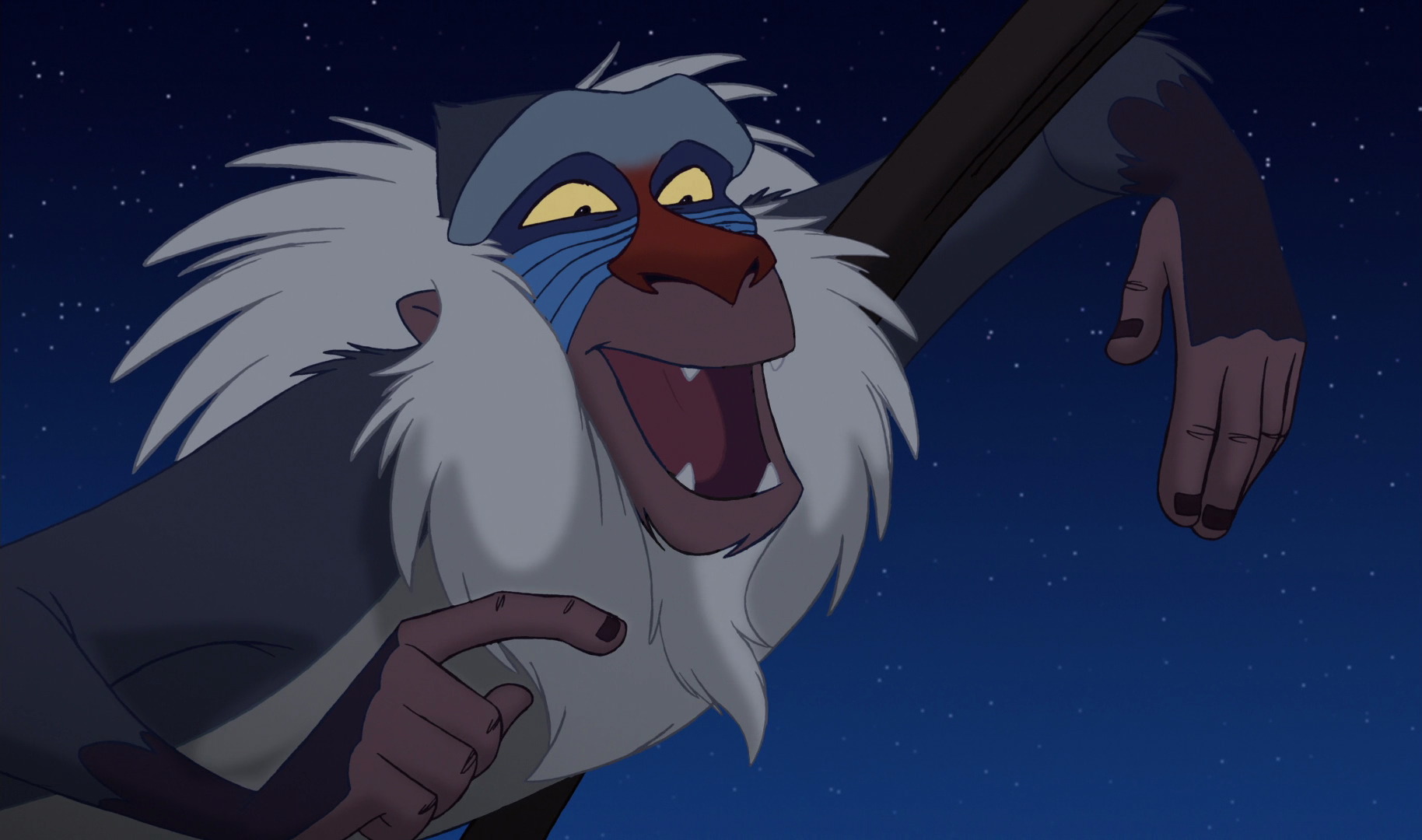
He’s the first character we see. Before the sun even finishes rising over the Pride Lands, there he is—smearing baobab fruit juice across a cub’s forehead and lifting him toward the heavens while Lebo M. screams those iconic opening chants. Everyone calls him the Lion King monkey.
But here’s the thing. He isn't a monkey.
If you grew up in the 90s, you probably just accepted Rafiki as a weird, mystical baboon with a colorful face and a penchant for hitting lions with a stick. Disney’s marketing team didn't help much either, often lumping him into the "monkey" category for the sake of simplicity. Honestly, though? If you look at the biology, the character design, and the actual folklore behind him, Rafiki is one of the most complex—and scientifically confusing—characters in the entire Disney canon.
The Mandrill vs. Baboon Debate
Most people see the blue and red snout and immediately think "Mandrill." You’re right. Sort of.
Mandrills (Mandrillus sphinx) are famous for those vibrant, almost neon facial colors. They are the largest of all monkeys, and they look intimidating because, frankly, they are. But if you watch The Lion King, the characters constantly refer to Rafiki as a "mutant" or a "baboon." Even the song "I Just Can't Wait to Be King" has Zazu looking at the "monkeys" and the "baboons."
Biologically, mandrills and baboons are different. Mandrills live in tropical rainforests. Baboons live in the savanna. Rafiki lives in a giant baobab tree in the middle of a grassy plain, yet he looks like a creature that belongs in the deep, humid jungles of Equatorial Africa.
Why the tail matters (or doesn't)
Here is where it gets weird. True mandrills have very short, stubby tails. They’re basically just little nubs. Rafiki, however, has a long, prehensile-looking tail that he uses for balance and dramatic effect.
This was a deliberate choice by the animators. James Baxter, one of the supervising animators for the 1994 film, has mentioned in various behind-the-scenes features that they wanted Rafiki to have a more "simian" feel. A stubby tail didn't look as good in silhouette. So, they basically frankensteined him. He has the face of a mandrill, the body of a baboon, and the tail of... well, something else entirely. It’s a classic case of "cool factor" over taxonomic accuracy.
The Shaman of the Pride Lands
Beyond the biology, we have to talk about what the Lion King monkey actually does. He isn't just a resident of the Pride Lands; he’s the Mganga. That’s a Swahili term for a traditional healer or medicine man.
In the original scripts, Rafiki was even more eccentric. He was originally envisioned as a wandering hermit who lived in a "tree of life." The filmmakers, including directors Roger Allers and Rob Minkoff, realized they needed a spiritual anchor for Simba. Without Rafiki, Simba is just a runaway living in the jungle eating bugs. Rafiki is the catalyst. He’s the one who forces the confrontation with the past.
Think about that scene in the tall grass. It’s arguably the most important moment in the movie. Simba is moping, and Rafiki starts singing "Asante sana, squash banana."
It sounds like gibberish. It isn't.
It’s an old nursery rhyme in Swahili. Roughly translated, it means "Thank you very much, squash banana, you are a big baboon and I am not." He’s literally trolling Simba. But then he drops the hammer: "The past can hurt. But the way I see it, you can either run from it, or learn from it."
That isn't just a movie line. It’s the core philosophy of the entire franchise.
Real World Mandrills vs. The Screen Version
If you ever see a real mandrill in a zoo or on a safari (though they are notoriously shy), don't expect them to laugh and hand you a piece of fruit. Mandrills are powerhouse primates. They have canines that are longer than a lion's. Seriously.
- Size: A male mandrill can weigh up to 80 pounds.
- Social Structure: They live in "hordes," sometimes numbering in the hundreds.
- Location: You'll find them in Gabon, Cameroon, and Congo.
The Lion King monkey is a solitary figure, which is rare for primates. Most baboons and mandrills are intensely social. Living alone in a baobab tree would make Rafiki a "bachelor" or an outcast in the real world. In the movie, it’s portrayed as wisdom and hermit-like enlightenment.
Why Everyone Misidentifies Him
The confusion persists because "monkey" is used as a catch-all term. In 1994, audiences weren't Googling "what species is Rafiki" on their iPhones during the credits. They just saw a primate.
Interestingly, the 2019 "live-action" (CGI) remake tried to fix some of the biological inconsistencies. The VFX team at MPC (Moving Picture Company) spent thousands of hours studying primate anatomy. They made his fur more realistic, his movements more weighted, and his facial structure more aligned with a real mandrill.
But even with the high-tech polish, they kept the "Rafiki-ness." He still carries that staff. He still performs the ceremony.
The Staff (Bakora)
Let’s talk about that stick. It’s a bakora. In East African culture, a walking stick can be a symbol of age, status, and authority. The gourds hanging from his staff are filled with "medicine" or ritualistic powders. When he cracks Simba over the head with it, it’s a physical manifestation of a "wake-up call."
It’s also a great tool for combat. We see him go full martial arts on the hyenas during the final battle. Animators actually looked at various fighting styles to make his movements look unpredictable and "fluid," which fits the archetype of the Wise Fool.
The Cultural Impact of the Pride Lands' Resident Sage
Robert Guillaume, the actor who voiced Rafiki in the original film, is a huge reason why the character stuck. He initially tried a few different accents but eventually landed on the one we know—a rhythmic, high-pitched, slightly gravelly tone that felt both ancient and energetic.
Guillaume once said in an interview that he saw Rafiki as a "tribal elder." That perspective changed how the character was written. He wasn't just comic relief like Timon and Pumbaa. He was the bridge between the physical world and the spirit world (the Great Kings of the Past).
Is He Actually Helpful?
If you look at the events of the film objectively, Rafiki is kind of a chaotic neutral character. He knows Simba is alive for years and doesn't tell Sarabi or the other lionesses. He waits.
Why?
Because he’s waiting for the "signs." He sees the dust and the pollen in the air. He reads the paintings on his tree. He’s a fatalist. He believes things will happen when they are meant to happen. To some, that's wisdom. To others, it's a bit frustrating that he let the Pride Lands turn into a graveyard under Scar's rule before he decided to go find Simba.
Common Misconceptions to Clear Up
- He’s a Baboon: Not quite. He’s a Mandrill/Baboon hybrid with a tail that shouldn't exist.
- He’s "The Monkey": Technically, Mandrills are Old World Monkeys, so "monkey" isn't wrong, but "ape" would be. (He isn't an ape).
- He’s Just for Laughs: He’s actually the most powerful political figure in the Pride Lands, acting as the King's advisor and the religious head of the territory.
How to Spot the Difference in the Wild
If you're ever out in the world and want to sound like a primate expert, remember these three things:
First, look at the face. If it has blue and red ridges, it's a Mandrill. If it’s a long, dog-like snout with dark skin, it’s a Baboon.
Second, look at the butt. Mandrills have brightly colored "rears" (blue and purple) that help them stay together in the dark forest. Baboons have calloused "ischial callosities" (sitting pads).
Third, check the tail. If it’s long and swinging, it’s a monkey. If it’s non-existent, it’s an ape. Rafiki breaks all these rules because he's a cartoon, but it's good to know for your next trivia night.
The Legacy of the Lion King Monkey
Rafiki remains a fan favorite because he represents the "unconventional teacher." He doesn't give Simba a lecture; he hits him with a stick. He doesn't give him a map; he makes him look in a pool of water.
In a world of rigid royalty and strict hierarchies (The Circle of Life), Rafiki is the only one who exists outside the rules. He can mock the King. He can disappear into the trees. He can laugh at tragedy.
What You Should Do Next
If you’re a fan of the character or just curious about the real science, there are a few things you can do to dive deeper.
Take a look at the Jane Goodall Institute archives. While she focused on chimpanzees, the institute has incredible resources on primate behavior that explain why the "solitary" nature of characters like Rafiki is so fascinating to biologists.
Also, go back and watch the "Reflections of Mufasa" scene. This time, don't just watch Simba. Watch Rafiki’s eyes. The animators put an incredible amount of detail into how he reacts to the ghost of the King. He isn't surprised; he’s satisfied.
If you're feeling particularly adventurous, look into Swahili linguistics. Learning the actual meanings behind the names in the movie—Simba (Lion), Nala (Gift), Rafiki (Friend)—changes how you view the dialogue. It’s not just "Disney-speak." It’s a beautifully constructed world rooted in real African language and culture.
Lastly, check out some footage of real Mandrills in the wild. They are stunningly beautiful and terrifyingly powerful. Seeing them in their natural habitat makes you realize just how much "personality" the animators had to work with when they created the most famous monkey in cinema history.