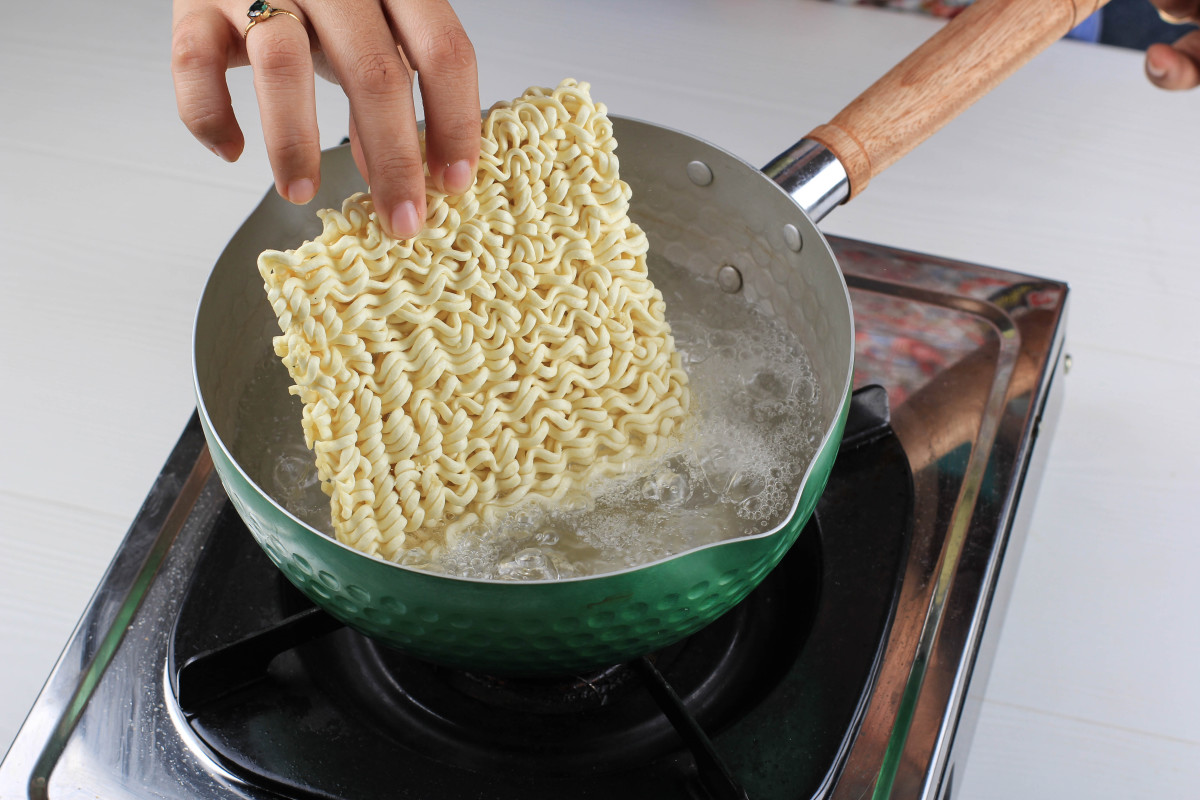
Ever stared at a bowl of instant ramen and wondered how those dry, brittle bricks turn into slippery, chewy strands in just three minutes? Honestly, most of us just eat it and move on. But when you actually put ramen noodles under microscope lenses, the view shifts from "cheap college meal" to a complex, slightly terrifying engineering marvel. It isn't just flour and water. It's a highly processed matrix designed for shelf-life and specific mouthfeel.
What’s wild is how porous the stuff is. Zoom in. You’ll see a landscape that looks more like a dried-out sponge or a lunar surface than food. These tiny holes are the secret. They are the reason hot water can penetrate the core of the noodle so fast. Without those microscopic pores, you’d be boiling that brick for twenty minutes instead of three.
The architecture of a flash-fried noodle
Most instant ramen isn't just dried; it’s deep-fried. This happens at the factory to remove moisture lightning-fast. When the water evaporates during frying, it leaves behind a network of "tunnels." Looking at ramen noodles under microscope setups reveals these voids in high definition.
Researchers like those at the Instant Noodles Resources Center explain that this dehydration process is what creates the "instant" property. The starch granules are essentially frozen in a gelatinized state. When you add water back, it doesn't just wet the surface. It floods those microscopic tunnels. It’s a structural rehydration.
Contrast this with traditional pasta. If you put a piece of dried Italian spaghetti under a 40x or 100x objective, it looks dense. Solid. Glassy. There are no tunnels. That’s why spaghetti takes ten minutes to cook—the water has to slowly hydrate the noodle from the outside in, layer by layer. Ramen cheats the system.
Why does it stay curly?
It's not just for aesthetics. The curls serve a functional purpose on a microscopic level. If the noodles were straight, they would pack together too tightly in the package. Under the microscope, you can see how the waves create air pockets. This prevents the noodles from clumping into a single, doughy mass during the steaming and frying process.
The "crimp" is actually a mechanical stress applied during production. It ensures that every single millimeter of the noodle surface is exposed to the hot oil and, later, your boiling water. If you look at the "bend" of a noodle under magnification, you can sometimes see tiny fractures in the starch. These aren't defects. They are entry points.
The TBHQ and preservative mystery
People get weird about preservatives. You might have heard about TBHQ (tertiary butylhydroquinone). It’s a byproduct of the petroleum industry used to prevent the oxidation of fats. Since instant ramen is fried in oil, that oil can go rancid. TBHQ stops that.
When looking at the surface of ramen noodles under microscope equipment, you aren't going to see "scary chemicals" floating around like little monsters. It's all integrated into the fat layer coating the starch. However, the presence of these preservatives is why ramen lasts for years. It’s also why it behaves differently in the stomach.
What happens inside you: The Gastrography Study
This is where things get a bit famous—and a little controversial. Dr. Braden Kuo of Massachusetts General Hospital once used a pill camera to see what happens after you swallow. This "microscope from the inside" revealed something fascinating.
After two hours, fresh noodles are basically gone. They’ve been broken down by enzymes into a mushy blur. But the instant ramen? It was still mostly intact. The stomach was churning and working hard, but the noodle strands maintained their shape.
- The noodles are highly processed.
- The fat content from frying creates a barrier.
- The structure is remarkably resilient to gastric acid.
Does this mean it's "toxic"? No. It just means your body has to work overtime to extract nutrients from it. It’s a slow-motion digestion process that most other foods don't require.
Starch granules and the "snap"
If you take a raw, dry ramen noodle and snap it, the break is clean. Under a microscope, that break looks like a cliffside. You can see the individual starch granules packed together with wheat protein (gluten).
In high-quality ramen, the gluten network is like a web that holds the starch in place. This is what gives the noodle "spring." Cheap ramen has a weak web. It gets mushy because the starch leaks out into the water. If you’ve ever noticed your ramen water getting cloudy and thick, you’re seeing a structural failure on a microscopic scale. The starch is escaping its protein cage.
Real-world experiment: Try this at home
You don't need a $5,000 lab setup to see some of this. A basic $50 digital microscope or even a powerful macro lens on a smartphone can show you the surface tension and the pore structure.
- Take a dry noodle and look at the surface. It looks like coral.
- Add a drop of room temperature water. Watch how it wicks. It doesn't sit on top; it disappears into the pores.
- Compare a "baked" air-dried ramen (like some premium brands) to a "fried" cheap brand. The fried one will have a much more jagged, cratered surface because the oil "exploded" the water out of the dough.
Salt and the microscopic shine
Ramen is packed with sodium. Sometimes you can see tiny crystalline structures on the surface of the dry noodle. These aren't just flavor crystals; they are often salts like potassium carbonate and sodium carbonate (Kansui).
Kansui is the "secret sauce" of ramen. It’s an alkaline mineral water that interacts with the wheat flour. Under magnification, you can see how it changes the color of the starch from white to a yellowish hue. It also toughens the protein, which is why ramen has that specific "chew" that bread or pasta lacks.
What to do with this information
Knowing that ramen noodles under microscope reveal a porous, oil-coated, and slowly-digesting structure should change how you eat them. It’s not about fear; it’s about better preparation.
First, if you're worried about the oil and preservatives, "double-boil" your noodles. Boil them once for a minute, toss that water (which is now full of the surface oils and extra starch), and finish them in fresh water or broth. You lose some flavor, but you strip away a lot of the microscopic debris and excess fats.
Second, understand the "Fullness Factor." Because these noodles take longer to break down in your gut, they can lead to a "blood sugar spike and crash" cycle that feels different than a steak or a salad. Pairing them with a heavy dose of fiber—like bok choy or frozen peas—helps balance the slow digestion of the noodle with the transit time of the fiber.
Finally, pay attention to the texture. If a noodle looks too smooth under a lens, it’s likely air-dried. These are generally "healthier" as they haven't been through the flash-fry tunnels, but they will never have that specific, sponge-like ability to soak up a spicy broth quite like the traditional fried brick.
Next time you're waiting those three minutes for the "cook," remember that you're watching a microscopic hydration event. Thousands of tiny tunnels are filling up with water, expanding the starch granules, and turning a shelf-stable engineering project into dinner.