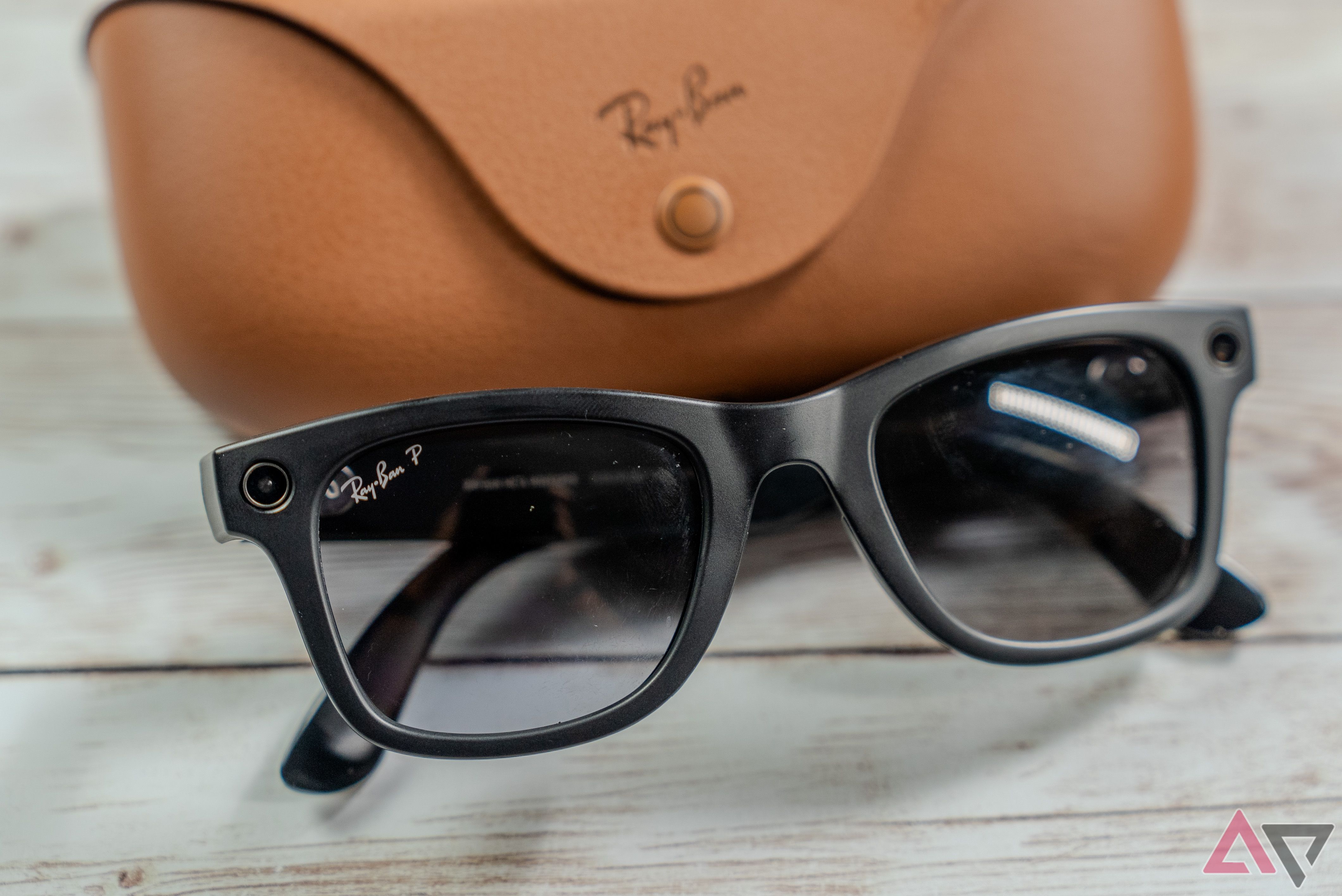
I was walking through a crowded terminal at LAX last month when I saw a guy tapping the side of his Wayfarers. He wasn't adjusting them. A tiny white LED flickered on the frame, and just like that, he was filming the boarding queue. It’s weird, right? We’ve spent a decade mocking Google Glass for being too "cyborg," but somehow, the Ray-Ban glasses that record—officially the Ray-Ban Meta smart glasses—have actually become cool.
They don't look like tech. They look like the glasses your cool uncle wears, except these ones have a 12MP camera tucked into the hinge and five microphones hidden in the frame.
The Reality of the Ray-Ban Meta Specs
Honestly, most people get the hardware wrong. They think it's just a camera strapped to your face. It's more of a wearable computer that happens to protect you from UV rays.
Meta (formerly Facebook) teamed up with EssilorLuxottica to fix the "glasshole" problem. They succeeded. The current generation—launched in late 2023 and updated throughout 2024 and 2025—features the Qualcomm Snapdragon AR1 Gen 1 Platform. That’s a fancy way of saying these things process images fast enough to livestream directly to Instagram.
The 12MP ultra-wide camera is the star. It captures 1080p video. It’s snappy. It's sharp. But there is a catch. You can only record clips up to 60 seconds long by default, though you can stretch that if you’re livestreaming.
Why? Battery life. If you recorded 4K video constantly, the temples would probably melt against your head.
Sound, Privacy, and the Creep Factor
The audio is surprisingly beefy. They use custom-built speakers in the temples that direct sound into your ears while minimizing "leakage" to people standing near you. You can listen to a podcast while buying groceries and the cashier won't hear a thing unless you have the volume cranked to 100%.
Privacy is the elephant in the room. Always. Meta included a "capture LED" that shines bright white when you’re recording. If you try to tape over it or paint it black, the glasses sense the obstruction and won't let you record. It’s a hard-coded safety feature. Is it enough? Some privacy advocates, like those at the Electronic Frontier Foundation (EFF), have pointed out that in bright sunlight or a busy crowd, a tiny white light is easy to miss.
Socially, we’re still figuring this out. Wearing Ray-Ban glasses that record in a public park is one thing; wearing them in a gym locker room or a doctor’s office is a fast way to get kicked out.
What Most Reviews Miss: The AI Integration
The 2024 and 2025 firmware updates changed everything. It’s no longer just about the camera. Meta AI with "Look and Learn" capability allows the glasses to see what you see.
Imagine you're in Paris. You look at a menu. You ask, "Hey Meta, translate this for me." The glasses "see" the French text through the camera lens, process it via the cloud, and whisper the English translation into your ear. It feels like living in the future.
Or maybe you're a home cook. You hold up a bunch of kale and a lemon and ask for a recipe idea. The AI analyzes the ingredients and gives you a step-by-step guide. It’s not perfect—it occasionally hallucinates or misidentifies a specific type of heirloom tomato—but it’s getting scary-good.
Battery and Charging Reality
Don't expect these to last all day if you're a power user.
- Pure Standby: About 4 hours.
- Continuous Use: Maybe 1.5 to 2 hours of mixed music and photos.
- The Case: The charging case is the savior. It looks like a classic Ray-Ban leather case but holds about eight extra charges.
If you're hiking, you'll be popping these in and out of the case constantly. It’s a bit of a dance.
The Real-World Competitors
Are there others? Sure.
The Snap Spectacles exist, but they are bulky and aimed more at developers.
Amazon Echo Frames have no camera—they are audio only.
Xreal Air 2 glasses are for AR displays, not really for recording your life.
Ray-Ban Meta owns this niche because they understood that nobody wants to wear a computer on their face unless it looks good. Style over specs. That was the winning formula.
The Problem With Meta's Data Policy
We have to talk about the data. When you use the Ray-Ban glasses that record, you aren't just giving Meta your photos. You’re potentially giving them a first-person view of your life to train their AI models. Meta has been relatively transparent that images used for "Look and Learn" (the AI features) can be used to improve their services, though you can opt out of some data sharing in the View app.
Still, it's Meta. If you’re someone who deleted Facebook in 2018 for privacy reasons, these glasses are your nightmare.
Actionable Steps for Potential Buyers
Before you drop $300 to $450 on a pair of recording glasses, you need a game plan.
- Check Your Prescription: You can get these with RX lenses. Don't buy the "Plano" (non-prescription) version and hope to swap the lenses later at a cheap shop; the frames are packed with delicate flex cables that easy-break during lens popping. Go through an authorized dealer like LensCrafters.
- Choose the Large Frame: Unless you have a very small face, the "Large" size is generally more comfortable for long-term wear because the electronics make the temples stiffer than standard Wayfarers.
- Download the Meta View App First: Check if your phone is compatible. Older Android phones sometimes struggle with the high-bandwidth Bluetooth/Wi-Fi handoff required to move videos from the glasses to the phone.
- Learn the "Single Tap" vs "Long Press": Practice the controls before you go out. There is nothing more awkward than accidentally starting a livestream when you just wanted to take a photo of your lunch.
- Respect the Light: Don't be "that person." If you're in a private setting, fold them up or take them off. The "recording" light is a social contract, not just a hardware feature.
The tech is finally here, and it's surprisingly functional. Just remember that once you put them on, you're essentially a walking GoPro. Use that power wisely.