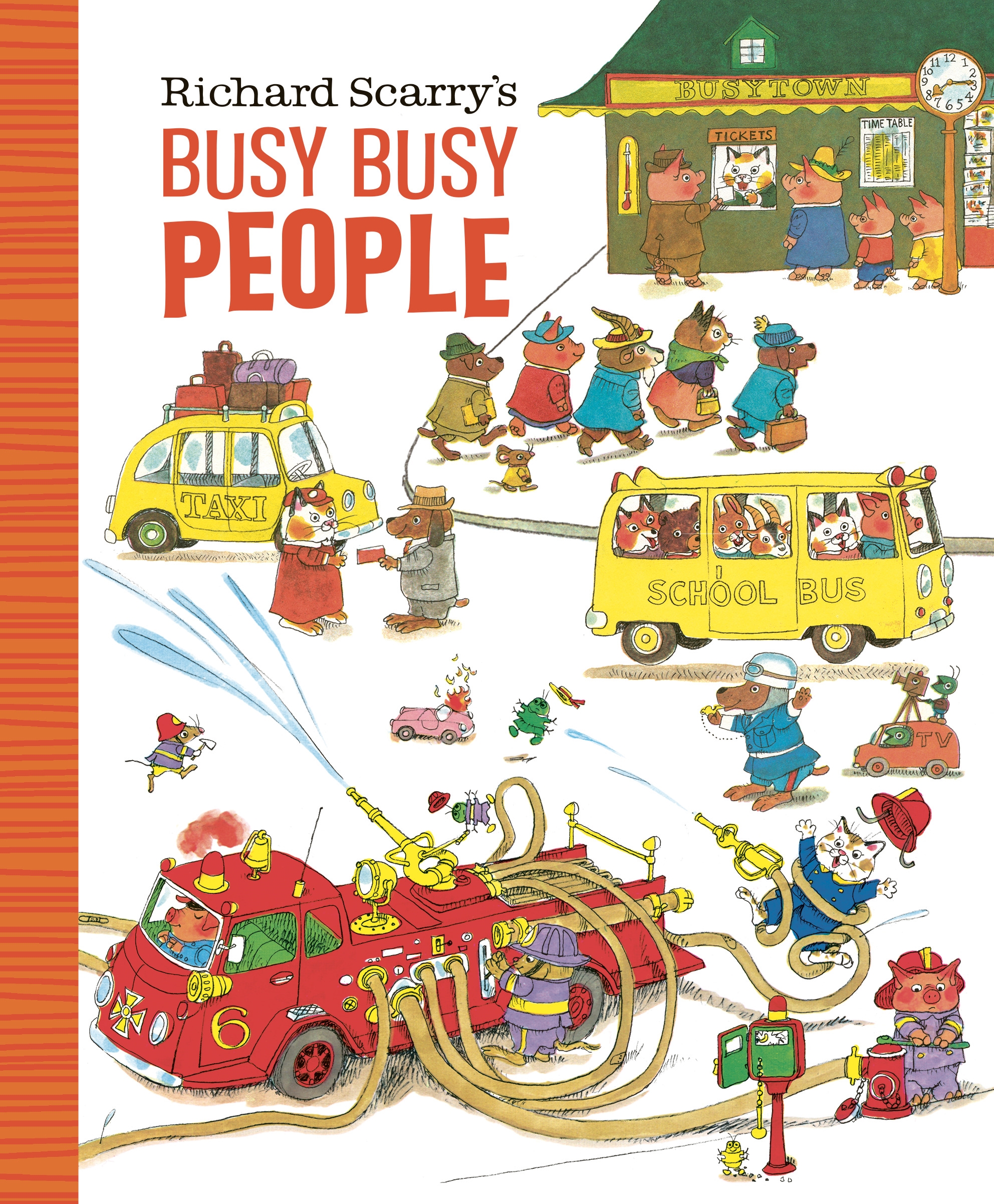
Ever stared at a drawing of a worm in a single shoe driving an apple and felt a strange sense of peace? You aren’t alone. For over sixty years, the work of Richard Scarry has been the unofficial blueprint for how a society is supposed to function. While we’re out here dealing with broken apps and confusing taxes, the residents of Busytown are just... working. They’re busy. And honestly, richard scarry busy people might be the most enduringly honest look at adulthood ever put on paper.
It’s easy to dismiss these books as just "toddler stuff." But look closer. Scarry didn’t just draw cute animals; he drew the intricate, messy, and deeply satisfying interconnectedness of a community. When a pig builds a house, he needs the cement mixer. The cement mixer needs a driver. The driver needs a sandwich from the baker. It’s a giant, chaotic circle of life that makes perfect sense to a four-year-old and feels like a lost utopia to a thirty-four-year-old.
The Secret Life of Busytown
Busytown is basically a high-functioning commune where everyone has a very specific job. There's Sergeant Murphy on his motorcycle, keeping the peace with a whistle and a smile. There’s Doctor Lion, who seems to handle everything from stubbed toes to mysterious ailments without once mentioning insurance premiums.
Richard Scarry had this weirdly brilliant ability to take complex systems—like how a post office works or how a road is paved—and strip them down to their most joyful parts. He didn't just show a finished product. He showed the process. In his 1968 masterpiece What Do People Do All Day?, he walks kids through the entire lifecycle of a loaf of bread. You see the wheat being harvested, the flour being milled, and the baker (usually a very focused-looking pig) finally pulling the loaf out of the oven.
It’s tactile. It’s messy. It’s busy.
Why Lowly Worm is the GOAT
You can’t talk about richard scarry busy people without talking about Lowly Worm. He is the ultimate enigma. Is he a pet? A friend? A civil engineer? Nobody knows, and nobody cares. Lowly is just there, usually wearing his iconic green Tyrolean hat and a single sneaker.
He’s the ultimate observer. In a world of frantic activity, Lowly is the guy who fits in anywhere. He’s the passenger in the pickle car. He’s the one hanging out on the edge of the construction site. For kids, he’s a focal point—a "Where’s Waldo" before Waldo was even a thing. Searching for Lowly (or Goldbug, if you’re reading Cars and Trucks and Things That Go) is a rite of passage. It teaches kids to look at the details, not just the big picture.
The Evolution of Busytown Roles
Scarry’s work hasn’t stayed frozen in 1963. Interestingly, his books have been edited over the years to reflect a more modern world. In the original versions of his "busy" books, gender roles were pretty rigid. Moms stayed home; dads went to the office or the farm.
By the 1980s and 90s, the illustrations were updated. You started seeing more female characters in professional roles—doctors, pilots, and business owners. It was a subtle shift, but a necessary one. The core remains the same, though: everyone has a part to play. Whether you’re a bear driving a steamroller or a cat running a household, your work matters. This sense of purpose is what makes these characters so magnetic.
Common Characters and Their Occupations
- Huckle Cat: The every-kid, usually learning the ropes.
- Sergeant Murphy: The dog who keeps the traffic flowing.
- Mr. Frumble: The bumbling pig whose hat is always flying off.
- Bananas Gorilla: The fruit-obsessed chaotic neutral of the universe.
- Able Baker Charlie: The pig who makes sure everyone stays fed.
The Psychology of "Look Books"
Child development experts often point to Scarry’s "busy" style as a massive win for early literacy. These aren't just stories; they're "look books." Because the pages are so jam-packed with labels—hammer, saw, truck, bread, whistle—kids start to associate the written word with the object immediately.
There’s also the slapstick. Scarry was the king of the "gentle disaster." A car might crash into a giant cake, or a steamroller might flatten a hat, but nobody ever gets truly hurt. It’s a safe way for kids to explore the idea of things going wrong. It’s "busy" in the sense that life is full of small accidents and quick fixes.
Real-World Impact: More Than Just Paper
The influence of these richard scarry busy people extends way beyond the bookshelf. We’ve seen:
- TV Adaptations: The Busy World of Richard Scarry (1994) brought the town to life with a catchy theme song that still haunts parents today.
- Educational Videos: Best Busy People Video Ever! was a staple of the VHS era, teaching kids that "you can be anything you want to be."
- Modern Memes: Adult fans now use Busytown imagery to satirize modern labor—the irony of a pig in a suit is not lost on the "quiet quitting" generation.
Scarry himself was a bit of a workhorse. Born in 1919, he spent his life drawing at a small desk, often in Switzerland, creating thousands of illustrations. He once said he didn't write his stories; he drew them. That visual-first approach is why a kid in Japan, a kid in Germany, and a kid in the US can all look at the same page and understand exactly what’s happening.
Putting Busytown Into Practice
If you're a parent or just a fan of the aesthetic, there’s a lot to take away from Scarry’s philosophy. It’s about celebrating the mundane. We often ignore the "busy people" in our own lives—the trash collectors, the road crews, the grocery clerks.
Next time you’re out with a kid, try "Busytown-ing" your walk. Point out the person fixing the power line. Look at the delivery truck and wonder where the packages came from. It turns a boring errand into a narrative. It makes the world feel like a place where things fit together.
Actionable Insight for Parents:
Don’t just read the words on the page. Ask your child to find the character who looks "surprised" or the character who is "helping." Scarry’s books are designed for dialogue, not just passive listening. Use them to build vocabulary by focusing on the "invisible" jobs, like the person who paints the lines on the road or the mechanic fixing the "pencil car."
Ultimately, Busytown isn't just a fictional place. It's a reminder that everyone is doing something, and in the grand scheme of things, every little job is what keeps the world from spinning off its axles.