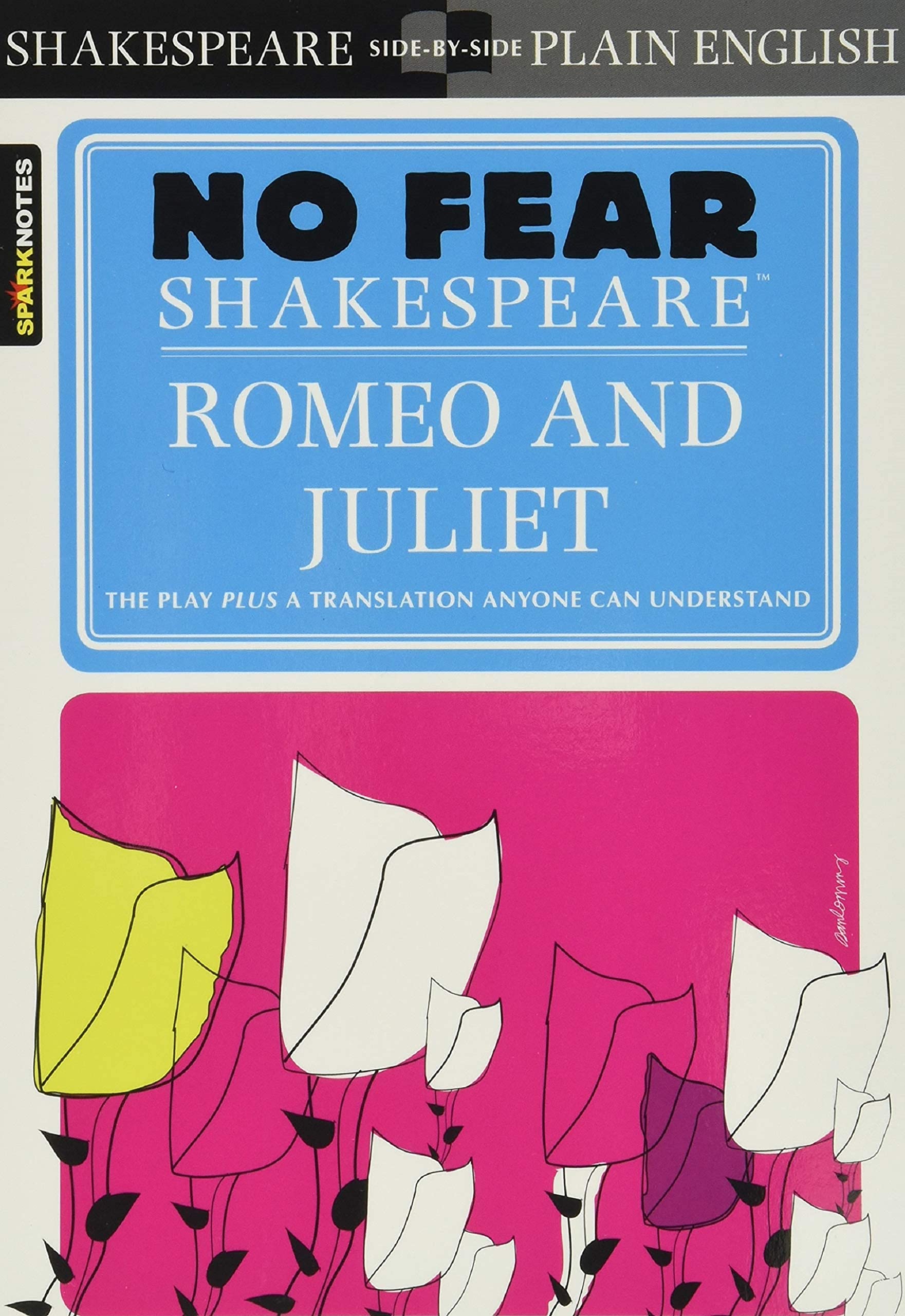
Let’s be honest. Nobody actually speaks Early Modern English when they’re ordering a coffee or arguing with their parents. Shakespeare was a genius, sure, but reading The Tragedy of Romeo and Juliet in its original form can feel like trying to solve a Rubik's Cube in a dark room. You’re squinting at words like "wherefore" and "cozen" while your brain slowly melts. That’s exactly why Romeo and Juliet No Fear became such a massive deal. It’s not just a "cheating" tool for students who forgot they had a test. It’s a bridge.
The SparkNotes No Fear series basically saved the sanity of millions. By putting the original 1590s text on the left and a plain-English translation on the right, it stripped away the elitism. You see what Shakespeare wrote, and then you see what he actually meant. It turns out he wasn't always being "poetic"—half the time he was making dirty jokes or describing a teenager having a literal temper tantrum.
What Romeo and Juliet No Fear Actually Does for Your Brain
Most people think reading a translation is "lazy." It isn't. When you use Romeo and Juliet No Fear, you’re actually engaging in a form of comparative linguistics. You’re looking at how language evolves. It's fascinating. You see a line like "Give me my long sword, ho!" and the modern side explains that Lord Capulet is basically calling for his weapon while his wife rolls her eyes at his mid-life crisis.
The real magic happens in the nuance. In Act 2, when Juliet says "Wherefore art thou Romeo?", every middle schooler thinks she’s asking where he is. She isn’t. "Wherefore" means why. She’s asking why the guy she likes has to be a Montague. If you didn’t have that modern side-by-side, you’d spend the whole scene wondering why she’s looking for him when he’s standing right under her balcony.
The translation doesn't just swap words; it contextually translates the vibe. Shakespeare wrote for the masses—the "groundlings" who stood in the dirt and threw cabbage if they were bored. He didn't write for professors in tweed jackets. The No Fear version restores that accessibility. It makes the stakes feel real. You realize Romeo isn't just a "star-crossed lover"; he’s a guy who was obsessed with a girl named Rosaline ten minutes before he met Juliet. He’s impulsive. He’s kind of a mess.
The "Dumbed Down" Myth and Why It's Wrong
There is a weird snobbery around Shakespeare. Critics often claim that tools like Romeo and Juliet No Fear ruin the "poetry." They argue that if you aren't struggling through the iambic pentameter, you aren't really experiencing the art.
That’s nonsense.
Look at it this way: if you go to an opera in Italian, you appreciate the music, but you’re probably looking at the subtitles to understand why the soprano is crying. No Fear is the subtitles. By removing the barrier of "What does this word even mean?", you actually have more brainpower left over to think about the themes. You can focus on the toxic masculinity of the Tybalt vs. Mercutio feud. You can analyze the absolute failure of the adult figures, like Friar Lawrence, who comes up with the worst plan in the history of plans.
Specific experts in education, like those at the Folger Shakespeare Library, have often noted that the goal of teaching these plays is engagement, not gatekeeping. If a student understands the plot, they are more likely to appreciate the wordplay later. Without the modern translation, many people just give up. They close the book and decide they hate "classics." That’s a tragedy far worse than anything that happened in the Capulet tomb.
Understanding the Infamous Act 3 Scene 1
This is the turning point. This is where everything goes south. In Romeo and Juliet No Fear, the confrontation between Mercutio, Tybalt, and Romeo is laid bare. Mercutio is joking—until he isn't.
The original text uses "consort" as a pun. Tybalt means "hang out with," but Mercutio pretends he means "a group of musicians." It’s a tense, weirdly funny moment that leads to a double murder. The No Fear version clarifies the escalating tension. It shows how a series of small misunderstandings and bruised egos leads to a "plague o' both your houses."
- Mercutio's Death: The translation makes his bitterness clear. He isn't dying a hero; he’s dying because of a feud he had nothing to do with.
- Romeo’s Rage: When Romeo kills Tybalt, the modern English emphasizes his total loss of control. He knows he’s "fortune's fool."
Without the clear translation, the rapid-fire dialogue in this scene can get lost. You might miss the fact that Mercutio is actually making fun of Romeo's new "soft" personality right before he gets stabbed.
Why "No Fear" is Better Than a Movie
Movies are great. Baz Luhrmann’s 1996 version is a fever dream of neon and handguns. The 1968 Zeffirelli version is a classic. But movies cut things. They cut a lot.
When you read Romeo and Juliet No Fear, you get the full, unedited script. You get the scenes with the servants that movies almost always skip. These scenes are actually important because they show that the "ancient grudge" between the families isn't just for the nobles. It has infected the entire city of Verona. Even the guys who work in the kitchen are ready to kill each other over a name.
Reading the text—even with the help of a translation—forces you to build the world in your own head. You decide what the balcony looks like. You decide how loud the Nurse is shouting. It’s an active experience rather than a passive one.
Common Misconceptions Solved by Plain English
People get so much wrong about this play. Seriously.
- It’s not a romance. Not really. It’s a tragedy about how hate ruins everything. Romeo and Juliet No Fear makes the aggression of the play much more obvious. The romance is just the collateral damage.
- Juliet isn't passive. In the original language, her strength can be masked by flowery metaphors. The modern side shows she’s actually the one making the plans. She’s the one who proposes marriage. She’s way more mature than Romeo.
- The ending wasn't "meant" to be. A lot of people think it was fate. But if you read the No Fear version closely, you see a dozen different moments where a single letter arriving on time or a person waking up five minutes earlier would have saved everyone. It’s not fate; it’s bad luck and bad timing.
How to Use No Fear Without Losing the Spark
If you want to actually get good at Shakespeare, don't just read the right-hand side of the page. That's the trap.
Read the modern English first to get the "gist." Once you know what’s happening, go back and read the original text out loud. You’ll start to hear the rhythm. You’ll notice how Shakespeare uses certain sounds to create a mood. You’ll see that he’s using "light" and "dark" imagery constantly—Juliet is the sun, but they can only meet at night; they want the day to end, but the day brings the reality of their deaths.
Using Romeo and Juliet No Fear as a training wheel is the smartest way to learn. Eventually, you won't need the right-hand side as much. You'll start to recognize the patterns. It's like learning a new language by watching a movie with subtitles—eventually, you start understanding the words without looking down.
Actionable Steps for Mastering the Play
If you’re staring at a copy of the play right now and feeling overwhelmed, here is how you handle it.
First, stop trying to read it like a novel. It’s a play. It was meant to be heard and seen. If you can, find a high-quality audio recording and follow along with your No Fear book. Hearing the emotion in the actors' voices while seeing the translation helps the "old" words stick in your brain.
Second, track the timeline. One of the most shocking things you'll realize when reading the clear English version is that the entire story takes place over about four days. Sunday to Thursday. That’s it. They meet, marry, and die in less time than it takes to finish a work week. This realization changes how you view their "love." It’s a whirlwind, a literal fever dream.
Third, focus on the insults. Shakespeare was the king of the burn. Using the No Fear guide, highlight the creative ways the characters insult each other. It makes the reading process way more entertaining and shows you a side of the "Bard" that isn't just about flowers and hearts.
Finally, look at the secondary characters. Everyone focuses on the leads, but the Nurse and Mercutio are the heart of the play. Their dialogue is often the most difficult because it’s full of slang and 16th-century pop culture references. The No Fear translation is essential here to understand their jokes and their motivations.
Shakespeare shouldn't be a chore. It shouldn't be something you suffer through just to say you did it. Using a tool like Romeo and Juliet No Fear allows you to actually enjoy the story for what it is: a violent, fast-paced, heartbreaking, and occasionally hilarious look at what happens when humans let their emotions run wild. Get the modern version, keep the original next to it, and actually see why people are still talking about these two kids 400 years later.