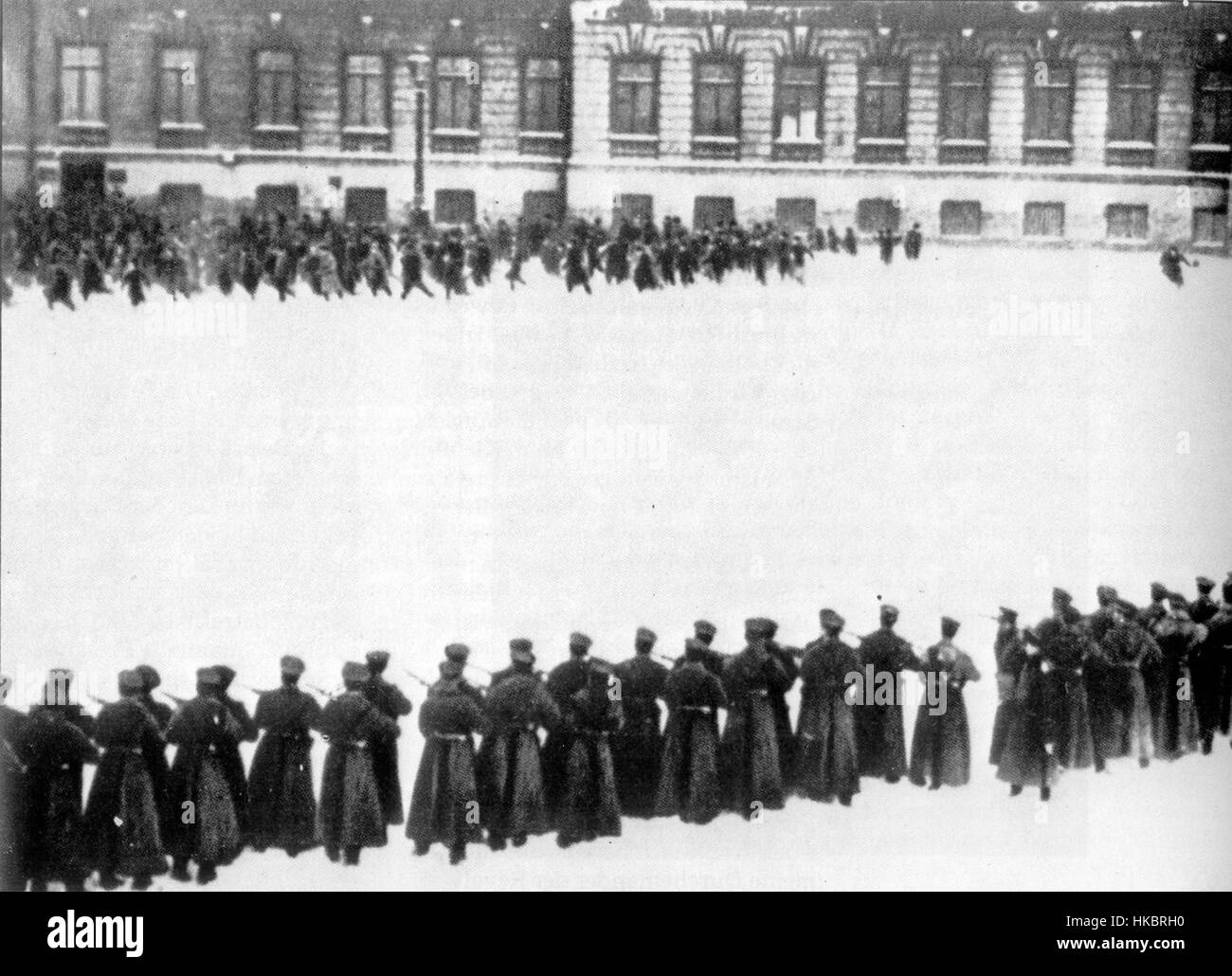
It was freezing. Imagine standing in the snow outside the Winter Palace in St. Petersburg, holding a religious icon or a portrait of the Tsar, honestly believing that if you could just talk to him, everything would change. That was the vibe on January 22, 1905. People weren't there to start a fight. They were hungry. They were tired of working 11-hour shifts in miserable factories. They just wanted a break. Instead, they got a massacre. Russia Bloody Sunday 1905 wasn't just a protest gone wrong; it was the exact moment the Romanov dynasty lost its soul.
History books often make it sound like a dry series of political moves, but it was incredibly messy. You had Father Gapon, this charismatic but slightly suspicious priest, leading a massive crowd of workers. They had a petition. It wasn't even that radical by modern standards—they wanted an eight-hour workday and a bit more money to buy bread. But Tsar Nicholas II wasn't even home. He was out at Tsarskoye Selo, and the military commanders on the ground had no idea how to handle a crowd that wouldn't leave. So, they fired.
The Man Behind the Petition: Father Georgy Gapon
Gapon is a fascinating figure because he sort of lived in the gray area between a genuine labor leader and a police informant. He ran the Assembly of Russian Factory and Mill Workers of St. Petersburg. Some historians, like Orlando Figes in A People's Tragedy, point out that the secret police actually supported Gapon’s union at first. They thought it would keep workers away from "real" revolutionaries like the Bolsheviks.
It backfired.
Gapon’s followers grew too fast. By early January, a strike at the Putilov ironworks had spiraled out of control. Gapon realized he had to lead or get out of the way. He drafted a petition that sounded more like a prayer than a political document. It used phrases like "We, the workers and inhabitants of the city of St. Petersburg... have come to Thee, Sire, to seek justice and protection." It was respectful. It was desperate. It was also a death warrant for the old Russian way of life.
What Actually Happened on the Streets
The morning was eerie. Thousands of people streamed toward the city center from different districts. They brought their kids. They wore their Sunday best. They really thought the Tsar was their "Little Father" who would protect them from the "bad" bureaucrats.
Then the shooting started.
At the Narva Gate and the Troitsky Bridge, the infantry opened fire. It wasn't just a few warning shots. They used live ammunition on unarmed civilians. Chaos broke out. People were trampled. The snow turned bright red. Estimates of the dead vary wildly because the government tried to downplay it. Official records said around 130 people died, but anti-government sources claimed it was closer to 1,000 or more. Honestly, the exact number almost didn't matter as much as the psychological impact. The "Little Father" had just murdered his children.
The Myth of the "Accidental" Massacre
Some people try to defend Nicholas II by saying he wasn't there. That’s true. He wasn't the one who gave the order to shoot. But as the absolute ruler of the Russian Empire, the buck stopped with him. By failing to show up or provide a peaceful way for people to voice their grievances, he created a vacuum filled by panicked soldiers.
- The military was exhausted and paranoid.
- The Russo-Japanese War was already going terribly.
- Communication between the palace and the city guard was a total disaster.
Basically, the regime was brittle. When you have an autocracy that refuses to bend, it eventually snaps. Russia Bloody Sunday 1905 was the snap.
Why 1905 Wasn't a "Real" Revolution (Yet)
A lot of people confuse the 1905 Revolution with the 1917 one. They're related, but different. 1905 was a dress rehearsal. After the massacre, the whole country went nuts. Strikes broke out everywhere. Sailors on the battleship Potemkin mutinied. For a second there, it looked like the monarchy was done.
But Nicholas II managed to buy himself more time. He issued the October Manifesto, which promised a Duma (a parliament) and basic civil liberties. It was a classic "too little, too late" move, but it worked to split the opposition. The liberals were happy enough with the promises, while the radicals like Lenin felt betrayed. This internal fighting allowed the Tsar to stay in power for another 12 years.
However, the damage was permanent. Before 1905, the average Russian peasant or worker might have been poor, but they generally respected the Tsar. After the massacre, that respect evaporated. You can’t shoot your way back into the hearts of your people.
The Economic Reality No One Mentions
We talk a lot about the "blood" and the "politics," but let's get real about the money. Russia was trying to industrialize at breakneck speed. Finance Minister Sergei Witte was squeezing the peasantry to pay for railroads and factories. People were living in cramped, disease-ridden barracks.
If you look at the work of historian Sheila Fitzpatrick, she emphasizes that the social friction in these new industrial cities was a powder keg. Russia Bloody Sunday 1905 was just the spark. The workers weren't reading Marx in secret basements; they were looking at their empty cupboards. The economic pressure made the political explosion inevitable.
Lessons from the Winter Palace
Looking back, there are some pretty clear takeaways from this disaster. It’s a case study in what happens when leadership loses touch with reality.
Communication is literally life or death. If the Tsar had sent a representative to meet the crowd—even just to take the petition and say "we'll look at this"—the massacre probably wouldn't have happened. Silence and absence are often interpreted as hostility.
Repression usually creates more radicals. Before 1905, the Bolsheviks were a tiny, fringe group. After the shooting, their message that "the Tsar must go" suddenly made a lot of sense to a lot of people. If you don't give people a seat at the table, they’re going to try to flip the table over.
The middle ground disappears fast. Once blood is spilled, people pick sides. The moderate reformers who wanted a constitutional monarchy lost their influence to the extremists who wanted to burn the whole system down.
How to Dig Deeper into 1905
If you're trying to understand the roots of modern political movements, you've got to look at this event. It’s not just a Russian story; it’s a story about power and its limits.
- Read the actual petition. It’s available online in English translation. It’s hauntingly polite and gives you a real sense of what the workers were actually asking for.
- Look at the photography. This was one of the first major "documented" social upheavals. The images of the crowds and the soldiers give you a visceral sense of the scale.
- Visit the sites (digitally or in person). If you ever find yourself in St. Petersburg, standing in Palace Square puts the whole thing in perspective. It’s a massive, open space where there's nowhere to hide from a line of soldiers.
The events of January 1905 didn't just change Russia; they changed the world. They set the stage for the rise of the Soviet Union and the Cold War that followed. It all started with a group of hungry people in the snow who just wanted to be heard.
To truly understand this period, start by comparing the petition of 1905 with the revolutionary slogans of 1917. You'll see the shift from "Save us, Sire" to "All power to the Soviets." That transition is the most important story in 20th-century history. Don't stop at the surface-level dates; look at the letters and diaries of the people who were actually there. That’s where the real history lives.