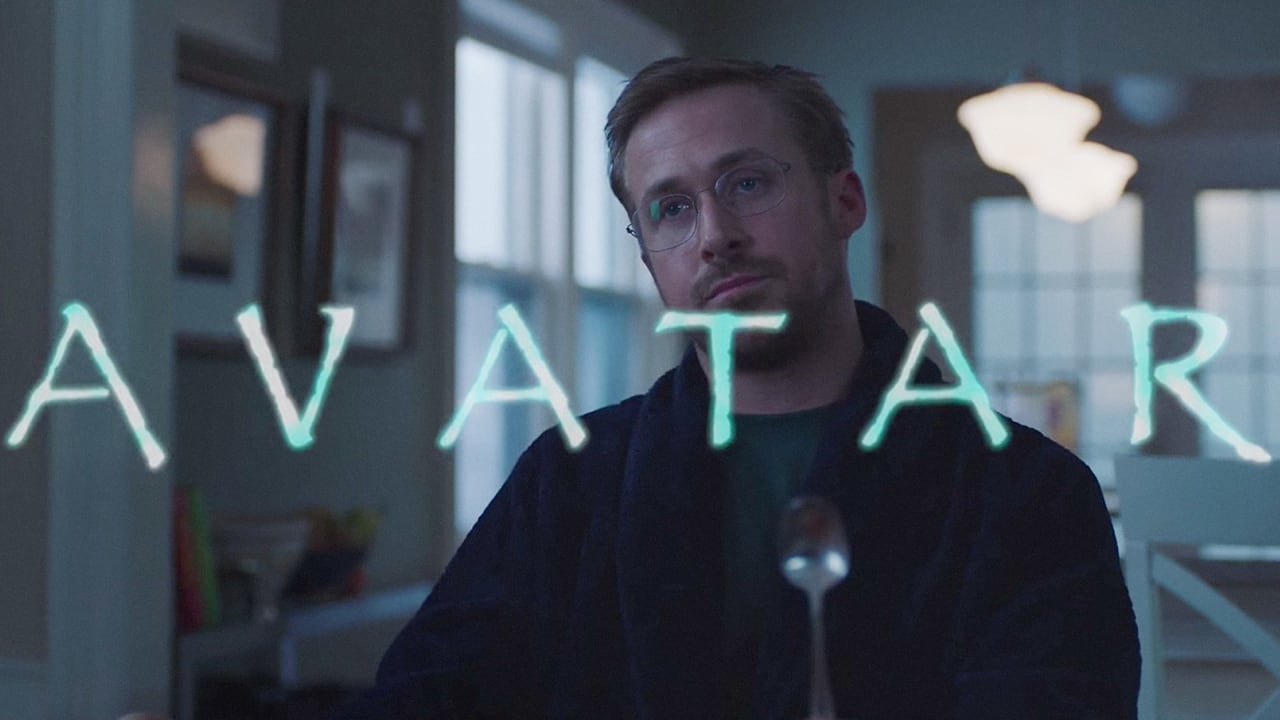
Honestly, it’s been years and I still can't look at a menu for a local Greek restaurant without thinking of Ryan Gosling. You know the one. That thousand-yard stare. The way he grips a glass of water like it’s the only thing keeping him tethered to reality.
The Ryan Gosling SNL Papyrus sketch is basically the "Citizen Kane" of niche graphic design comedy. It shouldn’t have worked. On paper, it sounds like a joke for three people in a Brooklyn ad agency. Yet, here we are, nearly a decade after the original 2017 premiere, and the world is still obsessed with Steven’s descent into madness over a font choice.
The Day the Design World Stood Still
Most SNL sketches are loud. They scream for your attention. But "Papyrus" was different. It played like a high-stakes psychological thriller—think Seven or Zodiac, but instead of a serial killer, the villain is a default typeface on a Windows 95 computer.
Gosling plays Steven, a man who simply cannot move past the fact that James Cameron’s Avatar—a movie with a $237 million budget—used Papyrus for its logo. "He just highlighted 'Avatar,'" Gosling whispers, his voice trembling with a mix of awe and pure, unadulterated disgust. "He clicked the drop-down menu and he just randomly selected Papyrus like a thoughtless child."
It’s hilarious because it’s true.
If you weren't online in the mid-2000s, you might not realize how pervasive Papyrus was. It was the "ethnic" font. It was on every yoga studio flyer, every box of off-brand herbal tea, and apparently, the biggest movie in cinematic history. For designers, seeing it on the Avatar poster was like seeing a Michelin-star chef garnish a $500 steak with a single slice of Kraft American cheese. It just didn't fit the "meticulous" world James Cameron built.
Who Actually Wrote This Thing?
The genius behind this madness is Julio Torres. He’s a writer who specializes in the weird, the specific, and the ethereal. Torres reportedly had the idea for a while, based on a tweet he'd written years prior. He told Entertainment Weekly that when he pitched it to Gosling, the actor didn't just "get" it—he inhabited it.
Gosling isn't "doing comedy" here. He’s acting for an Oscar. That’s why it works. If he winked at the camera once, the bit would die. Instead, he treats the font choice with the same gravity most people reserve for a family tragedy.
What Really Happened with the Avatar Logo?
Now, here’s where things get kinda wild. People assumed the SNL sketch was just a funny exaggeration. But the real story of the Avatar logo is almost as strange as the skit itself.
According to Peter Stougaard, a former marketing executive at 20th Century Fox, the studio actually rejected nearly 90 custom-designed logos. Designers were sending in sleek, chrome, futuristic stuff. But James Cameron wasn't feeling it.
Apparently, Cameron had been carrying around the script for Avatar for five years. On the cover of that script? The word "Avatar" typed in—you guessed it—Papyrus.
The "Thoughtless Child" Theory
It turns out the "professional graphic designer" Steven was hunting down was actually a team of people trying to please a legendary director who had simply fallen in love with a placeholder. Stougaard ended up tweaking the font in Photoshop because the original Papyrus lines were too thin for a movie poster. He basically "bolded" it.
When Chris Costello, the man who actually designed Papyrus in 1982, saw the movie, he noticed the changes immediately. He told CBS News he was "cracking up" at the SNL sketch. Imagine being the guy who made a font in his bedroom at age 23 for $750, only to have Ryan Gosling scream about your "laziness" thirty-five years later.
- The Cost: Costello sold the font rights for a pittance.
- The Inspiration: He was studying the Bible and looking for a "Middle Eastern" feel.
- The Reality: It became a default font on every Mac and PC, leading to its ultimate downfall through overexposure.
The 2024 Sequel: Papyrus 2
For years, fans begged for a follow-up. When Avatar: The Way of Water came out in 2022, everyone checked the logo immediately. They’d changed it! Sort of. It was a new, custom font called Toruk.
But the Ryan Gosling SNL Papyrus saga wasn't over.
In April 2024, Gosling returned to host SNL and gave us "Papyrus 2." This time, Steven is trying to heal. He’s in therapy. He’s avoiding triggers. He sees a flyer for Edible Arrangements and has to look away. Then, he sees the logo for the Avatar sequel.
At first, he’s relieved. "Somebody must have said something," he says, a glimmer of hope returning to his eyes. But then, late at night, he pulls up his computer. He starts playing with the font settings.
"He Just Put It In Bold"
The betrayal in this sequel is even deeper. Steven realizes that the "new" logo isn't a total redesign. The designer—a fictional character named Jacob Crone—just took the original and changed the weight.
"All the money in the world... and he just put it in bold."
The sketch ends with a twist that is so Julio Torres it hurts. We find out Steven’s last name is Wingdings. His father is the creator of the most unreadable font in history. It turns out his rage toward Papyrus was actually just displaced "daddy issues" because his father was "so hard to read."
It’s high-concept weirdness at its best.
Why We Still Care About a Font Joke
You might wonder why this specific bit has such long legs. It’s because it taps into a very specific modern anxiety: the gap between what things should be and what they actually are.
We live in a world where tech companies spend billions on "branding," yet the biggest movie ever used a font you’d find on a "Live, Laugh, Love" sign at Hobby Lobby. It’s the ultimate "glitch in the Matrix."
The "Impact" of the Sketch
Did the sketch actually change anything?
- James Cameron noticed: He eventually joked in Empire magazine that Ryan Gosling needs to "get out more."
- Typography awareness: It made the average person care about kerning and stroke weight for about five minutes.
- The "Avatar" Brand: It forced the franchise to actually commission a custom font (Toruk) for the sequels to avoid being the butt of the joke forever.
It’s rare for a comedy sketch to have a tangible effect on a multi-billion dollar franchise, but Steven’s pain was felt all the way in Pandora.
How to Spot Papyrus in the Wild
If you’ve been "infected" by the sketch, you’re going to start seeing it everywhere. It’s a curse. Look for these signs:
- Rough, tattered edges that look like they were drawn with a dried-out Sharpie.
- High "crossbars" on the capital letters.
- A general vibe of "I want to look ancient but I only have 30 seconds to design this."
If you find yourself getting angry at a juice bar menu, just remember: you aren't alone. Steven is out there somewhere, staring at a Taco Bell sign and wondering if anyone else sees the "hookah bar" font staring back at them.
Your Next Steps for Design Sanity
If this deep dive has triggered your own font-based trauma, there are a few things you can do to find peace. First, go watch the "Papyrus 2" digital short on YouTube—it was actually cut for time during the live broadcast, which is a crime against humanity. Second, if you’re a business owner, please, for the love of everything holy, check your branding. If your logo looks like it belongs on a 2009 Na'vi subtitle, it might be time for a refresh. Finally, take a breath. It's just a font. Or, as Steven would say, it's a "thoughtless child yanking leaves along the way." Choose your side.