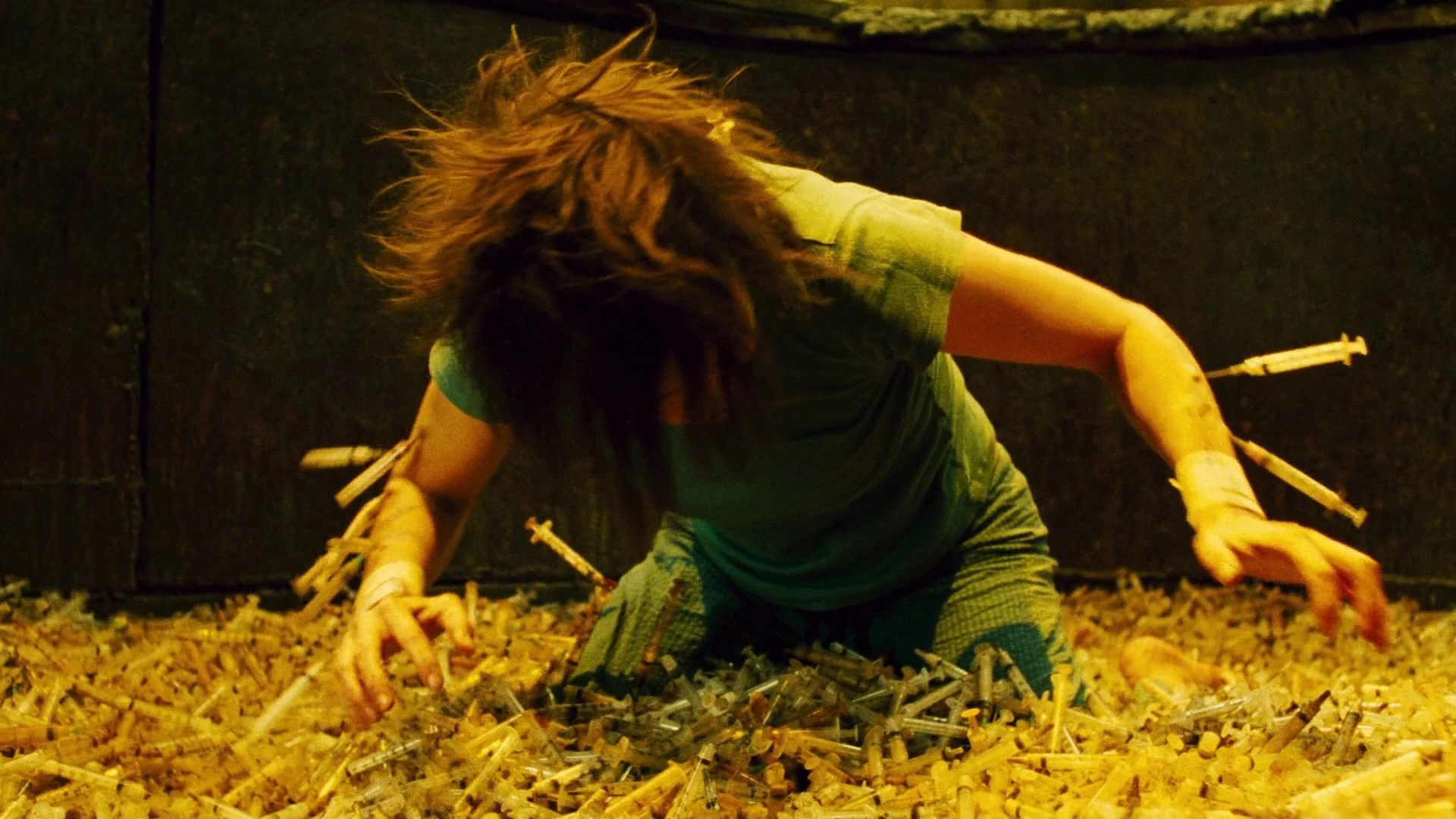
It’s been decades, but people still cringe at the mere mention of it. You know the one. Amanda Young, played by Shawnee Smith, being tossed into a literal pit of used, dirty syringes. It’s the Saw II needle pit, and honestly, it might be the most effective trap in the entire franchise because it doesn’t rely on elaborate gears or high-tech lasers. It relies on a very primal, very common phobia.
Try to remember the first time you saw it. The sound is what gets me every time—that dry, plastic-on-plastic rustling noise as she shifts through the pile. It’s gross. It’s visceral. And most importantly, it feels possible. While most of us will never find ourselves strapped into a Reverse Bear Trap, the idea of a stray needle poke is a "real world" fear that makes this scene hit different.
What Actually Happened in the Needle Pit?
The context matters here. In Saw II, directed by Darren Lynn Bousman, a group of people is trapped in a house breathing in a nerve agent. To get the antidote, they have to play Jigsaw’s games. Xavier, the "muscle" of the group who is becoming increasingly desperate and violent, finds a door with a peephole. Behind it is a room with a massive pit filled with what looks like hundreds of thousands of syringes.
There’s a timer. There’s a key.
Xavier was supposed to be the one to go in. That was his "test." But Xavier is a coward. He grabs Amanda and throws her into the Saw II needle pit instead. Watching her submerged in those needles, frantically tossing them aside to find a glow-in-the-dark key, is 120 seconds of pure, unadulterated anxiety. She’s screaming. The music is pulsing. Every time she plunges her hand into the stack, you expect a needle to go under a fingernail or into an eye.
It’s a masterclass in tension. It works because it isn't just about the pain; it's about the contamination. The needles aren't clean. They are supposed to be the discarded waste of "vices," symbolizing the drug habits Jigsaw (John Kramer) is judging them for.
The Logistics of Filming the Scene
You’d be surprised how much work went into making that pit look so terrifying. They didn't just buy some props and call it a day. The production team actually had to deal with a massive logistical hurdle to ensure the actors were safe while making the audience believe they were in mortal danger.
According to behind-the-scenes features and interviews with the crew, there were roughly 120,000 syringes used in that set piece. Now, obviously, they weren't real medical waste. That would be a legal and ethical nightmare. Instead, the crew spent four days taking the needles off real syringes and replacing them with fiber-optic tips or just removing the sharps entirely.
How They Pulled It Off:
- The Needle Swap: A team of people sat there for days replacing real metal needles with dull, safe alternatives.
- The "Hero" Needles: A few real-looking (but still blunt) needles were kept for close-up shots to ensure the texture looked authentic to the camera lens.
- Shawnee Smith’s Performance: She wasn't actually getting stabbed, but the physical weight of that many plastic tubes is significant. She had to "swim" through them, which is surprisingly difficult.
Even though she was safe, Smith has mentioned in various interviews over the years that the scene was still incredibly taxing. It’s dusty. It’s claustrophobic. And even if you know they are fake, being buried in 120,000 of anything that looks like a needle is going to mess with your head.
Why This Trap Outshines the "Gory" Ones
If you look at the later Saw movies—especially the ones like Saw 3D or Saw IV—the traps get incredibly complex. You have giant fans, lawnmowers, and complex pulleys. But the Saw II needle pit remains a fan favorite (or most-hated, depending on how you look at it) because it’s simple.
There is a psychological concept called "body horror" that Saw usually leans into with blood and guts. But this scene leans into "penetrative horror." It’s the same reason people hate the "eye" traps. We have a natural reflex to protect our soft tissues from sharp objects. When Amanda is thrown in, the audience’s collective skin crawls because we can feel that sensation of a prick.
Also, consider the character arc. At this point in the sequel, we still think Amanda is just another victim. Seeing her endure the pit makes us root for her. It builds a level of sympathy that makes the later reveal (that she’s Jigsaw’s apprentice) even more shocking. She "earned" her survival in the eyes of the audience through that sacrifice.
Real-World Phobias and the "Trypanophobia" Factor
Trypanophobia is the extreme fear of medical procedures involving injections or hypodermic needles. It’s estimated that up to 25% of adults have some level of this fear. When you put that on a cinema screen, you’re targeting a quarter of your audience directly in their psyche.
The movie plays with the idea of filth. In the mid-2000s, when Saw II was released, the stigma surrounding used needles and bloodborne pathogens was a huge part of the public consciousness. The trap isn't just about the poke; it's about what’s on the needle. It’s the fear of the unknown infection. Jigsaw’s traps are often moralistic, and the needle pit is a literal manifestation of "wading through the filth" of one's past.
Common Misconceptions About the Scene
I’ve seen a lot of rumors online about this scene. Some people think the needles were all CGI. That’s totally wrong. CGI in 2005 wasn't quite at the level where it could convincingly render 120,000 interacting physical objects on a mid-budget horror film budget. It was almost entirely practical.
Another myth is that Shawnee Smith was actually injured. She wasn't. The stunt and prop departments on the Saw films, particularly under the guidance of people like David Hackl (who later directed Saw V), were incredibly meticulous. They used "soft" needles for the parts where she had to move her body through the pile.
The Legacy of the Pit
The needle pit was so iconic that the franchise tried to call back to it several times. In Saw X (2023), they returned to more "grounded" and personal traps, reminding everyone why the early movies worked so well. They realized that fans don't necessarily want bigger machines; they want traps that feel personal and terrifyingly simple.
It also changed how horror movies approached "mass" props. Before this, you didn't see many scenes where an actor was submerged in thousands of small items. It paved the way for more tactile, practical effects in the "torture porn" era of the late 2000s.
Technical Breakdown: The Visuals
The lighting in the room is a sickly, jaundiced green. This is a staple of the Saw aesthetic, but it works overtime here. It makes the plastic of the syringes look aged and "used." If the room had been lit with bright, white hospital lights, it might have felt cleaner, less threatening. By keeping it dark and grimy, the production design forces your brain to fill in the gaps with the worst possible scenarios.
The sound design is the unsung hero. Listen closely next time you watch. You’ll hear the "tinkling" sound of the needles hitting each other. It sounds like rain on a tin roof, but sharper. That auditory trigger is what keeps the scene in your head long after the credits roll.
Practical Insights for Horror Fans and Filmmakers
If you're a fan of the genre or an aspiring creator, there are a few things to take away from the Saw II needle pit that explain its longevity in the cultural zeitgeist.
- Simplicity is King: You don't need a million-dollar robot to scare people. You need a relatable fear.
- Tactile Effects Matter: The fact that the actors were actually touching "needles" (even if they were fake) changes their performance. You can see the physical struggle.
- Psychological Stakes: The scene works because someone else (Xavier) forced Amanda into it. It’s a betrayal, not just a trap.
What to Watch Next if You Loved (or Hated) the Pit
If you’re looking to dive deeper into how these scenes are made, or if you want to test your mettle with similar "visceral" horror, there are a few places to go.
First, check out the "Behind the Scenes" documentaries on the Saw II Special Edition DVD or Blu-ray. They show the actual bins of needles and the "needle-pulling" parties the crew had. It’s actually kind of funny to see a group of tired film techs sitting around a table pulling metal tips off syringes for hours on end.
Second, look at the work of Greg Nicotero and KNB EFX Group. While they didn't do the needles for Saw II, their work in the industry defines this "practical-first" approach that makes horror feel so real.
Lastly, if you want to see how the franchise evolved, watch Saw X. It manages to capture that same "low-tech, high-stakes" feeling that made the needle pit so effective back in 2005. It’s a return to form that understands the audience doesn't just want to see blood; they want to feel the "itch" of a trap they could almost imagine themselves in.
The needle pit isn't just a movie scene. It’s a benchmark for how to trigger a physical reaction from a sitting audience. It’s why we still talk about it today, and why most of us will never look at a bin of medical waste the same way again.
To really understand the impact, you have to look at the "choice" element of Jigsaw’s games. In this specific case, the choice was stolen from Amanda by Xavier, which breaks Jigsaw’s "rules" in a way. This adds a layer of narrative injustice to the physical pain, making the viewer double-down on their emotional investment. It’s a perfect storm of writing, prop work, and a very common phobia.
Actionable Insights for Horror Enthusiasts:
- Analyze the Phobia: The next time a horror movie scares you, ask if it's "imaginary" (ghosts/demons) or "biological" (needles/infection). The latter usually has a longer-lasting psychological impact.
- Study Practical Effects: If you are a filmmaker, the needle pit proves that volume and texture can be more intimidating than complex mechanical movement.
- Contextualize the Character: Watch Amanda's face during the scene. It’s not just pain; it’s the look of someone who has been here before, metaphorically, and is fighting to never go back.
The Saw II needle pit remains the gold standard for visceral, low-tech horror. It’s a reminder that sometimes, the simplest ideas are the ones that stay under your skin the longest. Literally.