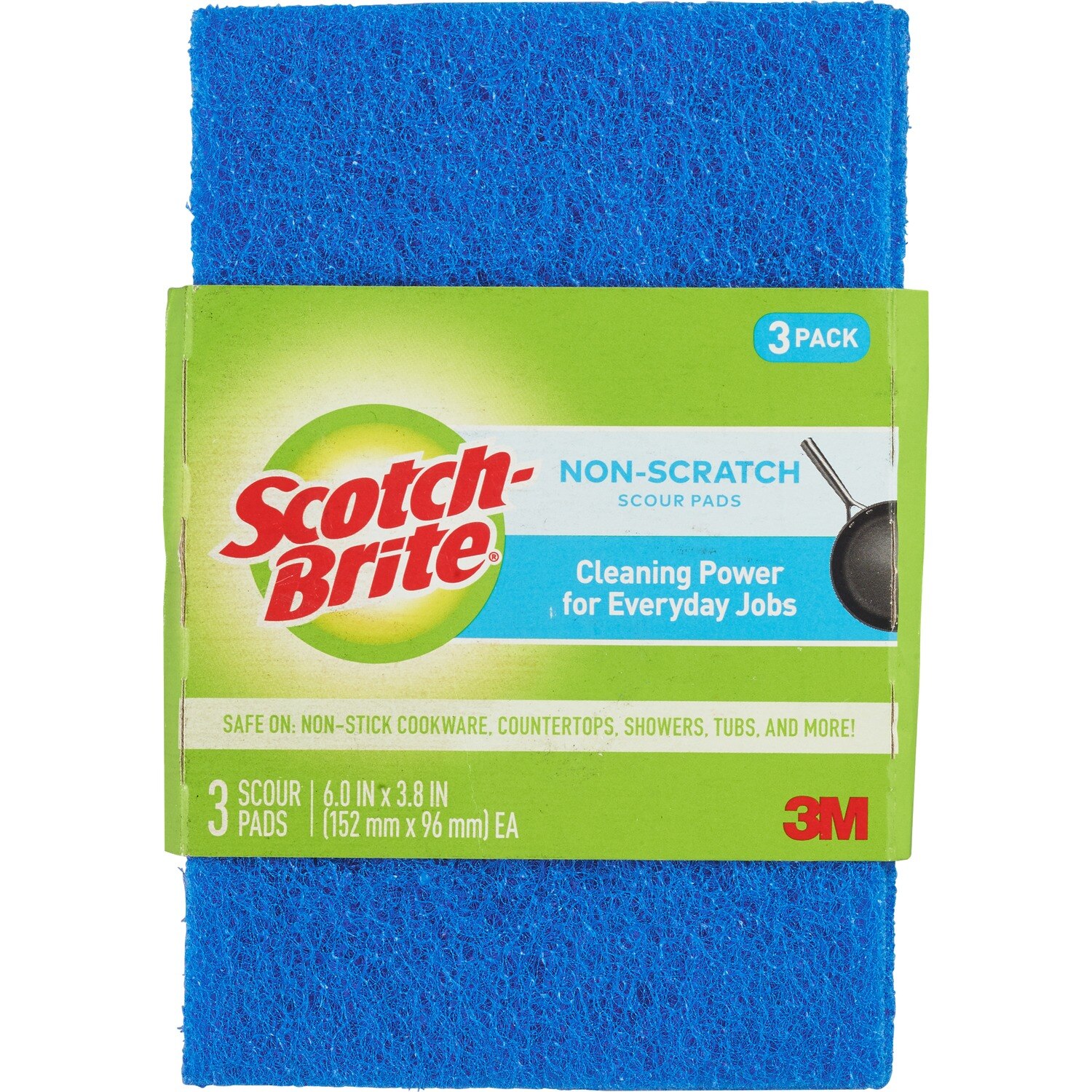
You just bought a brand-new Le Creuset Dutch oven or maybe a high-end All-Clad pan. It’s beautiful. You use it once, some protein sticks to the bottom, and suddenly you’re standing at the sink with a choice. Do you grab the heavy-duty green scrubby or the blue one? Most people think Scotch Brite non scratch pads are just the "gentle version" of the classic green scour pad, but there is actually a specific science to why they don't destroy your cookware. Honestly, if you use the wrong one, you’re basically sanding down your dinnerware.
Mistakes happen.
I’ve seen people use these on seasoned cast iron thinking they’re "safe" because the label says non-scratch. That is a massive misconception. While these blue pads are a lifesaver for Teflon and ceramic, they aren't a universal "get out of jail free" card for every surface in your kitchen. 3M, the company behind the brand, uses a specific synthetic fiber and a unique abrasive mineral density that differs wildly from their heavy-duty counterparts.
The abrasive truth about those blue scrubbers
Let’s talk about what is actually inside a Scotch Brite non scratch pad. It isn't just a soft sponge. The blue scrubbing surface is made of a non-woven polyester web. This web is impregnated with a soft abrasive. Unlike the green pads, which often use silicon carbide or aluminum oxide—minerals hard enough to scratch glass or stainless steel—the blue pads use a much softer mineral or, in some cases, just the friction of the tough polyester itself.
It’s about the Mohs scale of hardness.
If the scrubbing agent is harder than the surface of your pan, it will leave micro-scratches. Over time, those tiny scratches turn into a dull finish. Eventually, food starts sticking to those scratches. You’ve probably noticed your "non-stick" pan becoming "very-stick" after six months. That’s usually not the pan’s fault; it’s the cleaning tool. Scotch Brite non scratch pads are designed to be softer than the fluoropolymer (Teflon) coating or the ceramic glaze on your dishes. They remove the burnt-on egg without taking the coating with it.
Why color coding actually matters in your kitchen
3M didn't just pick blue because it looks nice with a kitchen backsplash. There is a global industry standard for scouring pads. Green is heavy-duty. Blue is non-scratch. Pink is often for delicate surfaces like fine china. If you’re at a restaurant supply store, you might even see white pads, which are the most gentle of all.
I once watched a roommate "clean" a stainless steel fridge with a green pad. It looked like someone had keyed the door. Had they used a blue Scotch Brite pad, the outcome would have been totally different. The blue fibers are flexible. They conform to the shape of the grime rather than cutting through the metal underneath.
The Teflon dilemma: Can you really scrub it?
Most manufacturers of non-stick pans tell you to use a "soft cloth or sponge." But let’s be real. A soft cloth doesn't do anything for a crusty carbonized mess. This is where Scotch Brite non scratch pads become the MVP of the kitchen.
You can actually apply pressure.
Because the abrasive particles are spaced further apart in the non-scratch version, the pad doesn't generate the same heat or friction as a heavy-duty one. This prevents the "delamination" of non-stick layers. If you look at a blue pad under a microscope, the fibers are looped in a way that allows them to "hook" onto food particles while sliding over the smooth surface of the pan.
But here is a caveat: even a non-scratch pad can become a scratching pad if it's dirty. If a tiny piece of sand or a hard burnt bit of carbon gets trapped in the blue fibers, that particle becomes the abrasive. You're no longer scrubbing with the pad; you're scrubbing with the debris. Always rinse your pads thoroughly before you touch your good pans.
Not just for the kitchen sink
People sleep on how good these are for bathrooms. Honestly, if you have a fiberglass tub or a plastic shower insert, you should never use a green pad or steel wool. It will strip the shine right off the plastic. The Scotch Brite non-scratch material is perfect for soap scum because it’s abrasive enough to break through the waxy buildup but soft enough to leave the acrylic finish intact.
I’ve even used them on car headlights. When that yellow oxidation starts to build up, a damp blue pad with a little bit of toothpaste (which acts as a mild polishing compound) can work wonders. It’s a bit of a "hack," but it works because of that specific balance of material hardness.
Managing the "stink" and pad longevity
One of the biggest complaints about any sponge or pad is the smell. Bacteria love the porous structure of a sponge. While the scrubbing side of a Scotch Brite pad is synthetic and doesn't hold much water, the yellow cellulose side (if you’re using the 2-in-1 version) is a breeding ground for germs.
To keep your pads from smelling like a swamp:
- Squeeze it out: Don't just leave it sitting in a puddle of soapy water.
- Air it out: Use a sponge holder that allows airflow to the bottom of the pad.
- Microwave trick: 30 seconds in the microwave while damp can kill a lot of the bacteria, though 3M officially recommends replacing them every few weeks for hygiene.
- Dishwasher: You can toss them in the top rack. It doesn't really "clean" the deep pores perfectly, but it's better than nothing.
Actually, the non-scratch pads tend to last longer than the green ones because they don't "shed" their minerals as fast. The bond between the blue fibers and the abrasive is quite resilient. You'll know it's time to toss it when the blue fibers start looking "fuzzy" or thin. Once the texture is gone, the cleaning power is gone.
Common surfaces that are secretly at risk
Just because it says "non-scratch" doesn't mean you should go wild. There are a few surfaces where you should still be cautious.
Polished or "mirror finish" stainless steel is the big one. While a blue pad won't gouge the metal, it can leave very faint swirl marks that ruin a mirror finish over time. If you have a fancy espresso machine or a high-polish toaster, stick to a microfiber cloth.
Another one is silver. Real silver is incredibly soft. A Scotch Brite pad, even a non-scratch one, will strip the patina and leave visible marks. Use actual silver polish and a cotton rag for that.
Moving beyond the basic scrub
To get the most out of your Scotch Brite non scratch pads, you have to pair them with the right chemistry. If you’re fighting grease, the pad is only half the battle. You need a surfactant (like Dawn) to lift the oils so the pad can reach the stuck-on bits.
For really tough burnt-on messes on a non-stick pan, try this:
- Simmer a little water and baking soda in the pan first.
- Let it cool slightly.
- Scrub with the blue pad while the residue is softened.
This prevents you from having to scrub so hard that you eventually wear down the non-stick coating through sheer physical force. It’s about working smarter, not harder.
Practical Next Steps
Stop using the same pad for your raw chicken cutting board and your coffee mugs. It's an easy way to get sick. Instead, buy a multi-pack and dedicate one color or one specific location for different tasks.
If you have a collection of non-stick pans or ceramic-coated cookware, go to your cleaning cabinet right now. Throw away any metal scourers or heavy-duty green pads that are sitting in your "daily use" tray. Replace them with a fresh Scotch Brite non scratch pad. This one small change can easily double the lifespan of your cookware.
Check the "scrubby side" of your current pad. If it feels smooth to the touch or looks balding, it's not cleaning effectively anymore; you're just moving bacteria around. Replace it today. Your pans—and your stomach—will thank you.