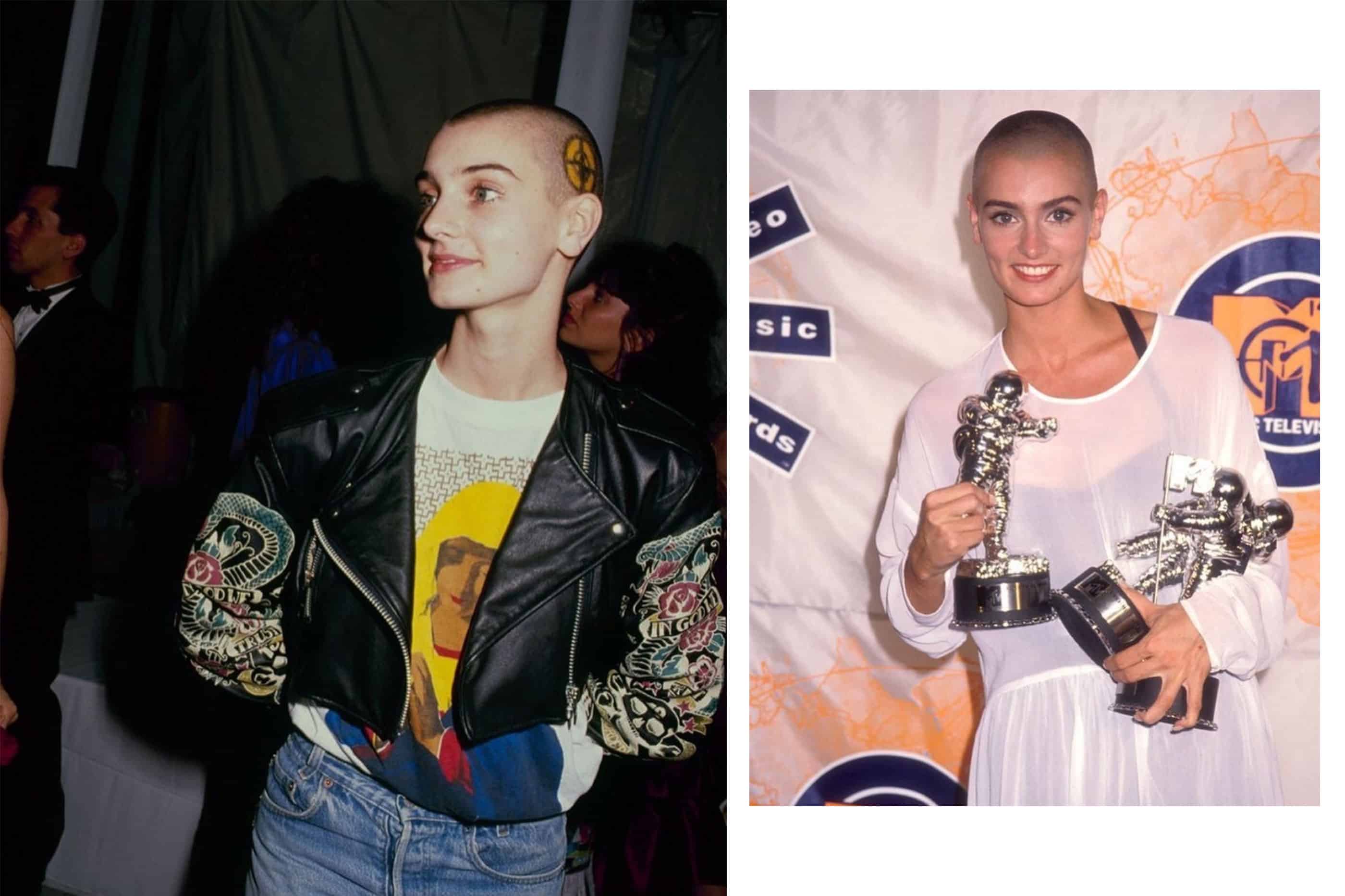
It’s the face that defined an entire era of MTV. You know the one—those massive, soulful eyes, the single tear rolling down a cheek, and that stark, perfectly smooth scalp. When people talk about Sinead O'Connor hair, they aren't really talking about a hairstyle. They’re talking about a revolution that happened in a London barber shop back in the late 80s.
Honestly, it’s wild how much a lack of hair can freak people out.
For Sinead, shaving her head wasn't some calculated PR stunt dreamed up by a marketing team. It was actually the opposite. It was a "screw you" to the very people who were trying to market her. If you’ve ever felt like someone was trying to mold you into a version of yourself that felt fake, you’ll get why she did it.
The Day the Curls Vanished
Imagine being 20 years old. You’re talented, you’re in London, and you’re about to record your first album, The Lion and the Cobra. Your record label execs sit you down and basically tell you that if you want to be a star, you need to look like a "traditional" girl.
They wanted long hair. They wanted miniskirts. They wanted boots.
Basically, they wanted a product they could sell to guys. Sinead wasn't having it. In her memoir Rememberings, she recalls looking at the exec and asking if he wanted her to look like his mistress. Talk about a power move.
The very next day, she walked into a barber shop and asked a young Greek barber to take it all off. He actually cried while doing it. He thought he was destroying something beautiful. But for Sinead, she was finally seeing herself for the first time.
It wasn't just about the music industry
While the label pressure is the most famous part of the story, the truth about Sinead O'Connor hair is a bit darker and more personal. Later in life, specifically in a heavy interview with Dr. Phil in 2017, she opened up about the trauma behind the look.
Her mother used to pit her against her sister. Her sister had this "glorious" red hair, and Sinead’s mother would introduce them as the "pretty daughter" and the "ugly daughter." Shaving her head was a way to opt-out of the "pretty" game entirely. It was a protective shield. If she wasn't "pretty" by society's weird standards, maybe she wouldn't be a target. It was a rejection of the male gaze before most people even knew what that term meant.
Why the Shaved Head Still Matters in 2026
You see it everywhere now. From Kristen Stewart to Demi Lovato to Doja Cat—women shaving their heads is almost a rite of passage for reclaiming identity. But Sinead did it when it was genuinely "dangerous" for a career.
It changed the visual language of pop music.
Before her, female pop stars were mostly big hair and heavy hairspray. Sinead proved that you could be vulnerable, feminine, and incredibly powerful without a single strand of hair. When she filmed the video for "Nothing Compares 2 U," there was nowhere for her to hide. No bangs to peek through. No curls to bounce. Just a raw, human face.
The Maintenance Myth
People often asked if it was "easier" to have no hair. Sorta.
She actually had to shave it every 10 days or so to keep that "velvet" look. It wasn't about being lazy; it was a commitment to a specific identity. She once said she didn't feel like herself if she had hair. It was her uniform. Even when she converted to Islam later in life and took the name Shuhada’ Sadaqat, that silhouette remained her most recognizable feature, even when she wore a hijab.
The Cultural Impact You Might Have Missed
It's easy to look back and think it was just a fashion choice. It wasn't.
- Androgyny as a Weapon: She used her look to force people to listen to her voice rather than look at her body.
- Defying the "Irish" Stereotype: In the 80s, people expected Irish women to have long, dark hair and wear Laura Ashley dresses. She blew that stereotype out of the water.
- The "Crazy" Label: Because she didn't look "normal," the media used her hair (or lack thereof) to paint her as unstable for decades. We're only now realizing she was just being herself.
What Most People Get Wrong
People think she shaved it because she was a rebel. Actually, she was a rebel, so she shaved it. Subtle difference, but important. It wasn't a costume.
There was a moment in the mid-90s where she actually grew it out a little. She had this sort of "flat top" or "Mohawk" situation for a minute, mostly because a barber messed up a cut. But she always went back to the buzz. It was her home base.
Even shortly before she passed away in 2023, that iconic look remained. It survived the 80s, the 90s, and the social media age.
Actionable Insights for Your Own Look
If you're thinking about following in those footsteps and doing a "Sinead," here’s the reality of the buzz cut life:
- Check your scalp health. When the hair goes, your skin is front and center. Use SPF daily—scalp sunburn is no joke.
- Invest in quality clippers. If you want that Sinead look, you’ll be buzzing every week. A cheap pair will tug and irritate.
- Prepare for the "Why?" People will ask. A lot. Have your answer ready, or better yet, don't give them one. That's the most Sinead move of all.
- Embrace the earrings. One thing Sinead did brilliantly was pair her shaved head with massive, statement jewelry. It balances the starkness of the scalp.
The legacy of Sinead O'Connor hair isn't about a barber's chair. It's about the courage to look in the mirror and decide that the world’s expectations don't mean a damn thing compared to your own comfort. She didn't want to be a "pretty girl" in a miniskirt. She wanted to be a musician. And by cutting off her hair, she made sure we had no choice but to listen.