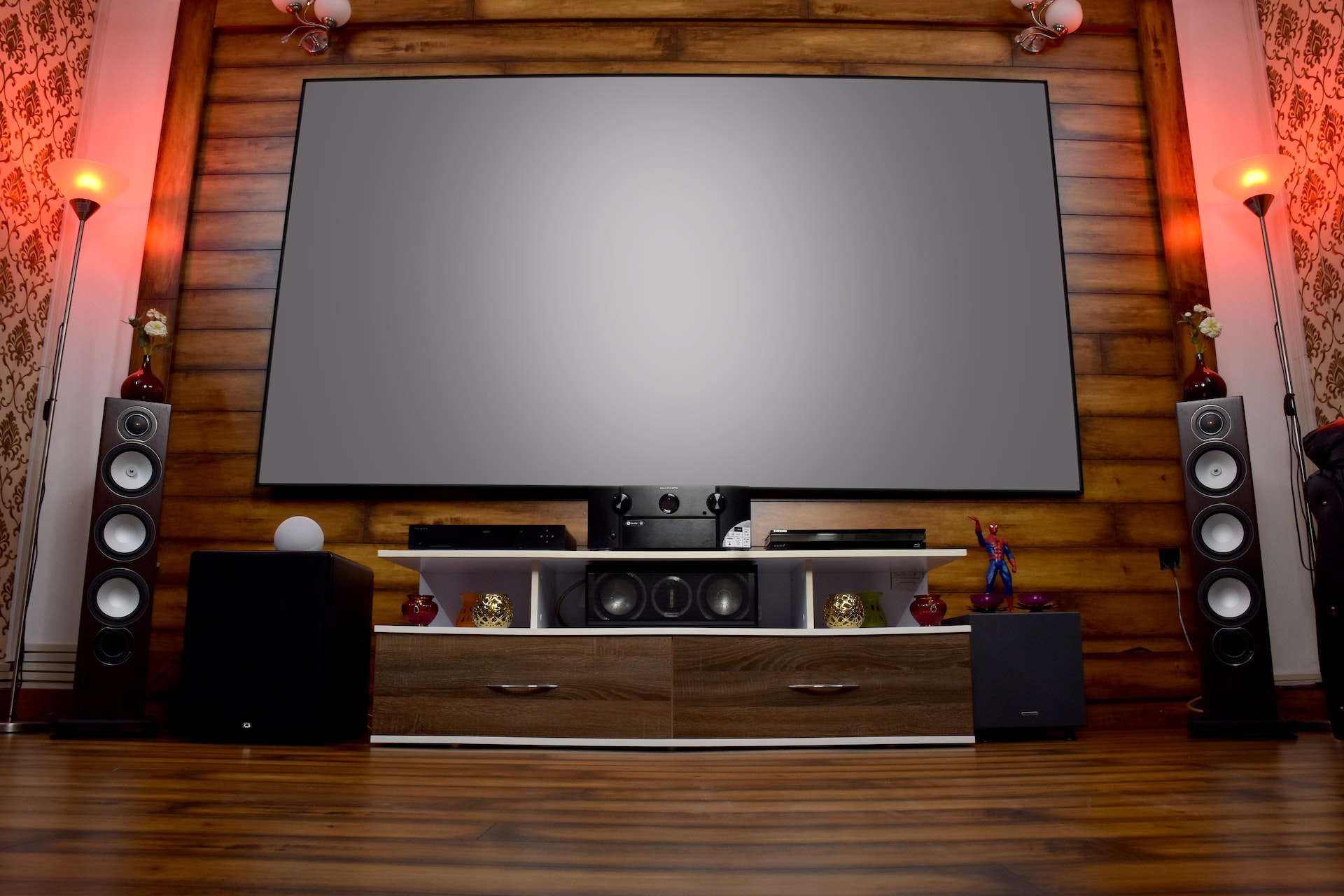
You don't need a sprawling basement or a dedicated wing of a mansion to get that "wow" feeling when the lights go down. Honestly, the most immersive setups I've ever seen weren't in dedicated cinema rooms. They were in converted spare bedrooms, cramped attic nooks, and even the corner of a studio apartment. Most people think a home theater requires a massive footprint, but that’s just not true anymore. Technology has shrunk. Our expectations for what a "small" space can do have shifted.
The real trick isn't just buying the most expensive gear you can find. It’s about scale. If you cram a 120-inch screen into a 10-foot room, you’re going to get a headache. It's basically like sitting in the front row of a real IMAX theater—fun for five minutes, miserable for a three-hour epic.
The Myth of the Massive Screen
When brainstorming small home theater ideas, the first instinct is always "bigger is better." We’ve been conditioned to think that way by big-box retailers. But in a small room, a massive TV can actually ruin the experience. You want a field of view that feels immersive but doesn't require you to whip your neck back and forth to follow the dialogue.
The Society of Motion Picture and Television Engineers (SMPTE) actually recommends a viewing angle of about 30 degrees for a standard experience. If you’re sitting 6 feet away—which is common in small rooms—a 55-inch or 65-inch 4K OLED is often the sweet spot. OLED is king here because of the "infinite contrast." In a small, dark room, those perfect blacks make the screen feel like a window into another world rather than just a glowing rectangle on your wall.
Projectors are the other route. Short-throw and Ultra Short Throw (UST) projectors have changed everything. You can place a UST laser projector, like something from the Formovie or Hisense lineup, just inches from your wall and get a 100-inch image. It’s wild. But—and this is a big but—you need an Ambient Light Rejecting (ALR) screen. Without it, your white walls will bounce light everywhere, washing out the image and making your "theater" look like a grainy mess.
Sound Architecture for Tight Quarters
Sound is 50% of the movie. Maybe more. In a small room, the biggest enemy isn't lack of volume; it's reflection. Sound waves hit walls, bounce back, and create a muddy "boomy" mess that makes it hard to hear what the actors are saying.
Forget a 7.1.4 system with eleven speakers. It’s overkill. In a tiny room, a high-end 3.1 or 5.1 system is plenty. Even better? Look into "phantom" center channels or high-quality soundbars like the Sennheiser Ambeo or the Sonos Arc. These use beamforming technology to bounce sound off your walls, tricking your ears into thinking there are speakers behind you. It’s sort of like magic, but it’s actually just clever physics.
If you are going the speaker route, look for "bookshelf" speakers rather than "tower" speakers. Brands like KEF with their Uni-Q driver array are legendary for small rooms because the sound radiates from a single point, which helps with clarity when you're sitting close.
And please, don't forget the bass. A subwoofer in a small room can be a nightmare if not handled correctly. Look for a "sealed" subwoofer rather than a "ported" one. Ported subs are great for massive rooms because they move a lot of air, but in a small space, they can sound bloated. A sealed sub, like those from SVS or REL, provides tight, punchy bass that won't make your neighbors call the cops.
Lighting and the "Vibe" Factor
You can have the best gear in the world, but if your room has white walls and a bright overhead light, it’ll never feel like a cinema. This is where most small home theater ideas fail. You need light control.
- Paint Color: If you can, paint the wall behind the screen a dark, matte color. Tricorn Black by Sherwin-Williams is a favorite among enthusiasts, but even a deep navy or charcoal works.
- Blackout Curtains: These are non-negotiable if you have windows.
- Bias Lighting: Stick an LED strip (like a Govee or Philips Hue) behind your TV. It reduces eye strain and makes the colors on the screen pop by providing a neutral reference point for your eyes.
Smart lighting is basically a requirement now. Being able to say "Hey, it’s movie time" and having the lights dim slowly adds a level of polish that makes the room feel professional. It’s about the ritual.
Furniture That Doesn't Eat the Room
Traditional cinema recliners are massive. They are the SUVs of furniture. In a small room, they are a disaster. They eat up floor space and make the room feel claustrophobic.
Instead, look for "apartment-sized" sectionals or even a high-quality loveseat. Some people swear by "bean bag" chairs like the Lovesac, which are surprisingly comfortable for long viewing sessions and can be moved around easily. If you really want that theater feel, look for "zero-clearance" recliners that can sit right against the wall and still lean back.
Think about "multipurpose" furniture too. An ottoman that opens up to store your physical 4K discs or extra blankets is a lifesaver. Speaking of discs—if you really care about quality, get a dedicated 4K Blu-ray player like the Panasonic DP-UB820. Streaming is convenient, but the bit-rate on a physical disc is significantly higher, meaning better sound and way less "color banding" in dark scenes.
The Problem of Heat and Air
Small rooms get hot. Fast.
Between a high-powered receiver, a gaming console (like a PS5 or Xbox Series X), and a large display, you’re basically running a space heater. If you tuck your gear into a cabinet, it's going to cook itself.
You need ventilation. Products from companies like AC Infinity are designed specifically for this. They make quiet fans that can be built into your media console to pull hot air away from your expensive electronics. It’s an unsexy purchase, but it’ll save you thousands in the long run by preventing hardware failure.
Acoustic Treatment: The Secret Sauce
If you take nothing else away from this, remember that a $500 acoustic panel will do more for your sound quality than a $2,000 speaker upgrade in a small room. You’ve got to kill those first reflections.
Identify where the sound hits the wall first—usually halfway between you and the speaker—and hang a panel there. You don't need to cover the whole room like a recording studio. Just a few strategic points. Even a thick rug on the floor or a heavy bookshelf filled with books can act as a natural diffuser, breaking up those pesky sound waves.
Practical Steps to Start Your Build
Building a small home theater is an iterative process. Don't try to do it all in one weekend. Start with the "bones" and build up as you figure out how the room behaves.
- Measure twice, buy once. Map out your floor plan. Account for door swings and window placements. Use blue painter's tape on the wall to visualize different screen sizes before you buy anything.
- Focus on the "Sweet Spot." In a small room, you usually only have one or two truly great seats. Optimize the speaker placement and screen height for those specific spots.
- Cable Management. Nothing ruins the aesthetic of a small room faster than a "spaghetti" mess of wires. Use on-wall cable racers if you can't go behind the drywall.
- Test your internet. If you’re streaming 4K HDR content, you need a rock-solid connection. If your router is on the other side of the house, consider running an Ethernet cable or upgrading to a Mesh Wi-Fi system.
- Acoustic "Cloud." If you really want to go pro, look into a ceiling-mounted acoustic panel (a "cloud"). In small rooms with low ceilings, the floor-to-ceiling bounce is a major source of audio distortion.
The goal isn't to recreate a 500-seat multiplex. It's to create an intimate, high-performance space where you can get lost in a story. When the lights go down and the sound kicks in, the size of the room disappears. That’s the real magic of a well-executed small home theater.
Focus on the black levels, manage your audio reflections, and don't over-scale your furniture. You'll end up with a space that rivals the local cinema without ever having to deal with someone kicking the back of your seat or overpriced popcorn. Small is often better because you have total control over every variable. Embrace the constraints and use them to your advantage.