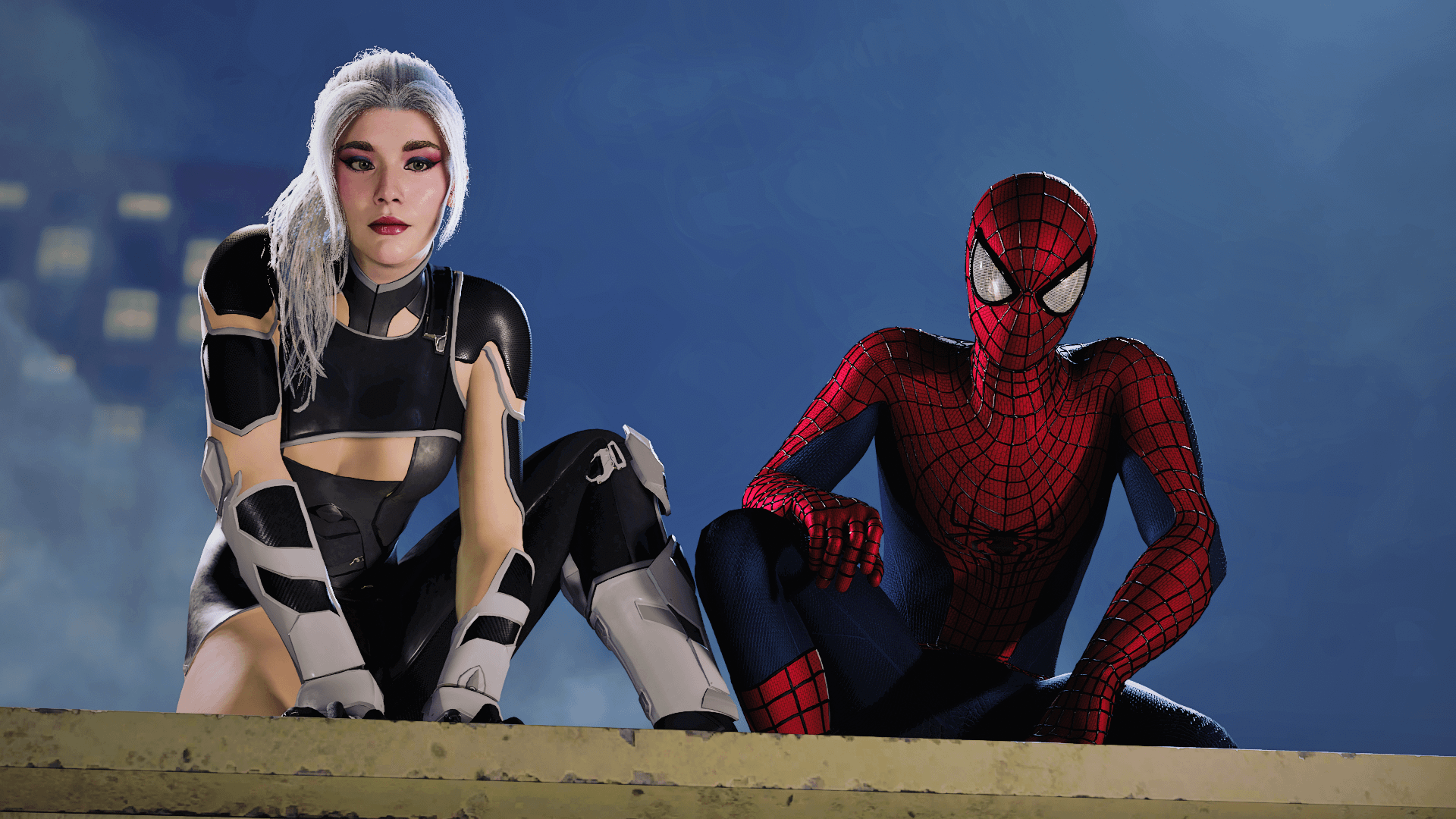
It usually starts on a rooftop. There’s the glow of the Empire State Building in the background, the smell of New York smog, and two people in spandex who probably should be doing anything else besides flirting. But when you think about Spider Man kissing Black Cat, you aren't just thinking about a random panel in a comic book. You’re thinking about the exact moment Peter Parker decides to make his life a whole lot more complicated.
Felicia Hardy is trouble. We know this. Peter knows this. Yet, for decades, writers like Marv Wolfman and Dan Slott have kept us coming back to this specific, high-stakes dynamic. It’s the "bad girl" trope dialed up to eleven, wrapped in leather and web-fluid. Honestly, it’s one of the few relationships in comics that feels genuinely dangerous because it isn't built on a foundation of "we both want to save the world." It’s built on adrenaline.
The First Time It Happened
The 1980s were a weird time for Spidey. He was transitioning from the classic Stan Lee era into something grittier. In The Amazing Spider-Man #226, things shifted. This wasn't the girl next door. This was a thief who looked at the mask and saw a soulmate, even if she didn't care much for the guy underneath it.
The first real instances of Spider Man kissing Black Cat were sparked by Felicia’s obsession with the "Spider." That’s the crux of their whole mess. She loved the hero; she didn't want the dork from Queens. When Peter eventually tried to show her his face—trying to be vulnerable and real—she actually asked him to put the mask back on. Talk about a blow to the ego. It’s a brutal bit of character development that separates Felicia from Mary Jane Watson or Gwen Stacy.
Why the Mask Matters
Think about the psychology here. Peter Parker spends his whole life hiding. With MJ, the mask comes off, and he’s just a guy who worries about rent. With Felicia, the mask stays on because that’s the part she’s attracted to. It’s a shallow love, sure, but it’s also an escape for Peter. He gets to stop being "Puny Parker" and just be the wall-crawler.
The 90s Animated Series Influence
If you grew up in the 90s, your version of the Spider Man kissing Black Cat saga probably came from the Saturday morning cartoon. Spider-Man: The Animated Series took some liberties, but it nailed the chemistry. In this version, Felicia was transformed by a version of the Super Soldier Serum. She wasn't just a cat burglar; she was a powerhouse.
The tension in the "Neogenic Nightmare" arc was palpable. Even with the heavy censorship of 90s TV—where Spider-Man wasn't even allowed to punch people—the romantic tension between him and Felicia felt more adult than anything else on the show. It gave a generation of kids the idea that maybe the "hero gets the girl" ending didn't have to be so wholesome.
Breaking Down the "Bad Luck" Powers
One thing people often forget when discussing their physical chemistry is Felicia’s actual power set. She literally gives people bad luck. It’s not just a name.
- She creates "accidents" for her enemies.
- In the early comics, this was actually a scientific hex or a latent mutation depending on the writer.
- This power eventually started affecting Peter.
Basically, the more time Peter spent around her, the worse his life got. Literally. His "Spider-Sense" would misfire or he’d have freak accidents. It’s a perfect metaphor for a toxic relationship. You love being with them, but your life falls apart every time you hang out. Yet, every time we see Spider Man kissing Black Cat, we’re seeing Peter choose that chaos over stability.
That Infamous Roof Scene in "Evil That Men Do"
If we’re being honest, Kevin Smith’s Spider-Man/Black Cat: The Evil That Men Do is where things got... intense. It took years to finish that miniseries, but the art by Terry Dodson made it iconic. It pushed the boundaries of what a Marvel comic could show in terms of intimacy.
There’s a specific sequence where the dialogue drops away, and it’s just the two of them. It’s moody. It’s drawn with a lot of shadows. It highlights that Felicia is the only person who can truly keep up with him physically. She can swing through the city at 60 miles per hour. MJ can’t do that. Gwen couldn't do that. There is a physical equality there that makes their encounters feel different than his other romances.
The Problem With "The Thief"
The recurring issue is that Felicia can't stop stealing. It’s in her blood. Peter is a moral binary; things are either right or wrong. Felicia lives in the grey. Every time they get close, she swipes a diamond or works for the Kingpin, and the trust shatters.
The Modern Era: From Silk to the PS5
Lately, the dynamic has shifted again. In the Marvel's Spider-Man game on PS5, we see a much more mature (and manipulative) version of Felicia. She tricks Peter into thinking he has a son just to get his help with a heist. That’s cold.
But even then, the chemistry is there. The way she moves, the way she talks to him over the comms—it’s a reminder that Peter will always have a blind spot for her. Even when he’s with MJ, Felicia represents the life he could have if he just stopped caring about the rules.
Is it actually Love?
Expert opinion varies. Most comic historians, like those at Comic Book Resources or Newsarama, argue that Felicia represents Peter’s id. She is his desire to be free of responsibility. While MJ is his heart and his "home," Felicia is his "vacation." You can't live on vacation, but you definitely want to go there.
Why Fans Never Get Tired of It
There is a visceral thrill in seeing a hero fail his own moral test. When Peter gives in to Felicia, he’s failing. He knows he should be catching her, not kissing her. That human fallibility is what makes Spider-Man the most relatable character in fiction. He’s not Superman. He’s a guy who makes bad dating choices.
The imagery of Spider Man kissing Black Cat serves as a visual shorthand for this conflict. Usually, the lighting is dark. The suits are high-contrast black and red. It’s visually striking in a way that Peter sitting on a couch with MJ just isn't.
Common Misconceptions About Felicia and Peter
People often think Black Cat is just a Catwoman rip-off. Honestly, that’s a surface-level take. Selina Kyle is a strategist; Felicia Hardy is a thrill-seeker. Selina wants to retire rich; Felicia wants the rush.
- Fact: Felicia was actually created by Marv Wolfman based on a Tex Avery cartoon, not Catwoman.
- Fact: She was the first person Peter ever revealed his identity to by choice (though it didn't go well).
- Fact: Their relationship isn't just "sexy"—it’s actually quite tragic because they want two different versions of the same person.
The Actionable Insight: What to Read Next
If you want to understand the depth of this pairing beyond the surface-level "hot" factor, you need to look at specific runs. Don't just browse fan art.
Go find the The Spectacular Spider-Man issues #74 through #100. This is the era where they were officially a duo. They fought the Owl and Doctor Octopus together. You see the relationship grow, bloom, and eventually rot because of the secrets they keep.
Also, check out the Black Cat solo series by Jed MacKay. It gives Felicia a voice that isn't just "Spider-Man’s ex." It explains her motivations and why she keeps coming back to him, even when she knows it’s a bad idea.
Moving Forward With the Web-Slinger
The story of the wall-crawler and the cat isn't over. As long as Marvel keeps rebooting universes, they’ll keep finding ways to put these two on a moonlit ledge. It’s a cycle of attraction and betrayal that keeps the books selling.
To really grasp the impact of this pairing, compare the "Back in Black" era to the more lighthearted "Brand New Day" appearances. Notice how the tone of their kisses changes from desperate to playful. It tells you everything you need to know about where Peter's head is at in that moment of his life.
Stop looking at them as just a couple. Look at them as a conflict. Peter vs. Peter. The hero vs. the man. That’s the real story behind the mask.
Next Steps for Fans:
- Track down Amazing Spider-Man #194 for the very first meeting; it sets the entire tone for the next 40 years.
- Play the "The City That Never Sleeps" DLC in the Spider-Man video game to see the modern interpretation of their "child" subplot.
- Compare the 1990s animated series portrayal with the Spectacular Spider-Man (2008) version to see how different age ratings handle the romance.