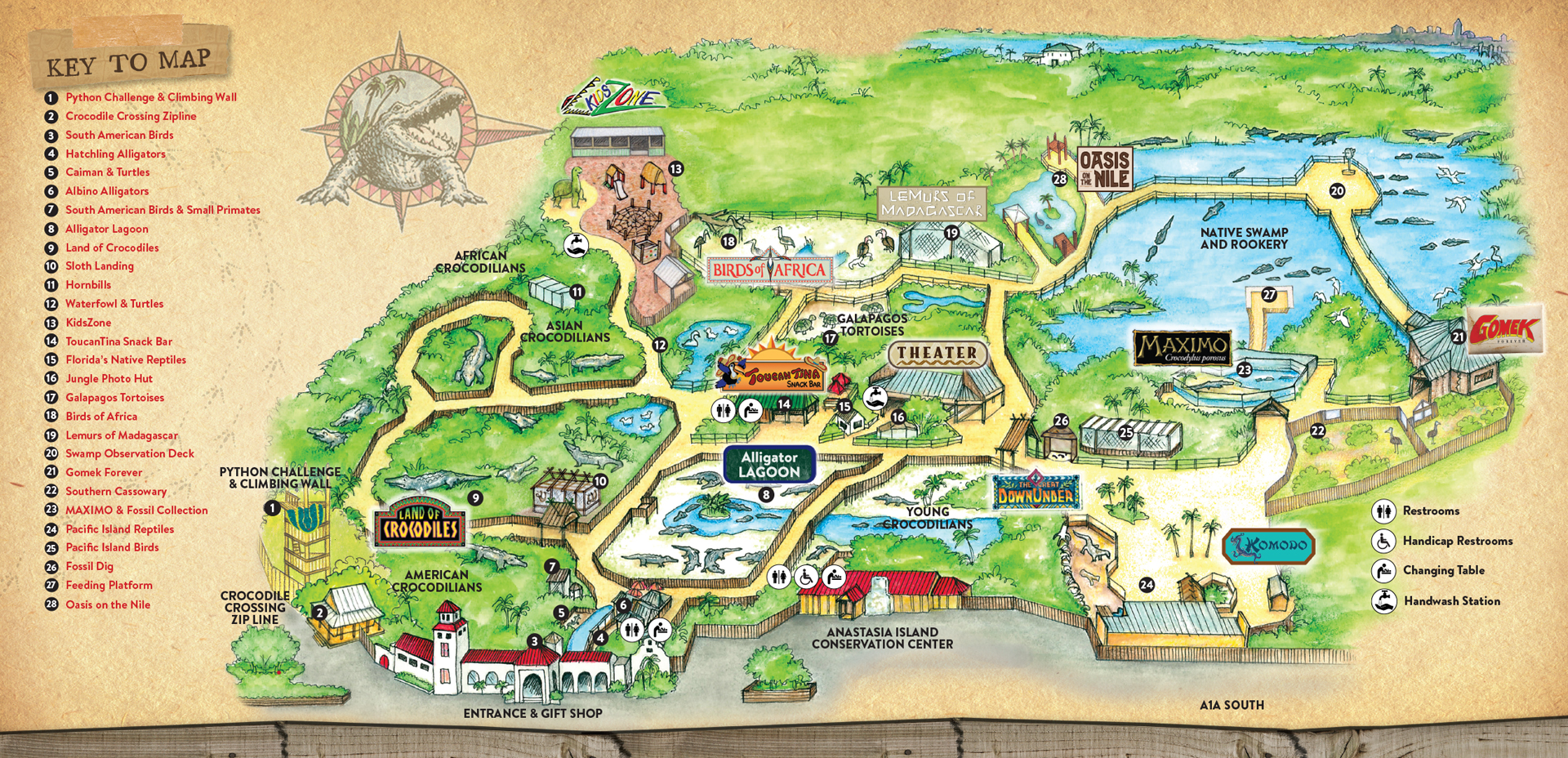
Honestly, when you hear the words "alligator farm" in Florida, your mind probably goes straight to those dusty roadside attractions from the 1950s. You know the ones. Faded plywood signs, a few sad gators in a concrete pit, and a gift shop full of plastic oranges. But the St. Augustine Alligator Farm Zoological Park is a completely different beast. It’s been around since 1893, making it one of the oldest continuously operating attractions in the entire country, yet it manages to feel more scientifically relevant than most modern zoos. It isn't just a place to see big lizards; it’s the only place on the planet where you can see every single living species of crocodilian. All 24 of them. That’s a massive deal for conservation, and it’s why researchers from places like UF and the Smithsonian are constantly hanging out here.
It started with a railroad and some curiosity
Back in the late 19th century, George Reddington and Felix Vassar started collecting alligators on Anastasia Island. It wasn't some grand scientific endeavor at first. It was basically a way to keep tourists entertained while they waited for the South Beach Railway. People loved it. They moved to the current location in the 1920s after a series of fires and storms, and since then, it’s evolved from a quirky curiosity to a dually accredited facility by the Association of Zoos and Aquariums (AZA).
Most people don't realize how rare that is. To get AZA accreditation, you have to prove you’re doing real work in animal welfare and education. It’s a rigorous process. This isn't a "tiger king" situation. It’s a legitimate institution that happens to have a very old-school name.
The Crocodilian Holy Grail
Let’s talk about the big draw. If you’re a reptile nerd, this is your Mecca. Most zoos have an American Alligator and maybe a Nile Crocodile. If you're lucky, you'll see a Gharial. But at the St. Augustine Alligator Farm, they have the full set. We’re talking about the critically endangered Philippine Crocodile, the blunt-snouted Caiman, and the massive Saltwater Crocodile.
Maximo is the king here. He’s a Saltwater Crocodile from Australia, measuring over 15 feet long and weighing comfortably over 1,200 pounds. Seeing him through the underwater viewing glass is... humbling. He’s a relic of a different era. The sheer girth of his head is hard to process until you’re standing inches away from the glass.
Why the species count matters
Having all 24 species in one spot isn't just a gimmick for the brochure. It allows for comparative research that you literally can't do anywhere else. Biologists can study growth rates, vocalizations, and nesting behaviors across different genera without having to fly across three continents. For example, the work done here with Chinese Alligators is vital. There are more of them in captivity at places like this than there are left in the wild in the Yangtze River. That’s a sobering thought.
The Rookery: A happy accident of nature
If you visit between March and July, you’re going to see something that feels like a glitch in the Matrix. Thousands of wild birds—Great Egrets, Snowy Egrets, Roseate Spoonbills, and Wood Storks—nest in the trees directly above the alligator swamp.
Why? Because they’ve made a deal with the devil.
In the wild, raccoons and opossums are the biggest threats to bird nests. They climb up and eat the eggs. But at the Alligator Farm, the raccoons won't go anywhere near those trees because the ground is a literal carpet of hungry alligators. The birds have figured out that the gators are a natural security system. The gators, in exchange, get the occasional chick that falls out of a nest. It’s a brutal, fascinating, and entirely natural symbiotic relationship that happens right in front of your face.
The noise is deafening. The smell is... earthy. But for photographers, there is nothing like it in the world. You can get within three feet of a nesting Roseate Spoonbill without a telephoto lens because the birds feel so safe from mammalian predators that they don't care about the tourists on the boardwalk.
Maximo and Gomek: Legends of the park
You can't talk about this place without mentioning Gomek. Even though he passed away in 1997, his legacy is everywhere. He was a Saltwater Crocodile captured in New Guinea and became one of the most famous individual animals in zoo history. He was massive—nearly 18 feet long. When he died, they preserved him, and he’s still on display in a dedicated gallery.
Today, Maximo carries that torch. He’s impressive, but he’s also a reminder of the sheer power these animals possess. Watching a feeding session is a must. It isn't some theatrical "wrestling" show—those are exploitative and dangerous. Instead, the keepers use target training. They use long poles with colored shapes to guide the animals, showing off their intelligence. Yes, gators are actually pretty smart. They can recognize their names and specific commands.
Living with the Zip Line
A few years back, they added "Crocodile Crossing." It’s a zip-line and aerial adventure course that goes right over the enclosures. Honestly, it’s a bit of a polarizing feature. Some purists think it detracts from the zoo vibe, but kids love it.
There’s something surreal about zipping 40 feet in the air while a dozen 10-foot crocodiles watch you from below. It gives you a perspective on their size that you can't get from a boardwalk. It’s safe, obviously, but your lizard brain definitely screams at you when you’re dangling over the Nile Crocodile pit.
What most people get wrong about the Alligator Farm
People often ask if it's "safe" for the animals to have so many people around. The reality is that the St. Augustine Alligator Farm is a leader in environmental enrichment. These animals aren't just sitting there. They have complex social structures, especially in the main lagoon.
Another misconception is that it’s just for kids. While there are plenty of families, the depth of information available makes it a legitimate destination for adults interested in herpetology or photography. The "Land of Crocodiles" section is laid out like a world tour, explaining the evolution of these creatures from the Mesozoic era to today.
Practical tips for your visit
If you’re planning a trip, go early. Florida heat is no joke, and the animals are much more active in the morning. By 2:00 PM, most of the gators are just trying to thermoregulate, which looks a lot like sleeping.
- Check the schedule: The feeding demonstrations are where you learn the most.
- The Rookery: If you're there for the birds, bring a camera, but maybe wear a hat. Birds in those numbers mean a lot of droppings.
- The Albino Gators: Don't miss the indoor building with the white alligators. They are incredibly rare and wouldn't survive a day in the wild because they have no camouflage. They look like they're carved from marble.
Actionable insights for travelers
To get the most out of your visit to the St. Augustine Alligator Farm, keep these specific steps in mind:
- Timing is everything. Visit during the spring (late March to June) if you want to see the wild bird rookery in full swing. If you're more interested in the reptiles, early morning feeding times are the peak of activity.
- Look for the "Species Survival Plan" (SSP) icons. These labels on the enclosures indicate which animals are part of international breeding programs. It helps you understand which species are on the brink of extinction and what the farm is doing to save them.
- Use the boardwalks strategically. Don't just stay at the front. The back of the park, where the Gharials and the "Sloth Forest" are located, tends to be much quieter and offers better opportunities for photos.
- Support the foundation. A portion of every ticket goes toward field conservation. In recent years, they've funded research on everything from sea turtles to rattlesnakes in the local Florida ecosystem.
This place is a rare example of a tourist attraction that grew a conscience and became a scientific powerhouse. It’s gritty, it’s old, it’s humid, and it’s absolutely essential if you want to understand the "real" Florida beyond the theme parks.