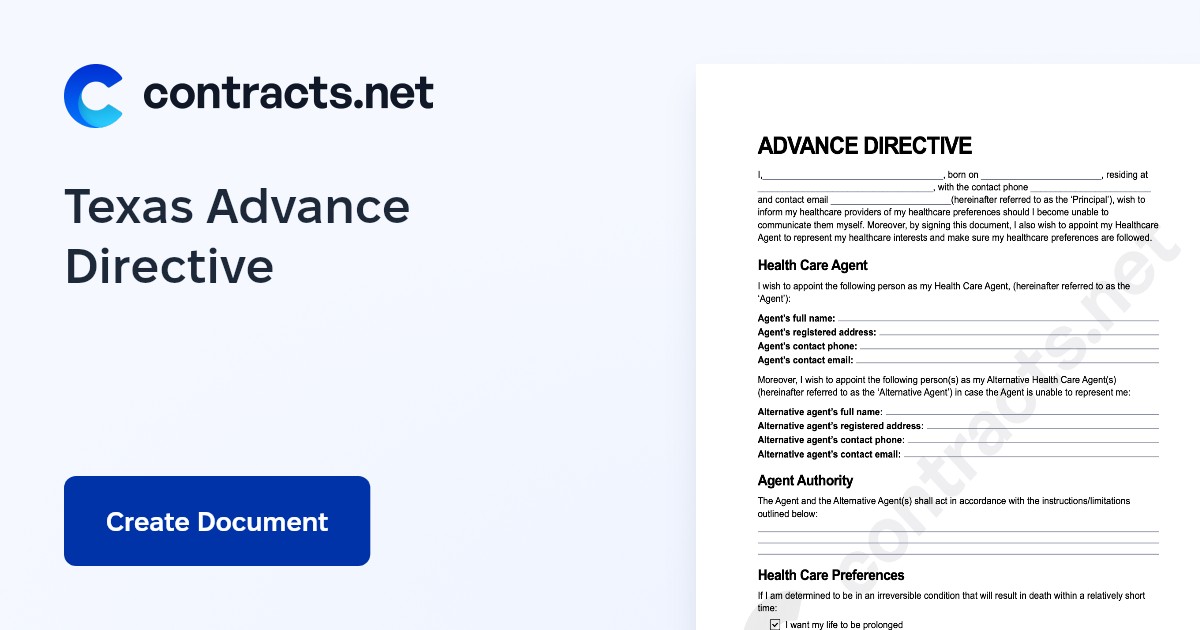
You’re sitting in a sterile hospital waiting room in Dallas or maybe Houston, the smell of industrial floor cleaner stinging your nose, and a doctor walks out with a clipboard. They ask you what your spouse or parent would want because they can't speak for themselves anymore. This is the moment where a texas advance directive form becomes the most important piece of paper you’ve ever touched. Most people think "I’ll get to it later" or assume their family just knows what they’d want. They don't. Or worse, different family members "know" different things, and that’s how legal battles start while someone is dying.
It’s heavy stuff. Honestly, nobody wants to spend a Saturday afternoon thinking about ventilators or feeding tubes. But in Texas, the law is pretty specific about how these things work, and if you haven't put it in writing, you're basically leaving your medical fate up to a default hierarchy of relatives that might not include the person you actually trust most.
The Three Pillars of a Texas Advance Directive
In the Lone Star State, "Advance Directive" is actually an umbrella term. It’s not just one single page. It usually bundles together three specific documents that do very different jobs. You’ve got the Directive to Physicians and Family or Surrogates (which people usually call a Living Will), the Medical Power of Attorney, and the Out-of-Hospital Do-Not-Resuscitate (OOH-DNR) Order.
The Directive to Physicians is the big one. This is where you tell the doctors, "Look, if I’ve got a terminal condition and I’m expected to die within six months even with treatment, here is what I want you to do." Texas law (Health and Safety Code Chapter 166) gives you two main choices here: you want them to keep you alive as long as possible using every bit of medical tech available, or you want them to stop the life-sustaining treatment and just keep you comfortable while nature takes its course. It’s a binary choice that feels impossible until you’re actually facing it.
Then there’s the Medical Power of Attorney (MPOA). This is different because it’s about a person, not a procedure. You’re picking a "healthcare agent." This person only gets power when your doctor certifies in writing that you’ve lost the "capacity" to make your own decisions. Maybe you’re under anesthesia. Maybe it’s advanced dementia. Whatever the reason, this person steps into your shoes.
Why Your "Next of Kin" Might Not Be Enough
A lot of Texans think, "Well, I’m married, so my spouse just decides." While Texas law does have a "surrogate decision-making" hierarchy, it’s messy. If you don't have a formal texas advance directive form naming a specific agent, the doctors have to look for a legal guardian first, then a spouse, then "adult children who are reasonably available," then parents. Imagine three siblings in a hospital room in San Antonio arguing over whether Dad would have wanted a feeding tube. The doctors are stuck in the middle. Without a clear directive, the medical team might have to keep providing treatment you never wanted just to avoid a lawsuit.
The "Art" of Filling Out the Form Without Messing Up
You don't need a lawyer to fill out a Texas advance directive. That’s a common myth. The state actually provides a "statutory form," which basically means there’s a template written into the law that everyone has to accept. You can find these on the Texas Health and Human Services website or through organizations like the Texas Medical Association.
But here’s where people trip up: the witnessing requirements.
Texas is picky. You need two witnesses. And no, your spouse can’t be one of them. Neither can your doctor, or an employee of the facility where you’re being treated, or anyone who stands to inherit your truck or your house when you die. At least one of the two witnesses must be a "disinterested" party. Usually, a neighbor or a co-worker works best. Alternatively, you can skip the witnesses if you get the document notarized, which is honestly the cleaner way to do it if you can find a notary at your local UPS store or bank.
Terminal vs. Irreversible Conditions
There is a subtle but massive difference in the Texas form between a "terminal" condition and an "irreversible" one. Most people gloss over this. A terminal condition means you're likely to die within six months even if they do everything right. An irreversible condition—like advanced Alzheimer's or a permanent vegetative state—means you can't care for yourself or make decisions, and you'll die without life-sustaining treatment, but you might "live" for years in that state.
The texas advance directive form asks you to make choices for both scenarios. You might want the doctors to try everything if it’s a temporary terminal crisis, but maybe you feel differently about being kept on a machine for a decade if your brain has essentially stopped functioning. You have to check the boxes clearly. If you leave them blank, the document is basically a paperweight.
Common Misconceptions That Cause Chaos
One of the biggest mistakes I see is people thinking their "Living Will" from another state is perfectly fine in Texas. While Texas law generally honors out-of-state directives if they were legal where they were signed, it can cause delays. If a doctor in Lubbock is looking at a form from Vermont that uses different terminology, they might hesitate. It’s always better to use the Texas-specific statutory language.
Another big one: the DNR.
A "Do Not Resuscitate" order is not the same thing as an advance directive. An advance directive is for when you’re already in the hospital. An Out-of-Hospital DNR is for when the paramedics show up at your house. In Texas, paramedics are legally required to try to save you unless they see a very specific, signed Texas OOH-DNR form, usually printed on yellow paper (though the color isn't strictly required by law anymore, it’s still the standard). If you have an advance directive tucked in a drawer but you stop breathing at home, EMS is going to start CPR unless that OOH-DNR is visible.
What Happens if You Change Your Mind?
Life changes. Divorces happen. Relationships sour. In Texas, you can revoke your advance directive at any time, regardless of your mental state. If you can communicate "I don't want this anymore," it's gone. If you get a divorce, and your ex-spouse was your named healthcare agent, Texas law automatically revokes their designation. But don't rely on that. If you go through a major life change, rip up the old texas advance directive form and sign a new one.
Make sure you give copies to:
- Your primary care doctor.
- The agent you named in your Power of Attorney.
- Your local hospital (they can often upload it to your electronic medical record).
- Your family (even the ones you didn't pick).
Don't put it in a safe deposit box. If you’re in a car wreck at 2:00 AM on a Tuesday, nobody can get into your bank to find your paperwork. Keep it on your fridge or in your glove box. Some people even keep a digital copy on their phone or use a service like the Texas Living Will Registry.
Actionable Next Steps
Planning for this isn't about dying; it's about making sure your voice is heard when you can't speak.
- Download the Statutory Form: Go to the Texas Health and Human Services (HHS) website and grab the official Directive to Physicians and Medical Power of Attorney. It's free.
- Have the "Awkward" Talk: Sit down with the person you want to name as your agent. Ask them: "If I was in a coma and the doctors said I wasn't coming back, could you turn off the machine?" If they hesitate or say they couldn't live with themselves, they aren't the right person for the job.
- Pick Your Witnesses or Notary: Don't wait until you're in the hospital to find a notary. Get it done while you're healthy and clear-headed.
- Review Every Five Years: Your medical wishes at 30 are rarely the same as they are at 70.
- Talk to Your Doctor: Ask your physician to explain what "life-sustaining treatment" actually looks like. It’s not like the movies. It’s ventilators, dialysis, and artificial nutrition. Understanding the reality of these procedures makes filling out the texas advance directive form a lot less abstract.
Texas law gives you a lot of power over your own medical future, but only if you use it. If you leave it to chance, you're leaving a burden on your family that most people wouldn't wish on their worst enemy. Get the form, sign it, and then go back to living your life knowing you've got your bases covered.