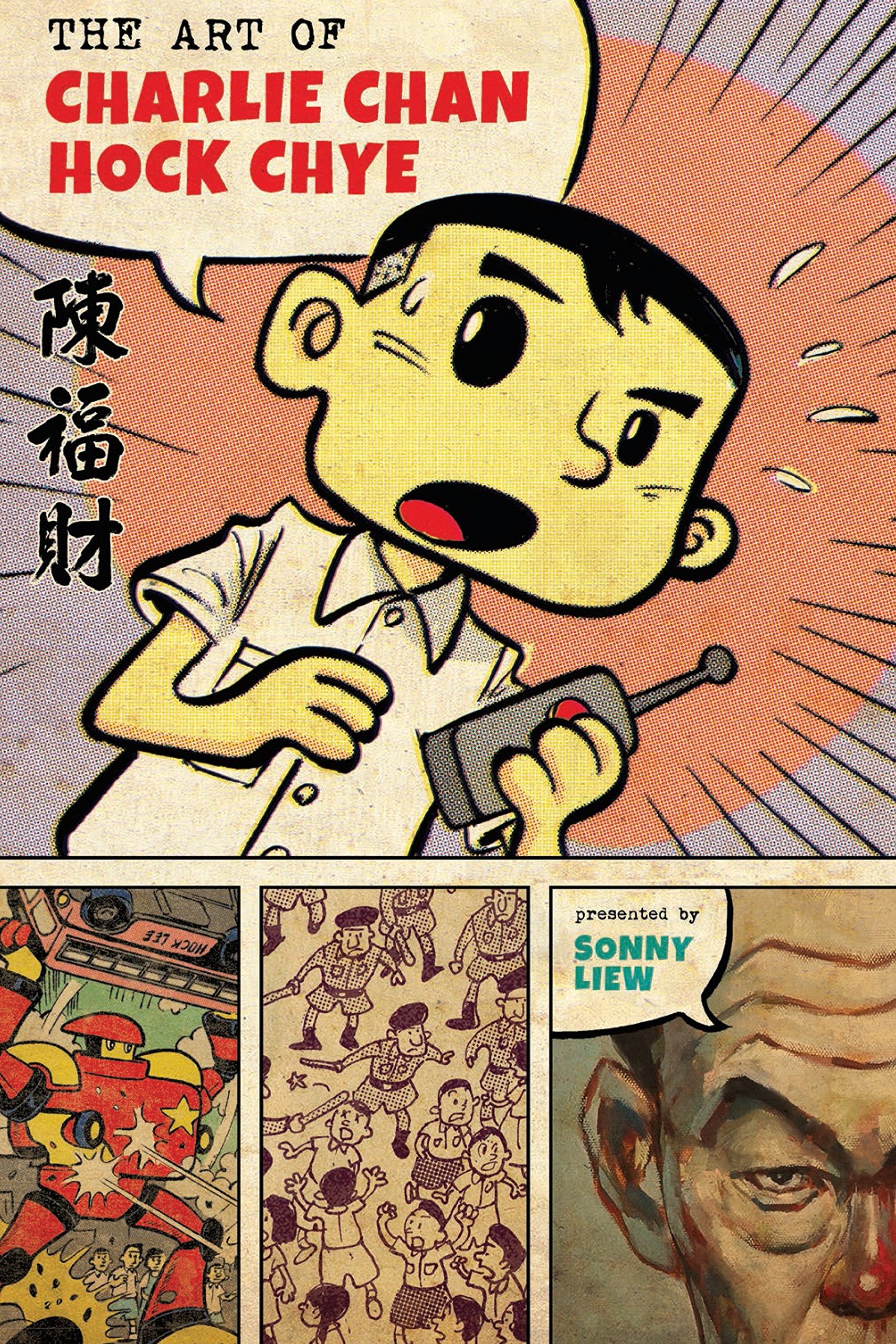
So, here’s the thing about The Art of Charlie Chan Hock Chye.
When you first crack open this massive, 300-page beast of a book, you’re basically convinced you’re looking at a history of a real guy. There are "archival" photos. There are yellowed newspaper clippings. There are sketches that look like they’ve been sitting in a damp humid basement in Geylang since 1954. You start reading about this pioneering Singaporean cartoonist, Charlie, and you think, "Man, how have I never heard of this legend?"
But then the penny drops.
Charlie Chan Hock Chye doesn’t exist. He’s a ghost. A fabrication. A perfectly crafted avatar created by the actual artist, Sonny Liew, to tell a story that the official history books usually skip over.
Honestly, it’s a brilliant bit of trickery. Liew didn’t just write a graphic novel; he built an entire museum of a man’s life to smuggle in a counter-narrative of Singapore’s birth. If you're looking for a simple "comic book," this isn't it. It's a stylistic chameleon that shifts from Tezuka-style manga to DC-inspired superheroes, all while dissecting the messy, often painful political evolution of a city-state.
The Controversy That Made It a Star
You can’t talk about The Art of Charlie Chan Hock Chye without talking about the "grant incident." It’s kinda meta, really. In 2015, Singapore’s National Arts Council (NAC) withdrew an $8,000 grant for the book right before it launched.
Why? Because the "retelling of Singapore’s history... potentially undermines the authority or legitimacy of the Government."
Talk about a backfire.
The moment the news hit that the government found the book "sensitive," everyone wanted it. The first print run evaporated. People were queuing at Kinokuniya like it was a new iPhone launch. By trying to quiet the book, the authorities basically handed Sonny Liew the best marketing campaign an indie creator could ask for.
But let’s be clear: the book isn't some angry, anti-government screed. It’s more of a "What If?"
What if Lee Kuan Yew’s political rival, Lim Chin Siong, hadn't been arrested? What if the "official" Singapore Story had different protagonists? Liew uses Charlie’s fictional career to explore these gaps, showing us the riots, the detentions, and the "Marxist Conspiracy" of 1987 through the eyes of an artist who never quite "made it" because he wouldn't stop drawing what he saw.
A Masterclass in Stylistic Parkour
One of the coolest things about the art itself is how it evolves. It doesn’t just stay in one lane. Liew is a bit of a shapeshifter.
When Charlie is a kid in the 1950s, the art looks like old British boys' adventure comics. When the story hits the 60s, it morphs into something resembling Osamu Tezuka’s Astro Boy. Later, we get these gritty, oil-painted portraits of Lee Kuan Yew that look like they belong in a fine art gallery.
- Roachman: A local superhero who gets his powers from a mutated cockroach (classic Singapore). This segment parodies early Marvel and DC, but the "villains" are things like poverty and urban redevelopment.
- Bukit Chapalang: An animal fable where Lee Kuan Yew is a cunning mousedeer (Sang Kancil) and the Malaysian leaders are orangutans.
- Sinkapor Inks: A biting satire where the nation is run like a stationery company, and employees get fired (or jailed) for complaining about the boss.
It’s dizzying. One minute you’re looking at a "recovered" watercolor from 1972, and the next, a "chibi" version of Sonny Liew himself pops up in the margins to explain the historical context of the Hock Lee Bus Riots. It keeps you on your toes. It forces you to question what’s real and what’s "curated."
Why Charlie Matters in 2026
We’re living in an era where everyone is obsessed with "fake news" and "alternative facts." The Art of Charlie Chan Hock Chye was ahead of the curve on this. It doesn't lie to you—it shows you how stories are built.
By creating a fictional artist, Liew highlights the very real artists who were sidelined or silenced during Singapore’s rapid climb to the top. It asks a heavy question: What did we lose in our rush to become a "First World" nation?
Charlie is a tragic figure. He ends up living in a small flat, surrounded by stacks of paper that nobody wants to publish. He’s the personification of the "unsuccessful" artist in a society that only values economic utility. Yet, his work is vibrant, soulful, and arguably more "true" than the polished version of history we see on TV.
It’s also worth noting that this book didn’t just stay a local curiosity. It went on to win three Eisner Awards (the Oscars of the comic world). It made Sonny Liew the first Singaporean to ever do that. It’s a global heavyweight now.
How to Actually "Read" This Book
If you’re going to dive in, don’t rush. Seriously. You’ll miss the jokes. Look at the "staple marks" on the edges of the pages. Notice how the paper texture changes when the story jumps from the 1950s to the 1980s.
It’s an immersive experience.
The book is basically an argument for complexity. It suggests that a nation isn't just one story told by the winners; it's a messy collage of millions of stories, some of which are unfinished, some of which are "sensitive," and some of which are just plain weird.
Actionable Insights for the Reader
If you're inspired by Charlie's (or Sonny's) journey, here's how to engage with the medium and the history:
- Visit the National Archives: If you're in Singapore, look up the real photos of the 1955 riots or the 1961 Bukit Ho Swee fire. Seeing the "real" versions of what Charlie draws makes the book hit twice as hard.
- Support Indie Comics: Books like this only happen when creators take massive risks. Check out other Singaporean graphic novels like The Resident Tourist by Troy Chin or Resident Kalis—the scene is thriving because Liew broke the door down.
- Question the Narrative: Next time you read a "biography," look for who isn't in the photos. Who was the rival? Who was the friend that "gave up"? That's where the real story usually hides.
The Art of Charlie Chan Hock Chye is more than just a book about an imaginary cartoonist. It’s a mirror. It shows us that while we can't change the past, we can definitely change how we remember it. And honestly? That's a lot more powerful than any grant.
To get the most out of this work, you should start by comparing the fictional "Bukit Chapalang" segments with the actual historical timeline of the 1963 Merger. Seeing how Liew translates complex geopolitics into a comic about a mousedeer and an orangutan is the best way to understand his genius for satire. Follow this up by looking into the real-life biography of Lim Chin Siong to see where the "alternate history" in the book begins to diverge from reality.