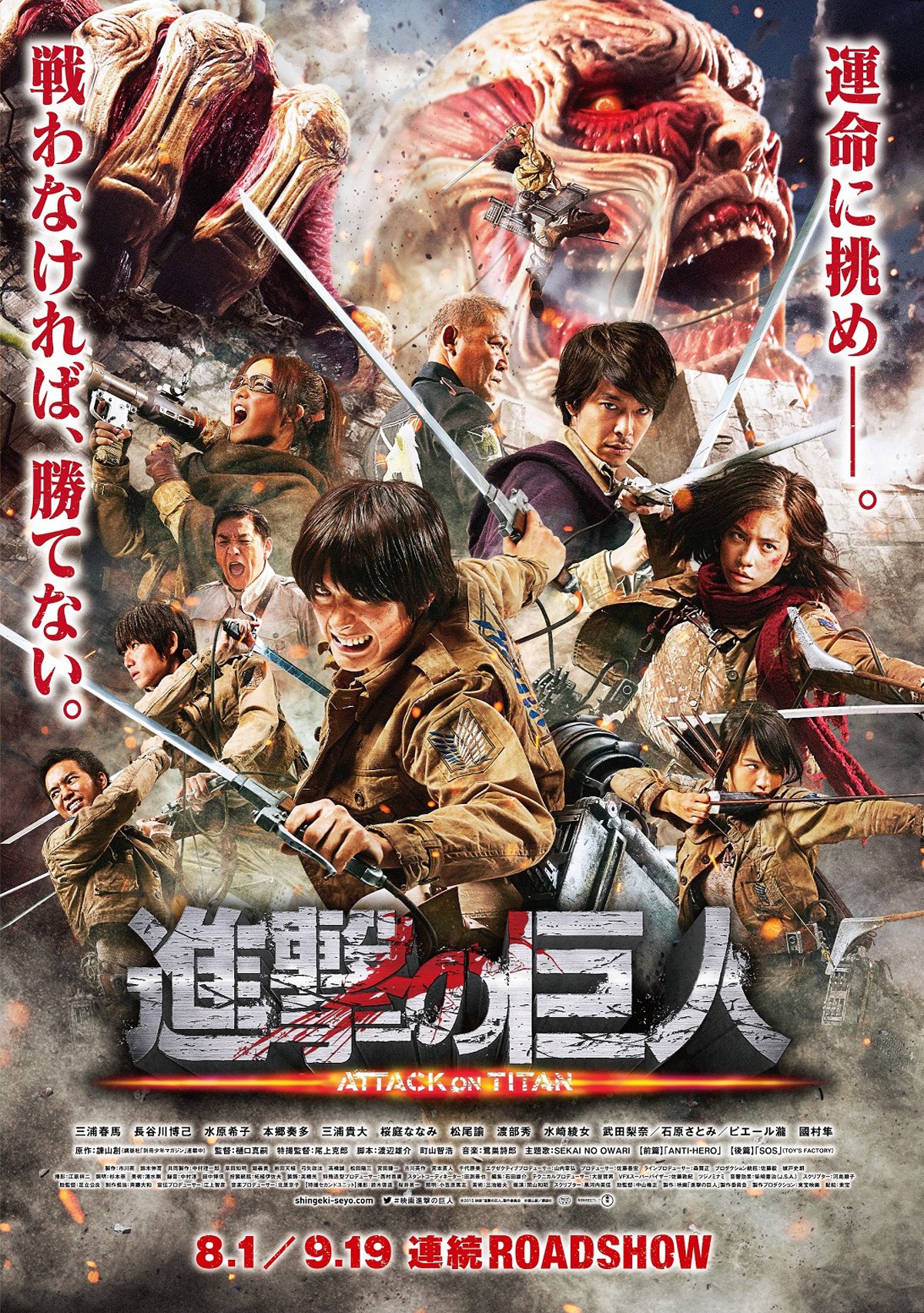
You probably think you’ve seen it all because you sat through all 100-ish episodes of the anime. Honestly, that's what most fans think. They assume the attack on titan movies are just leftovers or weird experiments that don’t matter to the "real" story. But if you’re trying to piece together the chaotic production history of Hajime Isayama’s masterpiece, the movies are where things get weird.
Look, there’s a massive divide here. On one side, you have the compilation films that basically act as a "Greatest Hits" album for the TV show. On the other side, you have the 2015 live-action disaster that people still argue about in dark corners of Reddit. It’s a mess.
We need to talk about why these films exist. Studios don’t just churn out movies because they love the art; they do it because the theatrical market in Japan is a different beast entirely.
The Compilation Trap: Are They Just Recaps?
Basically, yes. But also, no.
The first few attack on titan movies—Guren no Yumiya and Jiyuu no Tsubasa—came out when the hype was at a fever pitch. If you were a fan in 2014, you were waiting years for Season 2. These movies were the only way to see the Survey Corps on a big screen with remastered audio.
They cut out the fluff. Remember those three episodes where Eren was just a rock in a plaza? Mostly gone. The pacing in the movies feels like a fever dream. It’s violent, it’s fast, and it’s loud. WIT Studio actually added some new animation tweaks and redid some of the dialogue. It’s not a brand-new story, but it’s the "refined" version of the early days.
Think of it like this: The TV show is a long, grueling marathon. The compilation movies are a 100-meter dash through a slaughterhouse.
The Chronicle Factor
If you really want to skip the filler, Attack on Titan: Chronicle is the one people actually search for now. It condensed the first three seasons into one 120-minute block. It's an insane feat of editing. You lose the character development of Side Character #4 who dies in ten minutes anyway, but you keep the emotional core of the basement reveal. It’s the ultimate "I have a friend who won't watch 70 episodes" solution.
The 2015 Live-Action Elephant in the Room
We have to talk about it. We can’t just pretend it didn't happen.
When Shinji Higuchi—the guy behind Shin Godzilla—signed on to direct a live-action Attack on Titan, people lost their minds. Then the movie came out. And people really lost their minds, but for the wrong reasons.
The attack on titan movies in live-action changed almost everything. Levi? Gone. Replaced by a guy named Shikishima who eats apples and acts smug. The setting? Not exactly the pseudo-Germanic walled city we know, but a post-apocalyptic wasteland with discarded tanks.
It felt wrong.
But here’s the hot take: as a standalone "Kaiju" horror flick, it’s kinda gross and effective. The Titans in the live-action movie aren't sleek or cool. They look like fleshy, melting middle-aged people, and it is genuinely unsettling. The practical effects work is top-tier because Higuchi is a master of tokusatsu. If you stop viewing it as a faithful adaptation of Isayama’s manga and start viewing it as a weird Japanese horror movie, it actually has some merit.
Most fans hate it because it butchers the lore. Eren’s motivation is weird. Mikasa’s character arc is... questionable. But the visuals of the Colossal Titan appearing over the wall for the first time in live-action? That still holds up as a terrifying piece of cinema.
Why the "Final Season" Movies Changed the Game
MAPPA took over the franchise and decided that the ending was too big for regular TV. This led to the "The Final Chapters" specials. Technically, in some regions, these are marketed and categorized as attack on titan movies because of their runtime and theatrical screenings.
This is where the nuance of "movie" vs. "special" gets blurry.
The production of these final films was legendary for its difficulty. The Rumbling—thousands of Colossal Titans walking across the ocean—is an animator’s nightmare. Using CG for the Titans was the only way to make it work, but the "Final Chapters" movies refined that CG to a point where it almost looked hand-drawn.
- The visuals: They shifted from the bright, high-contrast look of WIT to a grittier, cinematic palette.
- The score: Hiroyuki Sawano and Kohta Yamamoto leaned into orchestral despair.
- The length: You’re looking at feature-film runtimes that don't have the typical "recap and intro" breaks of TV.
If you’re watching these for the first time, the flow is different. You don't get the breather of a "To Be Continued" screen every 20 minutes. You just get the relentless pressure of the end of the world. It’s exhausting. It’s meant to be.
The Cultural Impact and the "Hollywood" Rumors
For years, there’s been talk of a Hollywood version of the attack on titan movies. Andy Muschietti, the guy who did IT and The Flash, has been attached to it for ages.
Will it happen?
Warner Bros. has been quiet lately. The problem with a Western adaptation is the same problem the 2015 Japanese films faced: scale. How do you film 3D Maneuver Gear without it looking like a cheesy Spider-Man rip-off? How do you make the Titans look scary instead of goofy?
The anime succeeded because it embraced the "uncanny valley." It made the Titans look human enough to be creepy but distorted enough to be monsters. Hollywood tends to over-polish things. If they make the Titans look like sleek CGI aliens, the soul of the series is dead on arrival.
Navigating the Watch Order (It’s Not That Bad)
If you're diving into the attack on titan movies today, don't just start clicking randomly. You'll spoil the biggest twists in anime history within five minutes.
- Guren no Yumiya: Covers Season 1, Part 1.
- Jiyuu no Tsubasa: Covers Season 1, Part 2. (Watch this for the Annie fight alone).
- Kakusei no Houkou: This is the Season 2 recap. It’s actually great because Season 2 was short and tight.
- Chronicle: Only watch this if you’ve already seen the show and want a refresher before the finale.
- The Final Chapters: These are the "real" movies. The heavy hitters.
Avoid the live-action ones unless you’re a completionist or you really like weird, practical-effects gore. They don't connect to the anime at all. It’s a completely separate universe where the rules of the Titans are different and the world feels much smaller.
The Practical Reality of Titan Cinema
Honestly, the attack on titan movies serve a very specific purpose in 2026. They are the "fast track." We live in an era of content overload. Sometimes you don't have 40 hours to spare to understand why everyone is screaming about "freedom" and "forests."
The compilation films are surprisingly good at preserving the themes of systemic cycles of violence and the loss of innocence. You lose some of the B-plots, sure. You miss out on some of Sasha’s best food jokes. But the core—Eren’s descent from a victim to a monster—remains intact.
One thing the movies do better than the show is the sound design. If you have a decent home theater setup, the theatrical versions of these stories hit different. The sound of a Titan's footstep isn't just a "thud" in the movies; it's a sub-woofer-shaking roar that makes your floorboards vibrate.
Actionable Insights for Fans
If you want to experience the attack on titan movies the right way, follow these steps:
- Prioritize "Chronicle" if you are returning to the series after a long break. It is the most cohesive summary ever produced for the franchise.
- Check the subtitles. Some older versions of the compilation movies have "fan subs" that are notoriously bad. Stick to official releases from Crunchyroll or Hulu to ensure the lore terminology (like "The Coordinate" or "Paths") is accurate.
- Watch the live-action movies as "Elseworlds." Treat them like a "What If?" scenario. What if the world was even bleaker and technology was slightly more modern? It makes them much more enjoyable.
- Invest in the 4K releases. The "Final Chapters" specials were animated with high-fidelity screens in mind. The level of detail in the Titan steam and the environmental destruction is lost on a small phone screen.
The attack on titan movies aren't just a cash grab. They are a condensed, high-octane look at one of the most important stories of the 21st century. Whether you're watching the redone animation of the early years or the haunting finality of the end, they offer a perspective that the weekly TV grind sometimes loses. Grab some popcorn, turn up the bass, and prepare for a lot of screaming.