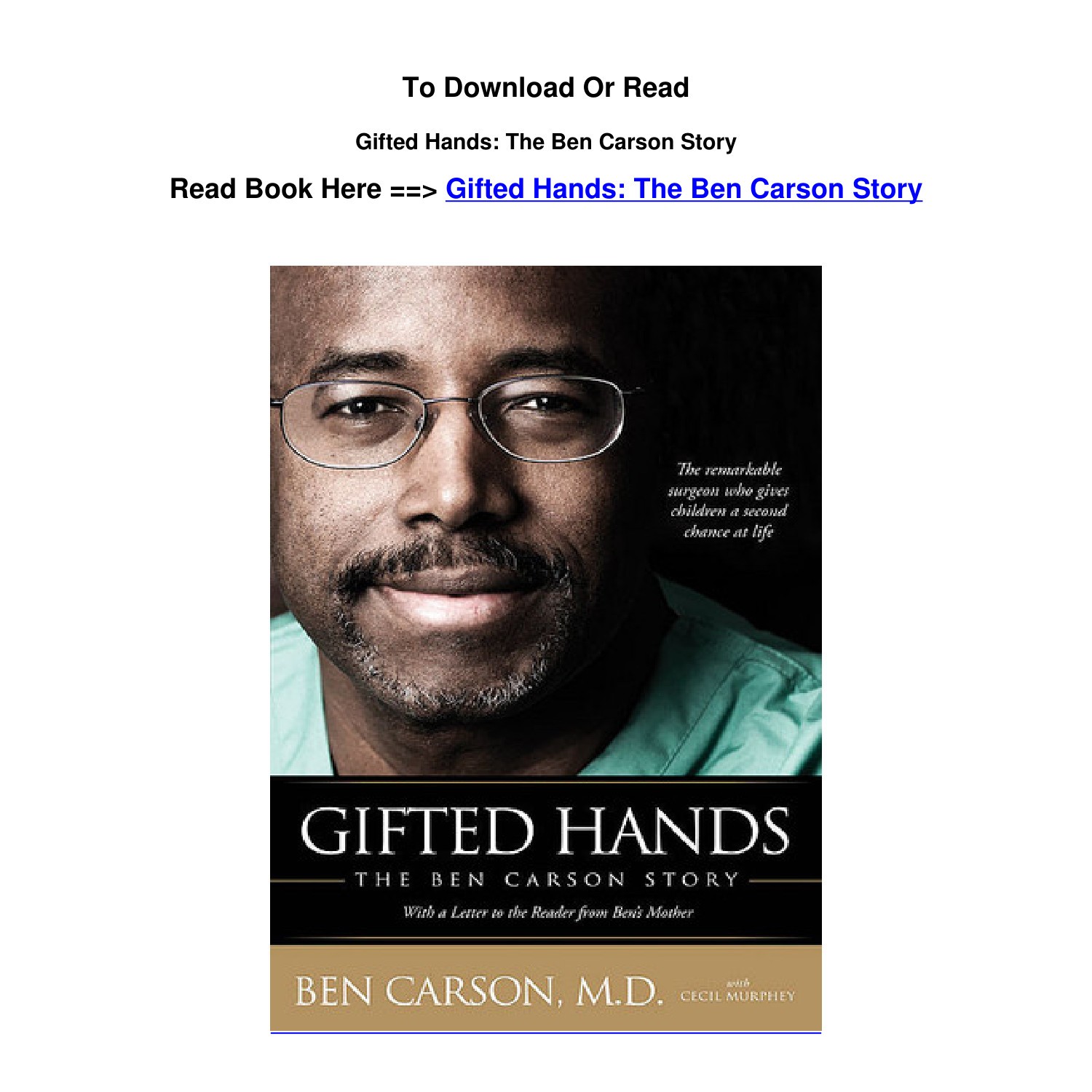
You’ve probably seen the movie. Cuba Gooding Jr. stares intensely at a model of conjoined twins, the music swells, and suddenly, a medical miracle happens. It’s the kind of story that feels almost too "Hollywood" to be real. A kid from the Detroit ghettos, failing his classes, labeled the "dummy" of the grade, somehow ends up as the Director of Pediatric Neurosurgery at Johns Hopkins at only 33 years old.
Honestly, the Ben Carson story Gifted Hands is way more complicated than a two-hour biopic can capture.
People love the "rags to riches" arc. They love the idea that Ben’s mother, Sonya Carson, forced him to read books and write reports she couldn't even read herself because she only had a third-grade education. That part is true. It’s also true that Ben had a temper so violent he once tried to stab a friend over a radio station choice. But when you dig into the actual history—the surgeries, the aftermath, and the life beyond the hospital—the narrative gets a lot more nuanced.
Beyond the "Dummy" Label: The Detroit Years
The foundations of the Ben Carson story Gifted Hands started in a broken home. Ben’s father, Robert, was a bigamist. When Sonya found out he had another secret family, the marriage imploded. Ben was eight.
Life became a scramble for survival.
Sonya worked two or three jobs at a time, mostly cleaning houses for wealthy people in Detroit and Boston. She saw how the "other half" lived. She noticed they didn't watch much TV; they read. So, she staged a domestic coup. She limited Ben and his brother Curtis to two TV programs a week. They had to go to the Detroit Public Library, check out two books, and hand-write reports for her.
The Turning Point in Fifth Grade
Ben was at the bottom of his class. His classmates mocked him. But once he started reading, things shifted. He went from a "D" student to the top of his class in about a year and a half. It wasn't just magic; it was the fact that he realized he could control his own brain.
But there was a darker side.
As his grades went up, so did his ego and his anger. The Ben Carson story Gifted Hands often glosses over the "locker incident." In high school, Ben got into a fight with a classmate and nearly hit him with a padlock. Later, he tried to stab a friend named Bob. The blade snapped on Bob's belt buckle.
That was the "God moment" for Carson. He locked himself in a bathroom with a Bible, read the Book of Proverbs, and allegedly never had a temper problem again. Whether you believe in the divine intervention or just a massive psychological shift, that was the day the "gifted hands" stopped clenching into fists.
The 1987 Surgery: A Medical Revolution or a Tragic Success?
If you mention the Ben Carson story Gifted Hands, most people immediately think of the Binder twins. 1987. Patrick and Benjamin Binder. These boys were joined at the back of the head—occipital craniopagus twins.
No one had ever separated twins joined this way where both survived.
Carson led a team of 70 people. They spent months practicing. The surgery itself took 22 hours. They used a technique called hypothermic arrest—basically cooling the boys' bodies down until their hearts stopped so they could work on the shared blood vessels without the kids bleeding out.
The Reality of the "Success"
Google the surgery today, and you’ll see it listed as a "success" because both boys survived the operation. But the reality for the Binder family was heartbreaking.
- Patrick Binder never spoke or walked. He spent years in a vegetative state before eventually passing away.
- Benjamin Binder fared slightly better but suffered from severe neurological delays and eventually required institutional care.
It’s a perspective people rarely talk about. Carson’s technical skill was undeniable—he did what no one else could—but the human cost was massive. This is where the Ben Carson story Gifted Hands meets the cold, hard reality of neurosurgery. It’s not always a "happily ever after." Sometimes, "success" just means they didn't die on the table.
Why the Story Still Resonates in 2026
We live in an era where everyone is looking for a shortcut. The Ben Carson story Gifted Hands is the opposite of a shortcut. It’s about "THINK BIG"—the acronym Carson later popularized:
- Talent/Time: Recognize your skills and don't waste time.
- Hope/Honesty: Stay positive and live with integrity.
- Insight: Learn from the successes and failures of others.
- Nice: Being kind to people actually gets you further.
- Knowledge: This is the big one. Knowledge makes you valuable.
- Books: Read everything.
- In-Depth Learning: Don't just skim the surface.
- God: For Carson, faith was the engine.
Actionable Insights from the Gifted Hands Legacy
If you're looking to apply the "Carson Method" to your own life or your kids' education, here’s the distilled version of what actually worked for him. It wasn't just "being smart."
The "Two-Book" Rule
Don't just read. Summarize. Sonya Carson didn't just tell her kids to read; she made them synthesize the information. If you want to master a subject, don't just consume it—write it down in your own words.
Mastering Three-Dimensional Reasoning
Carson’s "gift" wasn't just steady hands. It was his ability to see the brain in 3D. He spent years looking at X-rays and imaging until he could "see" around corners in the human skull. Whatever your craft is, you need to be able to visualize it from every angle before you touch the tools.
Calculated Risk-Taking
Carson was known for taking cases other doctors wouldn't touch. He famously performed hemispherectomies—removing half of a child’s brain to stop seizures. It sounds insane, but he reasoned that if the child was having 100 seizures a day, they already had no life. There was nothing left to lose.
Identify the "Belt Buckle" Moments
We all have a moment where we almost ruin everything. For Ben, it was the knife. For you, it might be a bad habit or a toxic trait. The lesson is that you don't have to be defined by your worst ten seconds. You can pivot.
The Ben Carson story Gifted Hands is a reminder that the brain is plastic—it can change, it can heal, and it can grow. Whether you’re a fan of his later political career or not, the medical legacy of the kid from Detroit who decided to pick up a book instead of a knife is a permanent part of American history.
To apply this to your own life, start by identifying one "low-value" activity you can replace with deep reading this week. Whether it's 30 minutes of scrolling or an hour of TV, swap it for a book on a subject you know nothing about. That is exactly how the "gifted hands" began.