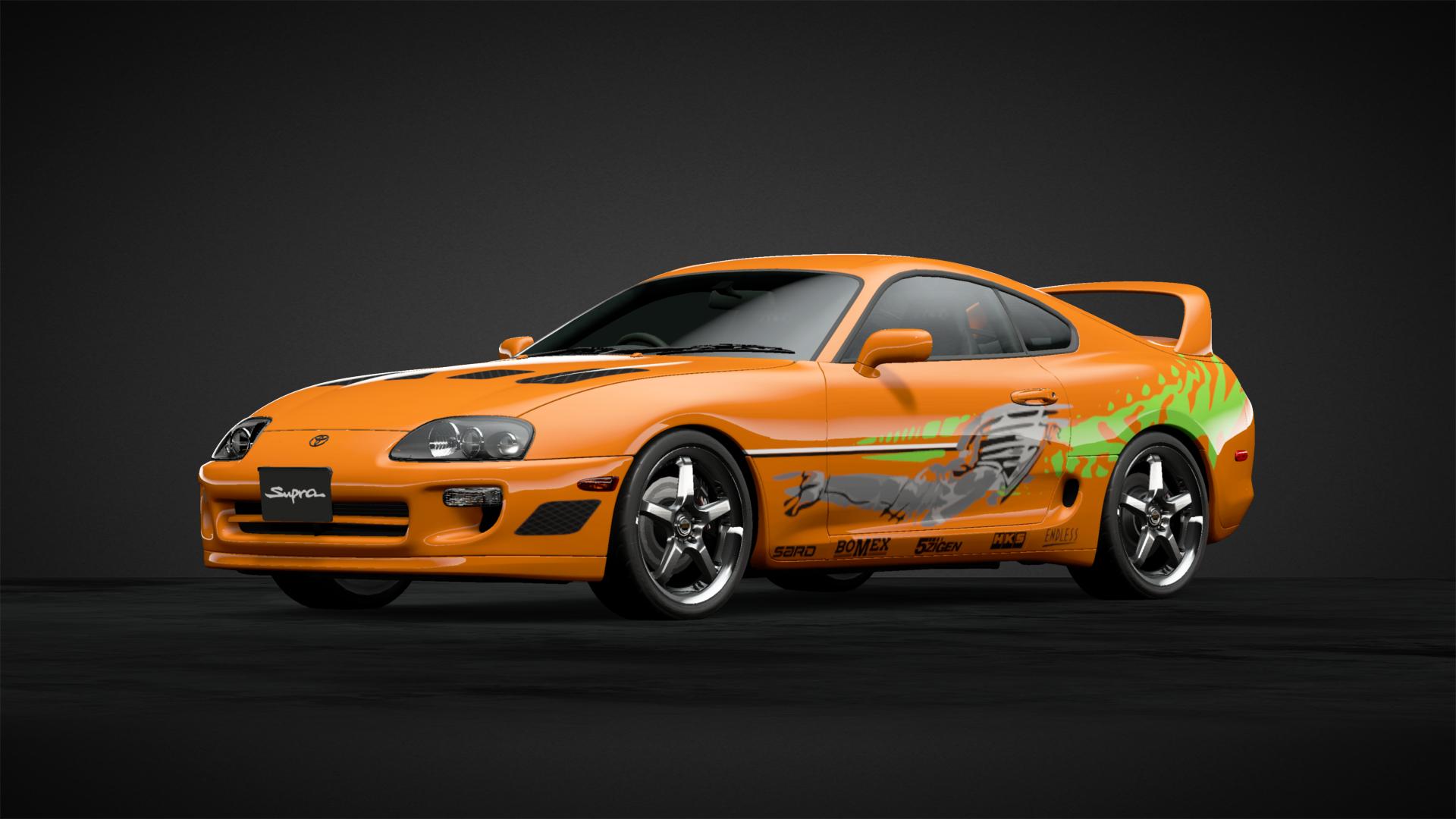
It was a junk heap. Honestly, when that rusted-out 1994 Toyota Supra Turbo first rolled onto the screen on the back of a flatbed truck in 2001, nobody—not even the most optimistic gearhead—could have predicted it would become the most famous movie car of the 21st century. Jesse called it a "ten-second car." Brian O’Conner saw potential.
The Fast and Furious Toyota Supra isn't just a prop; it’s the reason an entire generation knows what a 2JZ engine is. If you grew up in the early 2000s, that Candy Orange paint job and those Troy Lee Designs graphics were basically burned into your retina.
But here is the thing: the car wasn't just movie magic. It was a real-world beast.
The Real Story Behind the Hero Car
Technical director Craig Lieberman was the guy who actually sourced the cars for the original film. He didn't just find some random vehicle; he used his own personal 1994 Supra as the "Hero 1" car.
People forget that the movie had a tiny budget compared to the billion-dollar blockpots they make now. They couldn't afford to build twenty identical Supras from scratch. They used Lieberman’s car for the close-ups because it was already a show-stopper in the real-life SoCal tuning scene. It had the GReddy performance parts, the nitrous setup, and the iconic Stillen front bumper.
What was under the hood?
In the movie, they talk about "overnight parts from Japan" and a "2JZ engine." That wasn't just fluff. The 2JZ-GTE is a legendary 3.0-liter inline-six. It’s famous because the iron block is so overbuilt it can handle ridiculous amounts of boost without exploding.
Lieberman’s actual car was pushing about 544 horsepower. That’s plenty for the street, even if it wasn't quite the 10-second quarter-mile monster the script claimed. Interestingly, the "stunt" cars—the ones that actually jumped or crashed—were often powered by much weaker non-turbo engines or even hacked-together V8s just to keep them running for the cameras.
Why it looks the way it does
That orange color? It’s called Candy Orange, a Lamborghini shade.
The "Nuclear Gladiator" decal on the side has become one of the most replicated liveries in history. You’ll see it in Forza, in Gran Turismo, and on every other MK4 Supra at your local Cars and Coffee. It defines an era of "tuner" styling that was all about being loud, bright, and unashamedly aggressive.
The wing was a massive APR aluminum unit. In 2001, big wings were the height of cool. Today, some might call it "rice," but back then, it was the ultimate statement of performance.
The 1994 Supra vs. The World
The movie pitted the Fast and Furious Toyota Supra against a Ferrari F355 Spider in a famous street race scene.
"More than you can afford, pal. Ferrari."
"Smoke 'em."
That exchange basically summarized the ethos of the entire franchise: the underdog Japanese import taking down European royalty. Even though a stock 1994 Supra wouldn't necessarily "smoke" a Ferrari F355 without significant mods, the 2JZ platform made it possible in the real world. That’s why the scene resonated so deeply. It felt plausible to the kids working in their garages.
The "10-Second Car" Myth and Reality
In the film, Dominic Toretto demands a "ten-second car" to settle a debt.
Let's be real for a second. Running a 10-second quarter mile is incredibly fast. Even today, a modern Porsche 911 Turbo S barely dips into the 10s. In 2001, a 10-second street car was a unicorn.
To get the Fast and Furious Toyota Supra to actually hit those numbers, you’d need more than just a "big turbo" and "nitrous." You’d need massive rear slicks, serious suspension tuning, and a drivetrain that wouldn't snap the first time you launched it. The movie skipped over those boring mechanical details for the sake of drama, but that didn't stop thousands of fans from trying to build their own versions.
The Paul Walker Legacy
You can't talk about this car without talking about Paul Walker.
Walker was a genuine car enthusiast. He didn't just play one on screen. He owned Supras, Skylines, and a fleet of BMW M3s. His chemistry with the MK4 Supra felt authentic because he actually respected the machine.
When the film wrapped, several of the stunt cars were sold off. One of the original stunt cars—driven by Walker in the film—sold at a Barrett-Jackson auction in 2021 for a staggering $550,000.
Think about that.
A car that was originally a $40,000 sports car sold for half a million dollars because of its silver-screen pedigree. It’s arguably the most valuable Japanese car on the planet right now, rivaling the Toyota 2000GT.
Common Misconceptions About the Movie Car
- It wasn't all one car. Production used about eight Supras. One was the "Hero" car for interiors/close-ups, and the rest were "Stage" or "Stunt" cars built for specific tasks.
- The sound wasn't always a 2JZ. If you listen closely to some of the gear shifts in the movie, they dubbed in sounds from other cars to make it sound "cooler" to a general audience.
- The interior was mostly fake. The "high-tech" screens showing fuel maps and system checks were often just video loops playing on basic monitors.
The White Supra in Furious 7
While the orange car is the icon, the white 1995 Toyota Supra at the end of Furious 7 holds more emotional weight for many fans.
That car actually belonged to Paul Walker's personal collection. Using his own car for the "See You Again" tribute scene was a poetic way to retire the character of Brian O’Conner. It brought the story full circle—from the loud, flashy orange tuner car to a clean, sophisticated, and mature white Supra.
How to Build a Tribute (The Right Way)
If you’re crazy enough to try and build a Fast and Furious Toyota Supra replica today, be prepared to empty your bank account.
- Find a Shell: MK4 Supras are getting rare. A clean, non-turbo shell can still cost $50,000. A factory Turbo (GTE) model? You’re looking at $80,000 to $120,000 before you even buy the paint.
- The Body Kit: You need the Bomex front spoiler and side skirts. These aren't as common as they used to be, but several companies still manufacture replicas.
- The Graphics: Don't try to paint them. Get a high-quality vinyl wrap. Modern printing technology means you can get the "Nuclear Gladiator" design pixel-perfect.
- The Wheels: You need the Dazz Motorsport Racing Hart M5 Tuner wheels. These are incredibly hard to find now. Most builders settle for modern replicas that look similar.
The Cultural Impact
The Fast and Furious Toyota Supra changed the car industry.
Before this movie, Japanese imports were a niche subculture. After the movie, the price of Supras, RX-7s, and Skylines skyrocketed. It birthed the "tuner" era of the mid-2000s, influencing everything from Need for Speed: Underground to the way we customize cars today.
It proved that a Toyota could be just as aspirational as a Ferrari.
Even the new MK5 Supra, developed with BMW, constantly lives in the shadow of the orange MK4. Every time Toyota releases a new special edition, fans immediately ask: "When are we getting the orange one?"
Your Next Steps for Supra Fandom
If you’re looking to dive deeper into the world of the 2JZ, here is what you should actually do.
- Watch the Technical Breakdowns: Search for Craig Lieberman's YouTube channel. He’s the original technical advisor and has hours of footage explaining exactly how every car in the first two films was built, including the receipts.
- Check the VINs: If you’re ever at a car show and see a "movie car," look at the dashboard. Most of the real movie Supras are accounted for in private collections or museums like the Petersen Automotive Museum in LA.
- Research the 2JZ-GTE: Understand the difference between the VVTi and non-VVTi versions before you consider buying a project car. The non-VVTi (found in the earlier MK4s) is generally preferred for massive horsepower builds because of the thicker connecting rods.
- Visit a Major Auction: Keep an eye on Mecum or Barrett-Jackson. While you might not buy one, seeing a documented movie car go across the block is a masterclass in car valuation and history.