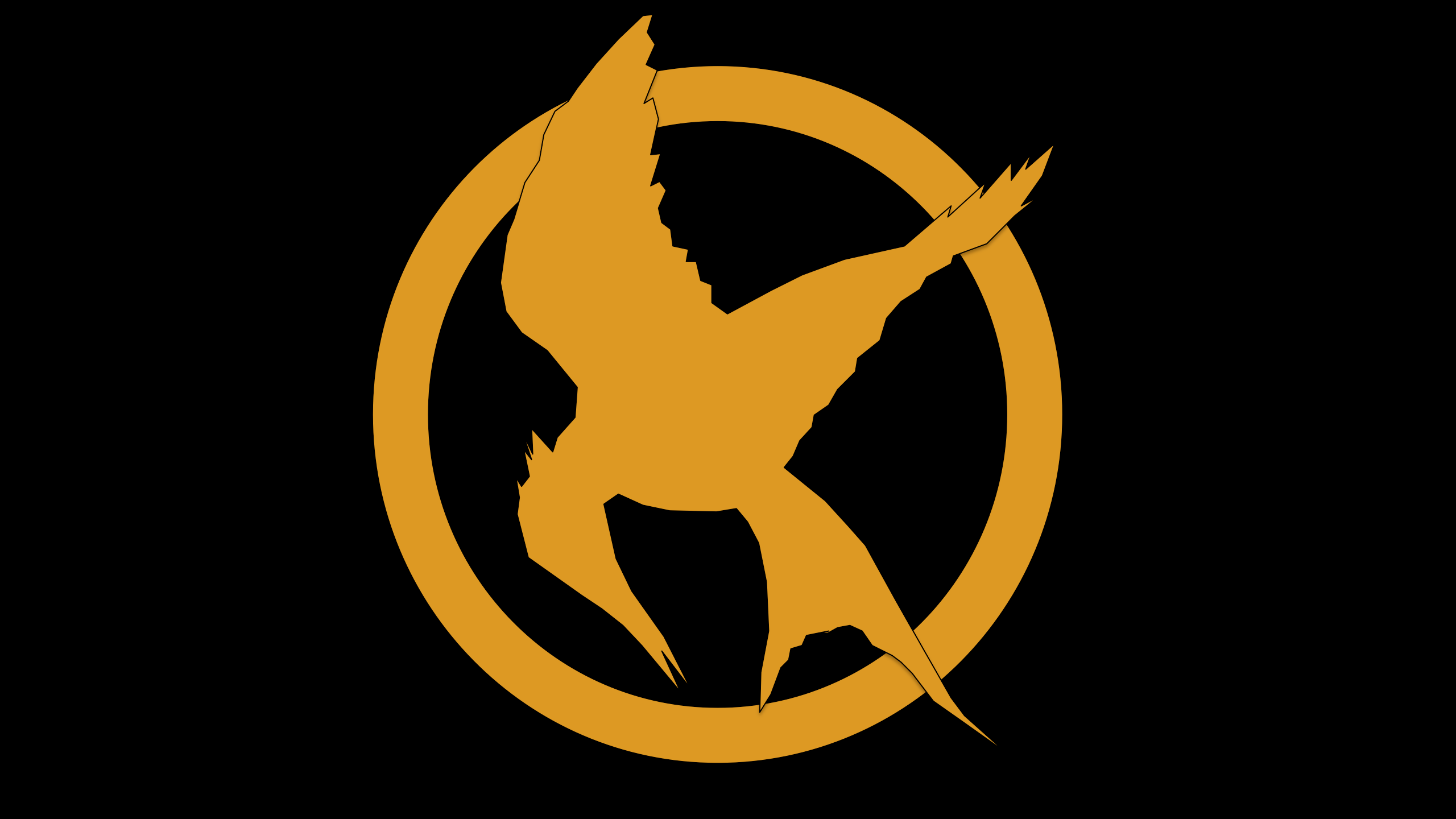
You know it the second you see it. That gold bird, wings flared, clutching an arrow in its beak. It's everywhere. From t-shirts to protest signs in the real world, the Hunger Games logo has transcended the books and movies to become something way bigger. Honestly, it’s rare for a fictional brand to escape the screen and actually mean something to people in their everyday lives.
Suzanne Collins didn't just pick a bird at random. The Mockingjay is a literal accident of nature within the story—a hybrid between the Capitol’s failed "Jabberjay" spy birds and common mockingbirds. It’s a middle finger to the government. When Tim Palen and the marketing team at Lionsgate got their hands on it for the 2012 film launch, they didn't just make a pretty picture. They created a visual shorthand for defiance.
The Evolution of the Mockingjay Pin
If you look back at the original book cover designed by Tim O'Brien, the logo was a bit more grounded. It looked like an actual piece of jewelry you might find in a vintage shop. It was gold, yes, but it felt heavy and tactile. By the time the movies rolled around, the Hunger Games logo started to "set on fire." It wasn't just a bird anymore; it was a transition.
In Catching Fire, the bird’s wings started to spread. By Mockingjay Part 1 and Part 2, the bird was fully upright, wings wide, looking less like a piece of District 12 scrap metal and more like a coat of arms. It’s interesting how the design reflected Katniss Everdeen's own journey from a girl trying to survive to a reluctant symbol of a global revolution. Design-wise, it follows a classic progression:
- The "Resting" phase (The Hunger Games)
- The "Awakening" phase (Catching Fire)
- The "Liberation" phase (Mockingjay)
Designers often talk about "silhouette value." If you can recognize a logo just by its outline, it’s a winner. The Mockingjay passes this test with flying colors. Even without the gold texture or the flaming background, that specific posture of the bird is unmistakable.
Why the Circular Border Matters
Most people ignore the ring around the bird. Don't. It’s actually a huge part of why the Hunger Games logo works so well as a brand. Circles represent many things: unity, cycles, or even a target. In the context of the Games, the circle is basically the Arena. It's a cage.
Notice how in the later versions of the logo, the bird’s wings and the arrow start to break outside the circle. That’s not just a cool 3D effect. It's a visual metaphor for breaking the system. It symbolizes the Districts literally overstepping the boundaries the Capitol set for them. It's subtle, but your brain picks up on that feeling of "breaking out."
The Real-World Impact of the Image
It’s kinda wild to think about, but the Hunger Games logo has actually been used in real political protests. We've seen it in Thailand and Myanmar, often accompanied by the three-finger salute. When a logo is so well-designed that it can be spray-painted on a wall in a real-world conflict to represent a fight against authoritarianism, you know the designers did something right.
It’s simple enough for a kid to draw but recognizable enough to carry weight. That’s the "Goldilocks zone" of graphic design. If it were too complex, like a traditional family crest, it wouldn't have been adopted by the masses. If it were too simple, it would be forgettable.
The Color Palette of Rebellion
Why gold? Well, it contrasts perfectly with the gritty, coal-dust aesthetic of District 12. But it’s also the color of the Capitol’s excess. By making the Hunger Games logo gold, the rebels are basically reclaiming the wealth of their oppressors. It says "we are valuable, too."
Then you add the fire. The orange and red gradients used in the film posters aren't just for action-movie vibes. They represent the "Girl on Fire." It’s a warm palette that suggests heat, energy, and destruction—but also rebirth. Like a phoenix, which the Mockingjay clearly draws inspiration from, though Suzanne Collins has been clear that it’s its own unique species.
Behind the Scenes: Creating a Global Brand
Lionsgate’s marketing for the films was famously "in-world." They didn't just sell a movie; they sold "Capital Couture." They treated the Hunger Games logo as if it were a high-fashion brand, which made the eventual rebellion feel much more impactful.
The motion posters were a big deal back then. Seeing the logo slowly rotate while the flames flickered was one of the first times a movie logo felt "alive" in digital spaces. It wasn't just a static JPG. It was a breathing entity. This helped the franchise dominate early social media, specifically Tumblr and Pinterest, where aesthetic was everything.
Common Misconceptions About the Logo
People often think the bird is a phoenix. It's not. It’s also not a hawk or an eagle. The Mockingjay is a "slap in the face" to the Capitol because it represents a failure of their bio-engineering. The Capitol created Jabberjays to spy on people, but the birds mated with mockingbirds and created something new that the government couldn't control.
Another thing: the arrow. In the Hunger Games logo, the bird is usually shown holding an arrow or with an arrow passing behind it. This is a direct link to Katniss, of course, but it also symbolizes the transition from being the "hunted" to being the "hunter."
What Makes It "Human-Quality" Design?
The logo feels like it was made by hand. Even the sleek movie versions maintain a bit of that "stamped metal" texture. In a world of flat, corporate Google-style logos, the Hunger Games logo feels tactile. It feels like something you could find in the dirt and pin to your jacket.
That's the secret sauce.
When things feel too digital, we lose our connection to them. The Mockingjay works because it feels like it belongs to the characters in the story, not just a marketing department in Los Angeles. It’s "diegetic" design—design that exists within the world of the story.
How to Use the Symbolism Today
If you're a designer or a brand builder, there's a lot to learn here. You don't need a complex mascot. You need a silhouette with a story.
- Focus on the "why" behind the symbols.
- Use contrast (like gold against coal).
- Let the logo evolve as the story evolves.
The Hunger Games logo didn't stay the same for four movies, and it shouldn't have. It grew up. It got louder. It got brighter.
Actionable Steps for Fans and Creators
If you're looking to incorporate the aesthetic of the Hunger Games logo into your own projects or just want to appreciate it more, here’s how to look at it through an expert lens.
First, look at the "negative space." In many versions of the logo, the space between the bird's wings and the circle is just as important as the bird itself. It creates a sense of tension.
Second, check out the typography. The font used for the movies is often a modified version of Bank Gothic or similar heavy, sans-serif typefaces. It’s "authoritarian" and "industrial." Pairing that heavy text with a delicate bird creates an instant visual conflict.
Finally, think about the material. If you're making fan art or a brand, consider how the logo would look if it were carved into wood or cast in bronze. The Mockingjay works because it’s not just a drawing; it’s an object.
To really understand the impact, try drawing the bird from memory. You’ll probably get the basic shape right—the wings, the tail, the arrow. That’s the mark of a legendary logo. It lives in your head, not just on a screen.
When you're analyzing any franchise logo, ask yourself if it could lead a movement. Most can't. This one did. Whether it’s on a book cover or a protest banner, the Hunger Games logo remains one of the most powerful examples of visual storytelling in the 21st century. It’s simple, it’s defiant, and it’s impossible to ignore.
The next time you see that gold bird, look closer at the wings. They aren't just feathers. They're a map of a revolution that started with a single girl and ended with a whole world changing its tune.
Insights for Designers
To apply these principles to your own work, start by stripping away all color. If your symbol doesn't communicate its core message in black and white, it’s too dependent on "fluff." The Mockingjay is powerful as a silhouette first and a gold icon second. Focus on the silhouette to ensure your design has the same longevity. Look for "organic" shapes that can be easily reproduced by hand; this encourages community adoption and "fan" engagement, making the brand feel like it belongs to the people.
Final Takeaway
The Mockingjay isn't just a bird. It's a reminder that even the most "perfect" systems have flaws—and those flaws are usually where the most beautiful things grow. In branding, as in revolution, the "accidents" are often the parts that people remember most. Use that. Embrace the imperfections. Build something that feels like it has a soul. That's how you create an icon that lasts for decades.