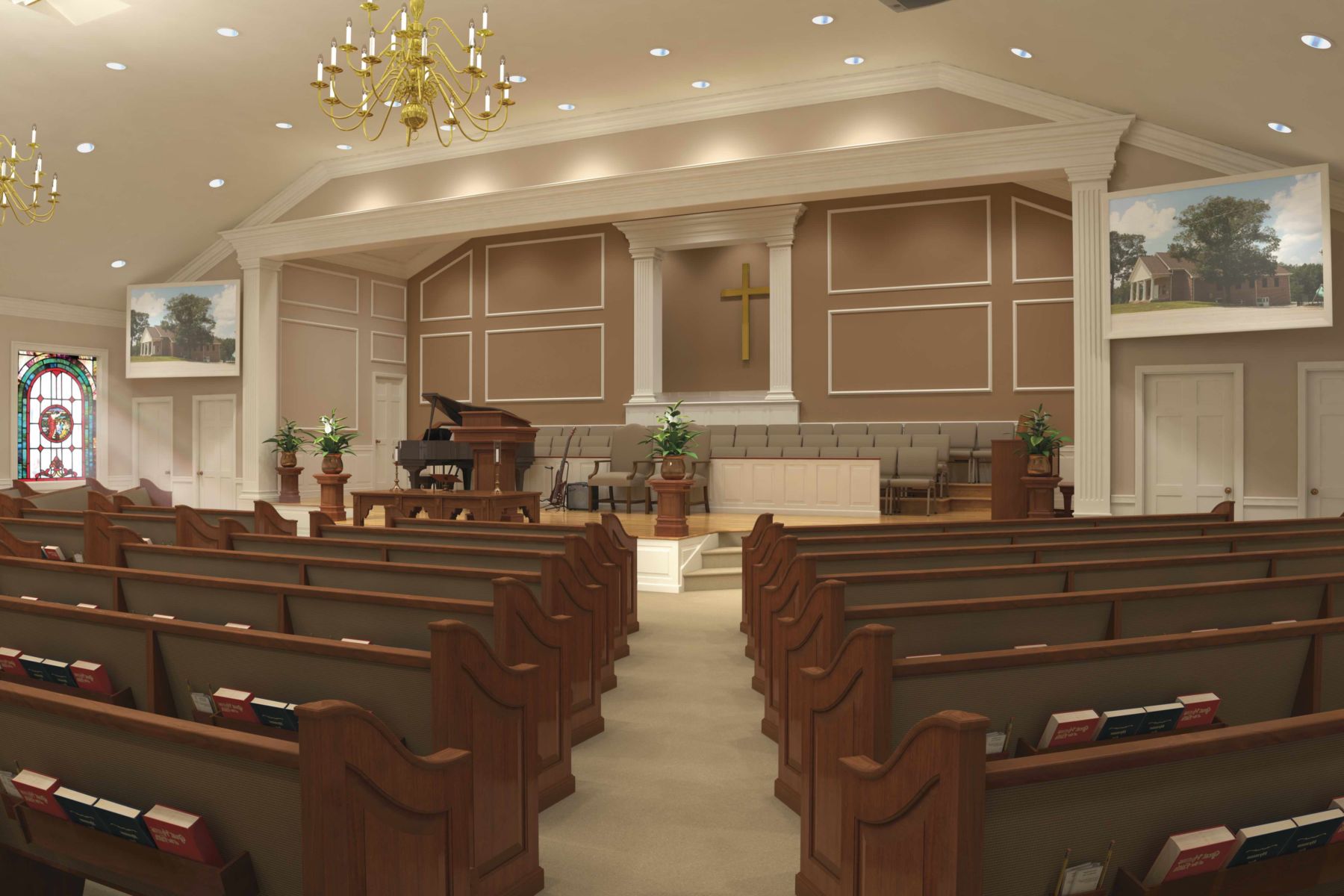
Walk into a cathedral and you feel it immediately. That weird, heavy silence. It’s not just the absence of noise; it’s the way the air seems to press against your skin. Most people think the interior of a church is just about pews and some dusty stained glass, but there is a massive psychological engine running under the hood of these buildings. Architecture isn't neutral. It’s an argument in stone and wood.
Honestly, we’ve kind of forgotten how to build spaces that make us feel small in a good way.
If you’ve ever sat in a 12th-century Romanesque chapel versus a 1970s "multipurpose" worship center, you know the vibe shift is real. One feels like a fortress for the soul. The other feels like a community college lecture hall that happens to have a cross on the wall. The layout, the lighting, and even the smell of old floor wax are all doing specific work on your brain.
The Anatomy of the Interior of a Church
The basic skeleton of a traditional church interior follows a blueprint that’s been refined over roughly two thousand years. It’s not just random. You have the Nave, which is where the people sit. The word actually comes from navis, Latin for ship. The idea was that the church was a vessel carrying the faithful through the stormy seas of the world. Kind of poetic, right?
Then you have the Chancel or the Sanctuary. This is the "business end" of the building. In high-liturgical traditions, like Catholicism or Eastern Orthodoxy, this area is often separated by a rail or a screen. The Iconostasis in Orthodox churches is a literal wall of icons. It’s meant to represent the boundary between heaven and earth. It’s not there to hide things; it’s there to remind you that you’re entering a different kind of reality.
The Power of the Vertical Axis
Gothic architecture changed everything. Before the 1100s, churches were chunky. Thick walls. Tiny windows. It felt safe but dark. Then, builders like Abbot Suger at the Abbey of Saint-Denis started obsessing over light. They wanted the interior of a church to look like it was defying gravity. They used pointed arches and flying buttresses to push the ceilings higher and higher.
When you look up in a Gothic cathedral, your eyes are forced toward the ceiling. This is a deliberate "vertical axis." It’s designed to make you feel tiny. In a world where we spend most of our time looking down at phones or straight ahead at TV screens, that upward pull is a massive physiological reset.
Why Modern Church Interiors Often Fail
There is a huge debate right now in the world of sacred architecture. Critics like Duncan Stroik argue that we’ve lost the "language" of the sacred. Since the mid-20th century, there’s been a trend toward "brutalist" or "minimalist" church interiors. Think concrete. Think theater seating. Think "theological efficiency."
The problem? Humans aren't particularly efficient creatures.
We respond to beauty. When the interior of a church looks exactly like the office building where you work or the mall where you buy shoes, the brain doesn't get the signal to switch gears. It stays in "secular mode." This is why you see a resurgence in traditionalist architecture. People are craving the "smells and bells" because modern minimalism often feels sterile rather than peaceful. It’s basically the difference between a hospital waiting room and a candlelit library.
The Psychology of Stained Glass
It isn't just about pretty pictures of saints. Stained glass serves a mechanical purpose in the interior of a church. It’s a light filter. In the Middle Ages, these windows were known as "The Poor Man’s Bible." Most people couldn't read, so they learned the stories through the glass.
But there’s more to it. Light passing through colored glass creates a "shimmer" effect. It’s called lux nova or "new light." It changes as the sun moves. It makes the interior feel alive. If you sit in the Sainte-Chapelle in Paris at 2:00 PM on a sunny day, the walls literally disappear into a haze of violet and red. It’s disorienting in the best possible way. It breaks your connection to the outside world.
The Role of Sound and Acoustic Design
Ever wonder why you can't help but whisper inside a cathedral? It’s the "reverb time."
A standard living room has a reverb time of maybe 0.5 seconds. A large stone church can have a reverb time of 5 to 8 seconds. This means a single note on an organ or a choir’s "Amen" hangs in the air long after the sound has actually stopped. This creates a sense of "timelessness." It’s an acoustic trick that makes the interior of a church feel like it exists outside of the normal ticking clock.
Modern "stadium-style" churches hate this. They want dry acoustics so the electric guitars don't sound like a muddy mess. So, they cover the walls in foam and carpet. It’s great for a rock concert, but you lose that haunting, lingering echo that makes a space feel ancient.
Functional Items You Might Miss
If you look closely at the interior of a church, every piece of furniture has a name you probably forgot from Sunday school.
- The Ambo/Pulpit: It’s usually raised. This isn't just so people can see the speaker. It’s about the "authority" of the word being spoken.
- The Font: Usually near the entrance. It’s a symbolic "entry point" into the community.
- The Reredos: The big decorative wall behind the altar. Sometimes it’s a massive painting; sometimes it’s carved wood. It’s the visual "period" at the end of the architectural sentence.
- The Sedilia: Stone seats built into the wall. These were for the priests to sit on during long services. They are often incredibly uncomfortable, which was probably the point.
What People Get Wrong About "Grandeur"
A common misconception is that a beautiful interior of a church is just a flex of wealth. History says otherwise. Often, these cathedrals were built by communities that were objectively poor. They poured their resources into a single building because it was the only "public" space they had. It was the village’s living room, theater, and sanctuary all rolled into one.
When you strip the beauty out of a church interior to "save money" or be "relevant," you’re often taking away the one place where a regular person can experience high art and silence for free.
Actionable Steps for Exploring Church Interiors
If you want to actually appreciate these spaces, don't just walk in and take a selfie.
- Check the "Orientation": Most traditional churches are built on an East-West axis. The altar is usually at the East end, facing the rising sun (a symbol of the resurrection). See if you can find the compass points.
- Look for the "Easter Eggs": Medieval stone masons were notorious for carving weird things into high corners. Look for "grotesques" (basically gargoyles that don't spout water) or "green men" (faces made of leaves). They represent the wildness of nature being brought into the order of the church.
- Sit in the back, then move to the front: Notice how your perspective changes. The interior of a church is designed as a journey. The closer you get to the altar, the more "intense" the decoration usually becomes.
- Listen to the silence: Stop talking for three minutes. Notice how the building breathes. The acoustics are part of the architecture just as much as the bricks are.
The interior of a church is one of the last places in modern society where you are "allowed" to do nothing. No one expects you to buy anything. No one expects you to be productive. It’s a machine designed for contemplation. Whether you're religious or not, the sheer engineering required to make a human being feel both insignificant and deeply peaceful at the same time is worth paying attention to.
Next time you pass an old church with the doors open, go inside. Don't look at your phone. Look at the way the light hits the floor. Notice how the ceiling disappears into the shadows. That's the architecture doing exactly what it was built to do over a thousand years ago. It’s still working.