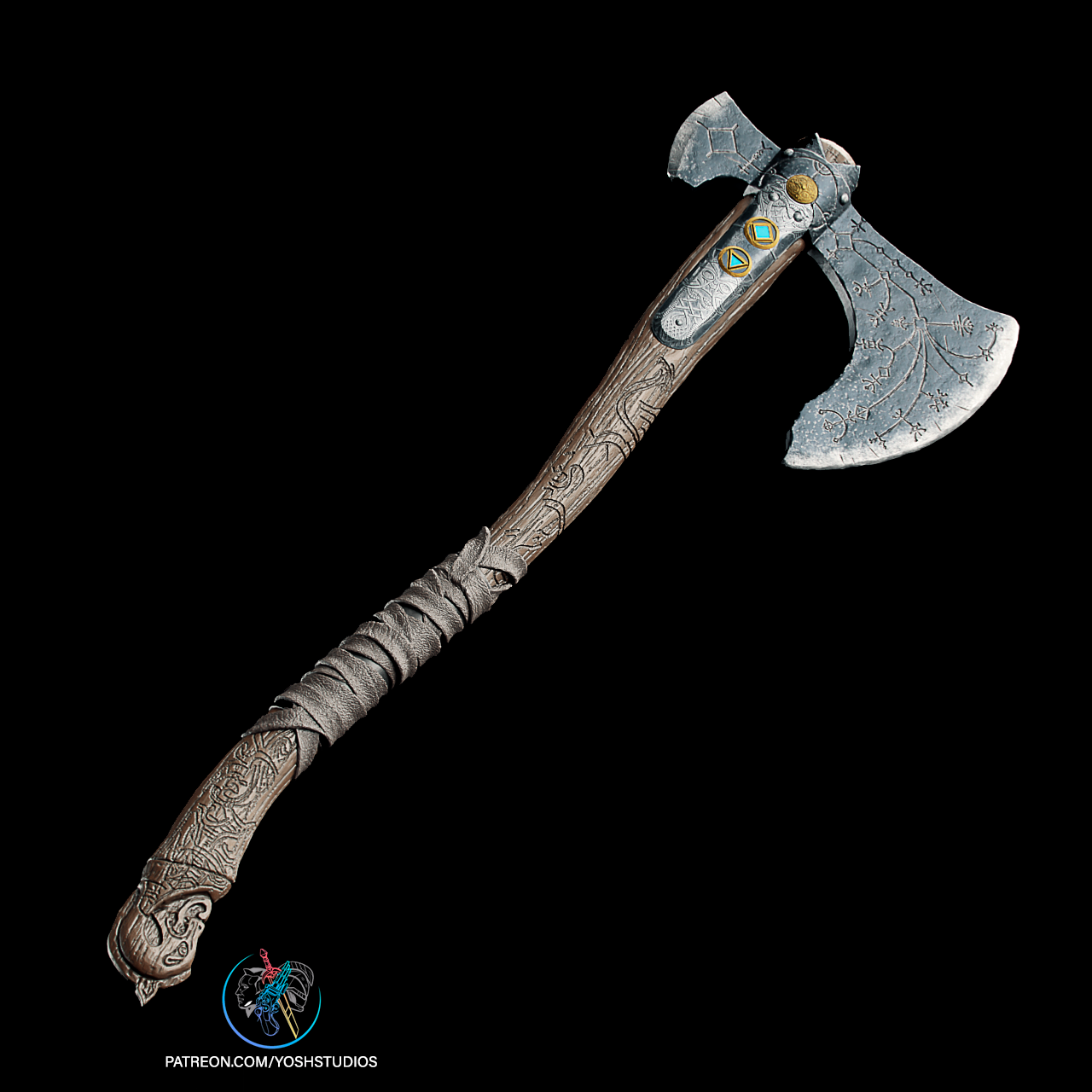
Kratos was always the "Blades of Chaos" guy. For over a decade, those flaming chains defined him. They were loud, chaotic, and honestly, a bit repetitive. Then 2018 happened. Santa Monica Studio took a massive gamble by handing the Ghost of Sparta a cold, heavy hunk of metal called the Leviathan Axe and telling players to just deal with it. It worked. Better than anyone expected.
The Leviathan Axe isn't just a tool for hitting things. It’s the mechanical heart of the modern God of War series. When Cory Barlog and his team decided to swap the blades for an axe, they weren't just changing a weapon; they were changing how we feel the game. It’s heavy. It’s deliberate. And the way it flies back to your hand? That might be the single most satisfying button press in the history of action games.
Where did the Leviathan Axe actually come from?
Most people assume it’s just a Norse version of Mjolnir. That’s partially true, but the lore is a bit more tragic. The axe was forged by the Huldra Brothers—Brok and Sindri—the same eccentric blacksmiths who made Thor’s hammer. They felt a massive amount of guilt for the destruction Mjolnir caused in the hands of the Aesir. To balance the scales, they created the Leviathan.
It was originally gifted to Laufey the Just, or Faye, who was Kratos’s second wife and Atreus’s mother. She used it to protect the Jotnar before passing it to Kratos on her deathbed. It’s a "Frost" weapon, specifically designed to counter the "Lightning" of Mjolnir. This isn't just flavor text. In the game’s logic, the axe is infused with the echoes of twenty souls of the frost giants. That’s why it freezes enemies solid. It’s literally a piece of Jotunheim’s legacy.
Brok and Sindri are pretty vocal about their craftsmanship throughout the games. If you pay attention to the dialogue in God of War Ragnarök, they mention how the axe was built to be the "equal and opposite" of the hammer. It’s a story of redemption for the smiths. They made a monster, so they had to make a hero’s weapon to stop it.
The "Recall" mechanic is basically magic physics
Let’s talk about the feel of the thing. The recall. You press Triangle (or Y on PC), and it snaps back. Behind the scenes, the developers spent months—literally months—just getting that one movement right. Lead combat designer Mihir Sheth has talked about how they had to tweak the "wobble" and the sound design to make it feel weighty.
If the axe just flew back in a straight line like a magnet, it would feel boring. Instead, it has a slight arc. It hits things on the way back. You can throw the axe past an enemy, then recall it so it strikes them in the back. This isn't just a combat move; it’s a puzzle-solving tool. It makes the player think about positioning in a 3D space.
It’s also surprisingly versatile. You’ve got the light throws for speed and the heavy throws that freeze gear mechanisms in place. The axe stays where you put it. You can walk three rooms away, and that axe is still wedged in a wooden pallet, holding a door open. That level of persistence was a huge technical hurdle for the PS4 back in 2018, but it’s what makes the world feel real.
Upgrades and the "Runic" problem
In the older games, you just mashed red orbs into your blades to make them glow. The Leviathan Axe is more complicated. You need Frozen Flames to upgrade the base stats, which are usually dropped by bosses like trolls or the Huldra brothers themselves.
Then you have the Runic attacks. This is where the customization gets deep.
- Light Runic Attacks: Usually for crowd control, like the Winter’s Bite or the Njord’s Tempest.
- Heavy Runic Attacks: These are the heavy hitters, like Ivaldi’s Anvil.
Honestly, a lot of players stick to the same two runes for the whole game. That’s a mistake. Some runes are specifically better for staggering bosses, while others are meant for clearing out those annoying nightmares or draugr swarms. The versatility is the point. You can build Kratos to be a "Cooldown" beast where he’s constantly spamming magic, or a "Strength" tank who just relies on the raw physical damage of the blade.
It’s a narrative mirror for Kratos
Think about the difference between a sword and an axe. A sword is for soldiers. An axe is for woodsmen. At the start of the 2018 game, Kratos is trying to be a man, not a god. He’s cutting down trees for his wife’s funeral pyre. The axe is a tool of labor before it’s a tool of war.
This mirrors Kratos’s internal struggle. He’s trying to bury the "Ghost of Sparta" persona. The Blades of Chaos represent his past—chains, fire, mindless rage, and slavery to Ares. The Leviathan Axe represents his present—ice, stoicism, fatherhood, and his connection to Faye.
When he finally has to go back and get the Blades in the middle of the game because the axe can’t hurt the Hel-walkers, it’s a massive emotional beat. It feels like a defeat. He’s forced to pick up the tools of his shame. But by the time we get to Ragnarök, he’s mastered both. He switches between them seamlessly, using the axe to freeze and the blades to burn. It shows he’s finally integrated his two halves.
Technical Tips for Mastering the Axe
If you're playing through the Norse saga right now, there are a few things most people miss about the combat flow. First off, learn the "cleave" move as soon as possible. Holding R2 for the Executioner’s Cleave deals massive damage and has high stagger value. It’s risky because of the wind-up, but it’s the best way to end a fight quickly.
Also, don't forget the bare-handed combat. Sometimes, the best thing you can do with the Leviathan Axe is throw it at an enemy's head and leave it there. Kratos deals way more "Stun" damage with his fists and shield. You can fill up an enemy's stun meter, perform a finisher, and then recall the axe at the last second. It makes you feel like a tactical genius.
The pommels matter too. Early on, you might just pick the one with the highest numbers. Later, look for "Perks." Some pommels have a low chance to grant a "Blessing of Runic" or a burst of health on a successful hit. These triggers happen way more often than the game lets on, especially if you have a high Luck stat.
Why it remains the gold standard
Since 2018, a lot of games have tried to copy the "weighty" feel of the Leviathan Axe. Very few succeed. It’s because the axe isn't just a static object; it’s a bunch of systems working together. The haptic feedback on the DualSense controller in the PS5 version adds another layer. You can actually feel the "thud" when it hits Kratos's palm.
It’s rare for a weapon to become as iconic as the character wielding it. Link has the Master Sword. Arthur has Excalibur. Now, Kratos has the Leviathan. It’s a masterpiece of game design that turned a one-dimensional rage monster into a complex, grieving father.
Actionable Steps for Players
- Prioritize the "Permafrost" Skill: In both games, this rewards you for not getting hit. If you can keep your momentum up, the axe begins to deal frost damage on every hit, which slows enemies down significantly.
- Check your Labors: Many players ignore the "Axe Throw" labors in the menu. Completing these gives you massive XP boosts early in the game, which allows you to unlock the high-tier skills much faster than just following the main story.
- Experiment with the Shield: Remember that the axe is a one-handed weapon. You can parry while holding it. Learning the parry timing for the specific enemy types (like the Travellers) is way more effective than just dodging.
- Don't hoard your resources: Brok and Sindri are everywhere. If you have the materials to upgrade the axe, do it. The power level scaling in God of War is strict; being even one level under an enemy makes the fight exponentially harder.
The Leviathan Axe is more than a weapon; it is the bridge between the old Kratos and the new. It requires precision, patience, and a bit of soul. Whether you are freezing a gear to open a hidden chest or splitting a dark elf in two, every movement feels intentional. That's the hallmark of great design.