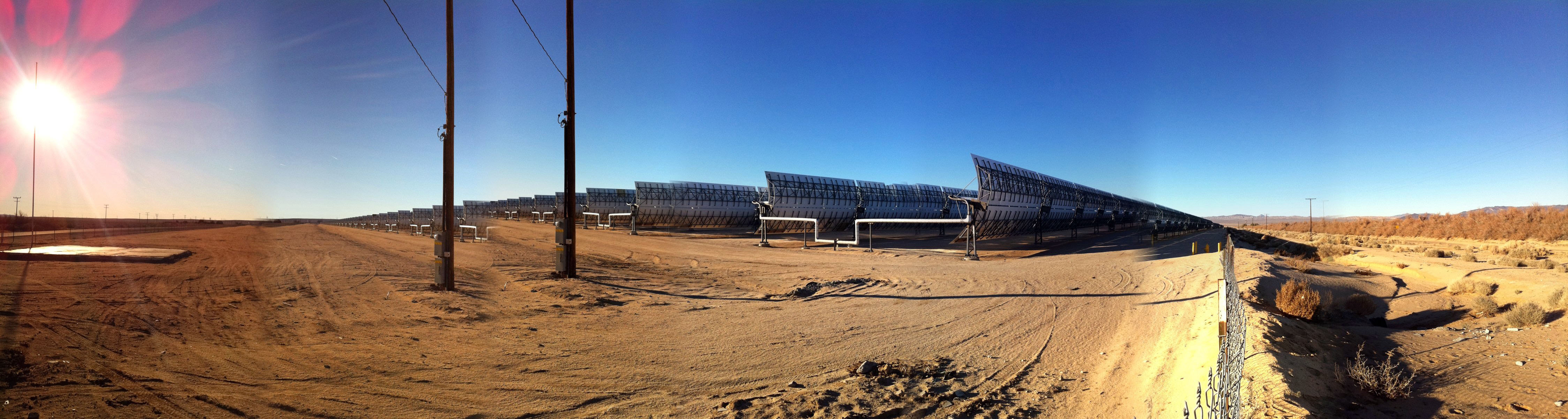
Drive out past Barstow toward the Nevada line and you’ll see it. It’s hard to miss. Thousands of mirrors tilted toward the sun, shimmering like a lake in the middle of a literal wasteland. People get it confused with the Ivanpah project all the time—the one with the glowing towers that look like something out of Blade Runner. But the Mojave Solar Power Plant is different. It’s quieter. It’s arguably more reliable. Honestly, it’s the project that proved concentrated solar power (CSP) wasn't just a fever dream of the late 2000s.
Construction finished back in 2014. It was a massive undertaking by Abengoa Solar, funded in part by a $1.2 billion loan guarantee from the Department of Energy’s Loan Programs Office. That’s a lot of taxpayer skin in the game. But unlike some other "green" experiments that fizzled out or became punchlines for political debates, this 250-megawatt facility actually does what it said it would do. It powers roughly 90,000 California homes. No small feat.
The scale is staggering. We’re talking about 1,700 acres of Mojave Desert. That’s roughly 1,300 football fields filled with parabolic troughs. If you’ve never seen a trough system up close, imagine a giant U-shaped mirror. It’s not flat. It’s curved to catch sunlight and focus it on a single pipe running down the center.
What Most People Get Wrong About the Mojave Solar Power Plant
People hear "solar" and they think of the blue panels on their neighbor’s roof. That’s Photovoltaic (PV). The Mojave Solar Power Plant doesn't work like that at all. It’s basically a giant plumbing system. Those parabolic mirrors heat up a synthetic oil—specifically a heat transfer fluid—to about 740 degrees Fahrenheit. This hot oil then flows through heat exchangers to create steam. That steam spins a traditional turbine.
It’s old-school industrial tech meeting new-school energy needs.
One big misconception is that these plants are "bird killers." You might have read stories about Ivanpah—the "power tower" design—singeing birds in mid-air because the light is focused at a single point in the sky. The Mojave Solar project uses troughs. The heat is concentrated much lower to the ground, inside the pipes. It’s a significantly safer design for local wildlife. While no massive industrial site is 100% impact-free, the "death ray" reputation of solar thermal doesn't really apply here.
Another thing? Efficiency. People love to complain that solar is useless when the sun goes down. While the Mojave Solar Power Plant doesn't have the massive molten salt storage tanks you see at some newer plants like Solana in Arizona, its thermal mass gives it a "buffer." It doesn't just shut off the second a cloud passes over. The fluid stays hot. The turbine keeps spinning. It provides a level of grid stability that cheap PV panels struggle to match without expensive batteries.
The Money, The Politics, and The Survival
Let's talk about Abengoa. They’re the Spanish company that built this thing. A few years after the Mojave plant went online, Abengoa hit a massive financial wall. They filed for something similar to bankruptcy protection in Spain. It was messy. Critics of the Department of Energy (DOE) loan program jumped on this immediately. They wanted another Solyndra-style scandal.
But here’s the thing: the plant kept running.
It’s a separate legal entity. Mojave Solar LLC had a 25-year Power Purchase Agreement (PPA) with Pacific Gas & Electric (PG&E). Even when the parent company was drowning in debt, the desert sun kept hitting those mirrors and PG&E kept buying the power. It’s a lesson in how these big infrastructure deals are structured. The "failure" of a company doesn't mean the "failure" of the technology or the specific project.
The DOE’s $1.2 billion bet was on the facility, not the corporate stock of the builder. Today, the plant is owned by Atlantica Sustainable Infrastructure. It’s a boring, steady generator of electricity. In a world of hype and "disruption," boring is actually pretty great.
Breaking Down the Tech (The Simple Version)
- Mirror Count: Over 112,000 parabolic trough collectors.
- The Fluid: They use a synthetic heat transfer fluid (HTF). It’s basically a high-tech oil that can stand incredible heat without boiling away.
- Water Usage: This is the controversial part. Being a steam-cycle plant, it needs water for cooling. In a desert, that’s a tough sell. They use "wet cooling," which is more efficient than "dry cooling" but uses more of the local aquifer. To mitigate this, they built massive evaporation ponds and use sophisticated filtration to recycle as much as possible.
- The Output: Two independently operated power blocks. Each generates 125 MW gross.
Why This Plant Still Matters in 2026
You might think that since solar panels (PV) have dropped 90% in price, projects like the Mojave Solar Power Plant are obsolete. Why build expensive mirrors and pipes when you can just slap down some silicon?
The answer is grid inertia.
Most of our power grid was designed for giant spinning masses—huge turbines in coal, gas, or nuclear plants. When the grid frequency wobbles, those spinning turbines provide "inertia" that keeps the lights from flickering. Standard solar panels don't do that. They provide "inverter-based" power. But because Mojave Solar uses a real, physical steam turbine, it behaves like a traditional power plant. It’s a stabilizer.
California’s grid is currently a circus of supply and demand. In the middle of the day, there’s so much solar power that prices sometimes go negative. But then 6:00 PM hits. The sun goes down, everyone turns on their AC, and the grid screams for help. While Mojave doesn't have 10 hours of storage, its ability to provide steady, predictable thermal power makes it a key player in preventing the "duck curve" from breaking the state's energy backbone.
Environmental Trade-offs: The Brutal Honesty
Let’s not pretend it’s all sunshine and roses. Building 1,700 acres of mirrors means moving a lot of desert tortoises. The Mojave Desert is a fragile ecosystem. Critics argue that we should be putting solar on every warehouse roof in Inland Empire instead of grading the desert floor.
They have a point.
When you build a project like the Mojave Solar Power Plant, you're trading one type of environmental protection for another. You’re sacrificing a local habitat to fight global carbon emissions. The developers had to spend millions on tortoise relocation and land mitigation. They bought up thousands of acres of "offset" land to keep it wild. Is it a perfect trade? Probably not. But when you’re trying to move a state as big as California off fossil fuels, these are the hard choices that get made in boardroom meetings in Sacramento.
The Lessons Learned from the Troughs
Looking back, the Mojave project was sort of the "peak" for parabolic trough technology in the US. Shortly after, the industry shifted toward "Power Towers" (like Ivanpah or Crescent Dunes) because they can reach higher temperatures and are easier to pair with molten salt storage.
However, Crescent Dunes in Nevada was a disaster. It leaked. It stayed offline for years. It became a symbol of over-complicating things.
The Mojave Solar Power Plant, by comparison, is a workhorse. It used "yesterday’s" tech to ensure today’s reliability. It’s the Toyota Camry of solar plants. It’s not flashy, it’s not the newest thing on the block, but it turns over every morning when the sun hits the horizon.
Actionable Insights for the Future
If you're following the energy sector or looking into how we actually transition away from gas, there are a few "real world" takeaways from the Mojave project.
- Reliability over Hype: The trough technology used here is decades old (pioneered in the 80s at the SEGS plants nearby). It works. Sometimes the "cutting edge" is just a place to get cut.
- Location is Everything: The solar radiation in this specific part of the Mojave is among the best in the world. You couldn't build this in Ohio. The proximity to existing transmission lines from the old SEGS plants made this site viable.
- The Hybrid Future: We likely won't see many more standalone trough plants. The future is "Hybrid" projects—using PV for cheap daytime power and CSP (Concentrated Solar Power) with storage for the night.
- Maintenance is the Silent Killer: Thousands of mirrors mean thousands of surfaces that get dusty. A massive part of the budget for the Mojave Solar Power Plant is literally just washing mirrors. If you're looking at solar stocks or tech, always ask: "How do they keep it clean?"
The plant is a testament to what happens when you actually build big things. It’s easy to write a white paper about "green energy." It’s much harder to weld miles of steel pipe and align 100,000 mirrors in 110-degree heat. Next time you're driving the I-5 or the 15 and you turn on your AC, there's a decent chance some of that cooling is coming from a quiet field of mirrors out in the dirt. It’s not magic. It’s just physics, a lot of mirrors, and a very hot desert.