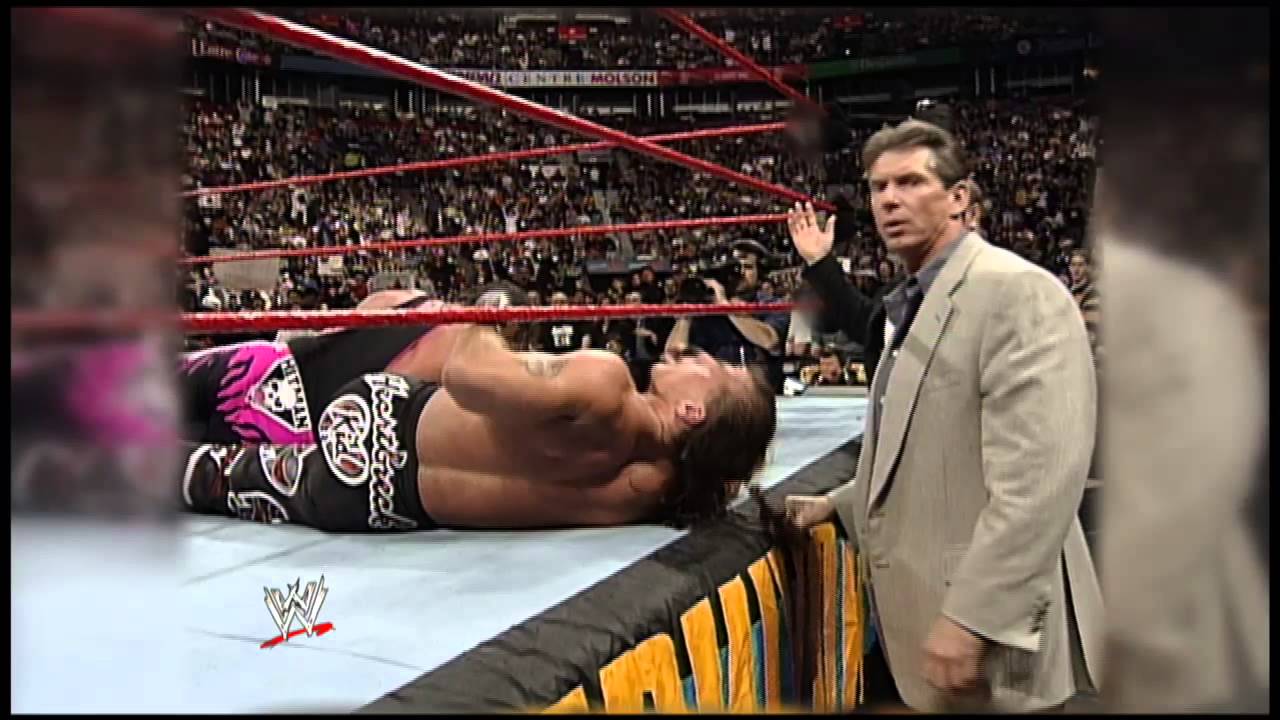
If you’ve spent more than five minutes in a wrestling ring or a locker room, you know the business is built on a foundation of lies. Some call it "kayfabe," others call it "working the marks," but basically, it's the art of the con. But on November 9, 1997, the world saw something that was supposed to be the ultimate truth—the moment the curtain was ripped down and the boss actually betrayed his top star. Or did he? For decades, a vocal minority of insiders and obsessed fans have argued that the Montreal Screwjob was a work, a masterfully executed performance designed to launch the "Mr. McMahon" character and let Bret Hart leave for WCW with his dignity intact.
It sounds crazy. Why would Bret Hart, a man whose entire identity is wrapped up in "The Excellence of Execution" and a code of old-school honor, agree to be humiliated in his home country? Why would Vince McMahon risk a locker room mutiny?
Honestly, the deeper you dig into the timeline of Survivor Series '97, the more the "official" story starts to feel like a script. We’ve been told for years that Vince took the title off Bret because Bret refused to lose in Canada. But if you look at the economics of the WWF at the time, the contract disputes, and the sheer perfection of the aftermath, the idea that the Montreal Screwjob was a work becomes less of a conspiracy theory and more of a logical business pivot.
The Problem With the Official Narrative
The standard story is legendary. Bret Hart was leaving for WCW because Vince couldn't afford his 20-year contract. Bret had "reasonable creative control" for his final 30 days and refused to drop the belt to Shawn Michaels in Montreal. So, Vince, fearing Bret would take the WWF Championship to Nitro (like Madusa did with the Women’s title), called an audible. He had referee Earl Hebner ring the bell while Bret was in the Sharpshooter, even though he hadn't tapped. Bret spat on Vince, smashed up some TV monitors, and punched Vince in the eye backstage.
But wait.
Think about the cameras. The Hitman Hart: Wrestling with Shadows documentary crew just happened to be there? They had unprecedented access to the most private conversations in wrestling history during the exact week the most "secret" betrayal occurred. If you’re Vince McMahon and you’re planning a real-life double-cross that could result in lawsuits or physical violence, do you let a film crew document the lead-up? Or do you use that film crew to ensure the "reality" of the moment is captured forever?
Some people, like Kevin Nash, have hinted for years that the whole thing felt "off." Nash famously said that if someone screwed him like that, he wouldn't just punch them once; he’d destroy the room. Instead, we got a perfectly framed shot of Bret tracing "WCW" in the air with his finger. It was cinematic. It was iconic. It was, perhaps, the greatest "work" ever pulled on the wrestling public.
Why Bret Hart Might Have Been In On It
Bret Hart is a traditionalist. He loves the business. He also understood, perhaps better than anyone, that his character needed a graceful exit. If Bret simply loses to Shawn, he’s just another guy who got beat on his way out. But if he’s "screwed"? He becomes a martyr. He becomes the most sympathetic figure in the industry.
If the Montreal Screwjob was a work, it solved every one of Bret's problems. He didn't have to lose. He kept his "tough guy" reputation by punching the boss. He went to WCW with more heat than he’s ever had in his life.
Then there’s the punch itself.
Vince McMahon walked into Bret’s locker room after the match, allegedly to apologize or face the music. Bret hit him. Vince went down. But let’s look at the "injury." Vince showed up the next day with a "black eye" that looked remarkably like theatrical makeup, and he was able to sit down for the famous "Bret screwed Bret" interview with Jim Ross. In that interview, Vince didn't look like a man who had been assaulted; he looked like a man who had just found the golden ticket. That interview birthed the Mr. McMahon character, the greatest heel in the history of the sport. Without Montreal, there is no "Mr. McMahon." Without "Mr. McMahon," there is no Stone Cold Steve Austin vs. The Authority. Without that feud, the WWF likely goes bankrupt and WCW wins the Monday Night Wars.
The Mathematical Impossibility of the "Secret"
Pro wrestling locker rooms are the leakiest environments on earth. It is a world of gossip. Yet, for 25+ years, the core participants have stuck to the "it was real" script. But consider this: Shawn Michaels, Triple H, Vince McMahon, Jerry Lawler, and Earl Hebner all knew.
If it was a "shoot" (real), Vince took a massive legal risk. Bret had a contract with creative control. Screwing him over publicly was a breach of that contract. Why didn't Bret sue the WWF into oblivion? Instead, he took his WCW money and eventually, years later, came back to the WWE fold for a Hall of Fame induction and a (very staged) "reconciliation" with Shawn Michaels.
Maybe the reconciliation happened in 1997, not 2010.
Evidence often pointed to by "work" theorists includes:
- The placement of the documentary cameras in the halls.
- The fact that Bret’s wife, Julie, was part of the backstage footage, adding to the emotional weight.
- The "spit" that landed perfectly on Vince's face from several feet away.
- The "destruction" of the ringside equipment, which was mostly cheap monitors and cables, nothing that couldn't be replaced for a few hundred bucks.
Breaking Down the "Bret Screwed Bret" Philosophy
The phrase "Bret screwed Bret" is the ultimate gaslighting line. If you’re a promoter and you actually stole someone's title, you don't go on TV and explain the logic behind it unless you want the fans to hate you for a specific storyline reason. Vince used the Montreal incident to pivot the entire company toward the "Attitude Era."
He stopped being the nerdy announcer in the colorful blazers and became the corporate tyrant. If the Montreal Screwjob was a work, it was the most successful business transition in the history of entertainment. It moved the product from "comic book wrestling" to "reality-based soap opera."
Could Vince and Bret have sat down in a hotel room and realized that a standard title change was boring?
"Bret, I can't pay you. You're going to Turner. But if you just lose, you're just a traitor. If I screw you, you're a hero, and I become the biggest villain in the world. We both win."
It’s the kind of high-level thinking that Vince McMahon was known for. It protects the legacy of the Hart family in Canada while giving Vince the nuclear heat he needed to compete with the NWO.
The Role of Shawn Michaels
Shawn Michaels has spent years playing the "I didn't want to do it" card. In his autobiography and various shoots, he talks about the tension and the fear he felt that night. But Shawn was also a performer who thrived on chaos.
If you watch the footage of the finish, Shawn doesn't look surprised. He doesn't look like a man who just witnessed a crime. He grabs the belt and bolts. It was the perfect "heel" move. If the goal was to make the audience believe the "reality" of the situation, everyone played their part to a T.
Even the referee, Earl Hebner, had a car waiting for him outside the building. He was out of the arena before Bret could even get out of the Sharpshooter. That’s not a panic move; that’s a choreographed exit strategy.
Counter-Arguments: Why It Might Actually Be Real
We have to be fair. Most people who were there swear it was real. Jim Cornette, who was in the booking meetings, insists that Vince was truly terrified that Bret would show up on Nitro with the belt. Scott Hall and Kevin Nash have said they were shocked.
But in wrestling, "knowing" something doesn't mean you actually know it. You only know what you’re told. Vince could have easily kept the "work" between himself, Bret, and Shawn. Everyone else's genuine reaction would only add to the realism. That’s "Work 101." If the locker room thinks it’s real, the fans will definitely think it’s real.
The strongest argument against the work is Bret Hart's ego. People argue that Bret would never allow his name to be tarnished by a "submission" loss, even a fake one. But Bret is also a businessman. He knew his WWF career was over. He knew he needed to make a splash in WCW. Being the victim of the "Montreal Screwjob" made him the most talked-about person in the world.
How the Theory Changes the Legacy of 1997
If we accept the possibility that the Montreal Screwjob was a work, it changes how we view the Monday Night Wars. It wasn't a moment of desperation from a failing promoter; it was a tactical strike. It was a "controlled demolition" of the old WWF to make room for the new one.
The aftermath saw the Hart Foundation split up, Bret going to a disastrous run in WCW, and the WWF catching fire. If it was a work, Bret Hart is the greatest actor in the history of sports, and Vince McMahon is a genius on the level of Barnum or Houdini.
Actionable Insights for Wrestling Fans and Historians
To truly understand the nuance of this debate, you shouldn't just watch the match. You have to look at the context surrounding the business in 1997. If you want to dive deeper into the "Work vs. Shoot" Rabbit Hole, here are the next steps for your research:
- Watch "Wrestling with Shadows" with a Skeptical Eye: Pay attention to where the cameras are positioned during "private" conversations. Ask yourself: "Who is holding the microphone?"
- Compare the "Punch" to Other Backstage Fights: Look at the aftermath of the Bret/Shawn "Pullman's T-Shirt" fight versus the Montreal punch. Real backstage fights in wrestling are usually messy, legal nightmares. This one was "resolved" with a single interview.
- Study the 1997 Financials: Look at the WWF’s debt at the time. Vince needed a massive change to survive. The Screwjob provided that change overnight.
- Analyze the WCW Debut: Notice how WCW failed to capitalize on Bret's arrival. If it was a work by Vince and Bret, they may have successfully tricked Eric Bischoff into paying millions for a character that had already peaked emotionally in Montreal.
The truth is likely buried somewhere in a grave or a nondisclosure agreement. But in a business where "the truth" is whatever you can get the audience to pay for, the Montreal Screwjob remains the ultimate masterpiece. Whether it was a betrayal or a collaboration, it saved the WWF. And in the end, that's the only result Vince McMahon ever cared about.