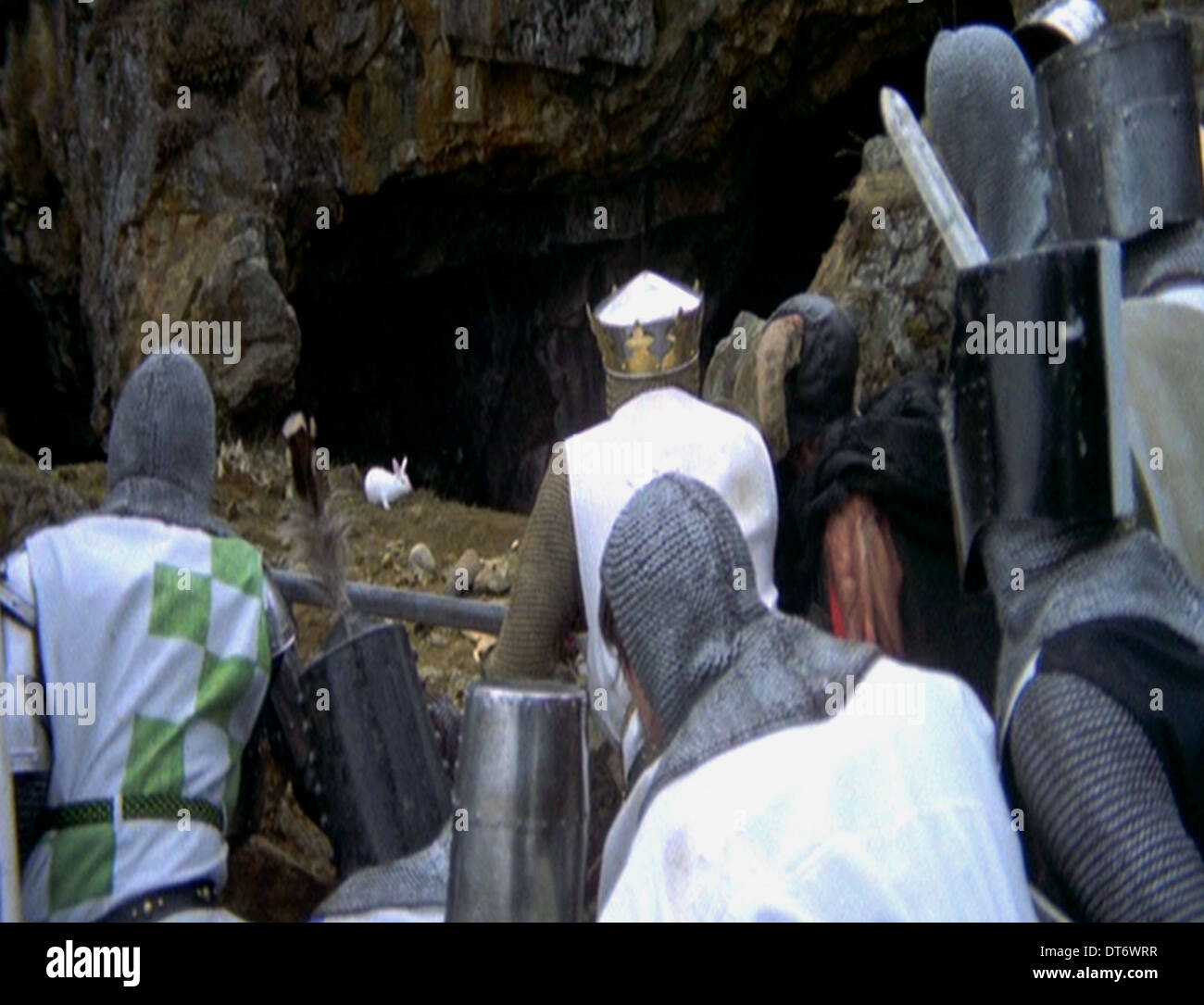
Look, we've all seen it. That tiny, fluffy white ball of fur sits innocently outside a cave, surrounded by the skeletal remains of "full fifty men." It’s the ultimate bait-and-switch. One second King Arthur is mocking Tim the Enchanter for being scared of a "harmless little bunny," and the next, Sir Bors is losing his head to the sound of a can opener.
The Monty Python Holy Grail rabbit is arguably the most famous killer lagomorph in cinematic history. But honestly? The story behind how that scene was filmed is almost as ridiculous as the movie itself. People think it was just a silly puppet or a cheap gag, but there’s actual history, a very stressed-out rabbit owner, and some surprisingly deep medieval lore buried under all that fake blood.
Why the Monty Python Holy Grail Rabbit Isn't Just a Random Joke
Most people assume the Pythons just thought "rabbits are funny" and rolled with it.
That's only half true.
The Monty Python Holy Grail rabbit, technically known as the Rabbit of Caerbannog, actually has roots in "droleries"—those weird, violent little drawings you find in the margins of medieval manuscripts.
If you look at 13th-century prayer books, you’ll find images of rabbits hunting humans or even decapitating knights. It was a world-turned-upside-down motif. It symbolized cowardice. Basically, if a knight was so "un-chivalrous" that he'd run from a rabbit, he was the ultimate failure. Terry Gilliam, who did the film’s animations and co-directed, was obsessed with this kind of historical imagery. He didn't just want a monster; he wanted a subversion of the very idea of a monster.
The Real Rabbit and the "Washable" Dye Incident
Here’s a detail that usually gets missed: they used a real rabbit for the wide shots.
It belonged to a local woman near the filming location in Scotland.
The crew promised her they’d take good care of it.
Then, they covered the poor thing in red liquid to simulate the blood of its victims.
They thought the dye was washable.
It wasn't.
As the sun started to set on the Tomnadashan Mine (the actual "Cave of Caerbannog"), the crew realized the rabbit was still stained bright red. They spent a frantic hour trying to scrub the "blood" off the bunny before the owner came back to claim it.
Imagine being a world-class comedian and having your career flash before your eyes because you can't get red ink off a borrowed pet. That’s the kind of low-budget chaos that defined Monty Python and the Holy Grail.
The Holy Hand Grenade and the Count to Five
You can't talk about the rabbit without talking about its demise. The Holy Hand Grenade of Antioch is the only thing that could stop the beast.
- Arthur pulls the pin.
- He starts counting.
- He skips three and goes straight to five.
This isn't just a throwaway "Arthur is dumb" joke. It’s a recurring theme of innumeracy in the film. Earlier, he says they lost "Gawain, Ector, and Bors, that's five." He can't count his own knights, so of course he can't count to three for a grenade.
The "Scripture" read by Brother Maynard (played by Eric Idle) is a perfect parody of liturgical readings. It mentions "breakfast cereals" and "orangutans." It’s pure Python. But the punchline is the timing. The pause between Arthur saying "Five!" and Galahad correcting him to "Three, sir!" is a masterclass in comedic pacing.
Where Exactly Is the Cave of Caerbannog?
If you're ever in Perthshire, Scotland, you can actually visit the site. It’s not a cave, technically. It’s the Tomnadashan Mine.
An eccentric nobleman named John Campbell, the 2nd Marquess of Breadalbane, had the mine dug in the mid-1800s. He was convinced there was copper, gold, and sulfur in the hills. He was wrong. He found almost nothing.
It’s poetic, really. A failed mine became the home of a fictional killer. Today, fans still hike up there to take photos. Just a heads-up: the path is steep, and there aren't any actual killer rabbits, though you might run into some very confused sheep.
The Puppet vs. The Real Deal
While a real rabbit was used for the "sitting there looking cute" shots, the actual attacks were done with a puppet.
They couldn't afford animatronics.
Heck, they couldn't even afford real horses—hence the coconuts.
The puppet was basically thrown at the actors from off-camera.
John Cleese has mentioned in interviews that the "Tim" character (the Enchanter) was originally supposed to have a much longer, more complex name. But during filming, Cleese forgot the name and just shouted "Tim!" It stuck. That’s why his warning about the rabbit feels so frantic—Cleese was basically ad-libbing his way through the scene while standing on a windy Scottish cliffside.
Actionable Insights for Fans and Creators
If you're a filmmaker or a writer, there's a lot to learn from the Monty Python Holy Grail rabbit scene:
- Subvert Expectations Early: The joke only works because the rabbit looks harmless. If it looked like a wolf, the knights wouldn't be idiots for being afraid.
- The Power of Contrast: Mixing high-brow "Biblical" language with the image of a puppet bunny being tossed at a man’s neck is peak comedy.
- Embrace Your Constraints: The Pythons had no money. They turned their lack of a budget into a stylistic choice. If you can't afford a dragon, make a rabbit the scariest thing in the world.
Next time you watch the film, pay attention to the background. The "bones" surrounding the cave were mostly just plastic and plaster, but they look surprisingly grim in the Scottish mist. It’s a reminder that great content doesn't need a massive budget; it just needs a really good, really weird idea.
If you’re planning a pilgrimage to the Tomnadashan Mine, make sure to bring sturdy boots and maybe a copy of the Book of Armaments. Just don't forget how to count to three.
Check out the original filming locations if you're ever in the UK; Doune Castle is only a short drive away from the "cave" and served as almost every castle in the movie.
Source References:
- The First 200 Years of Monty Python by Kim "Howard" Johnson.
- Monty Python and the Holy Grail 25th Anniversary DVD Commentary (Michael Palin & Terry Jones).
- The Tomnadashan Mine historical records, Perth and Kinross, Scotland.