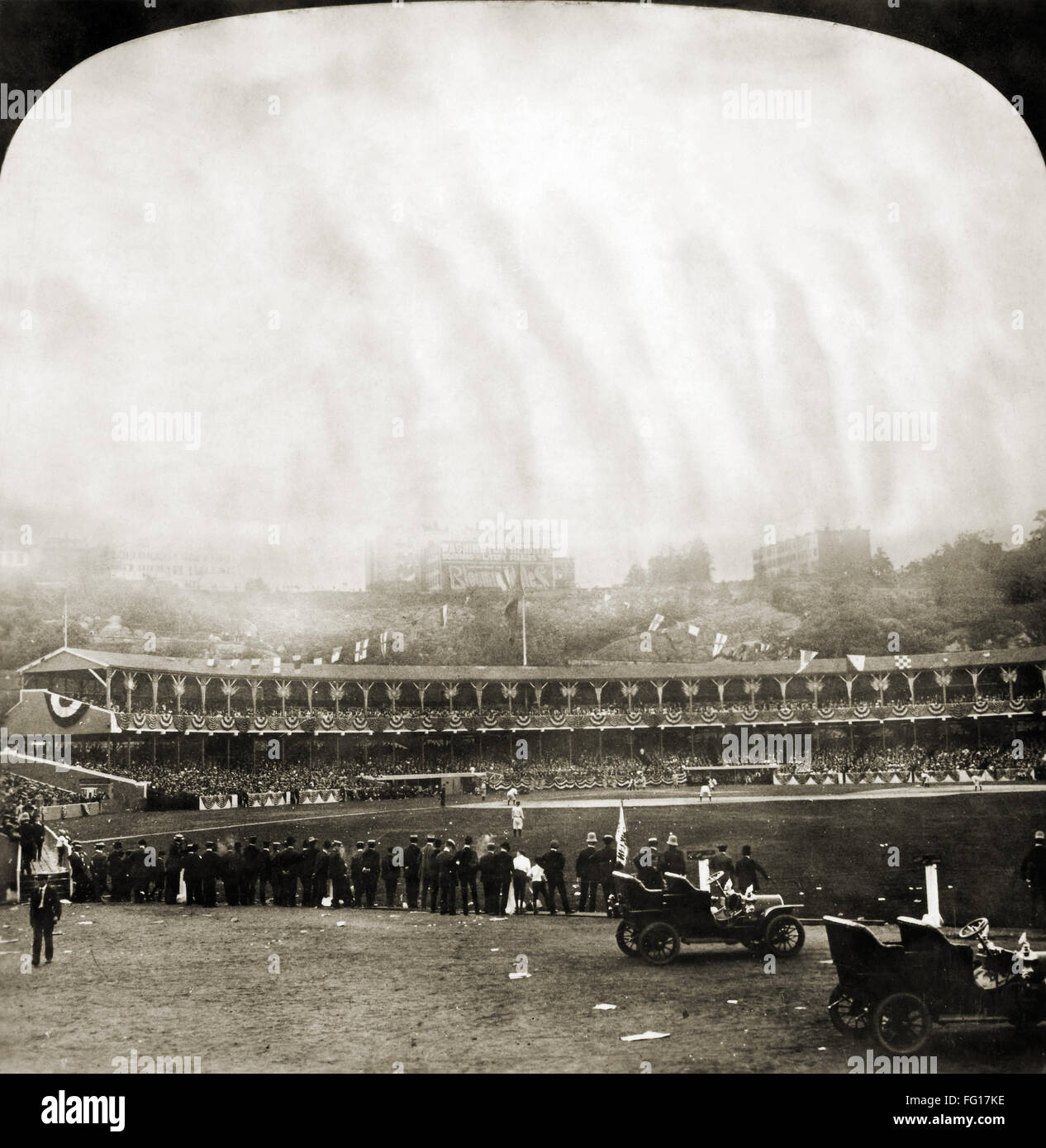
You’ve seen the grainy black-and-white footage of Willie Mays running toward the wall. He’s sprinting. His back is to the plate. Then, that impossible over-the-shoulder grab in the 1954 World Series. That moment didn't happen in a modern, symmetrical stadium with predictable dimensions. It happened at the New York Polo Grounds, a place that honestly shouldn't have worked for baseball at all. It was shaped like a bathtub. Literally. While most parks were trying to be diamonds, the Polo Grounds was a long, awkward oval that made every fly ball a gamble.
If you stood at home plate in the final iteration of the park (Polo Grounds IV), the left-field foul pole was a measly 279 feet away. You could practically sneeze a home run over that wall. But if you tried to hit one to dead center? Good luck. That was a 483-foot trek to the recessed clubhouse.
It was weird. It was cramped. It was beautiful.
A Messy History of Four Different Stadiums
Most people talk about "The Polo Grounds" like it was one single building that stood forever. It wasn't. There were actually four of them, and the first one—opened in 1876—was actually used for polo. James Gordon Bennett Jr., the guy who owned the New York Herald, wanted a place for the sport of kings. But by 1880, the New York Metropolitans moved in, followed by the Giants.
The city eventually cut a road (111th Street) right through the original site, forcing a move. The version most of us picture, the steel-and-concrete horseshoe, was mostly the result of a massive fire in 1911. John Brush, the Giants' owner at the time, rebuilt it in just a few months. Think about that. They didn't have modern cranes or CAD software, yet they threw up a massive grandstand while the team played temporary home games at Hilltop Park with their rivals, the Highlanders (who we now know as the Yankees).
The Yankees were actually tenants of the Giants at the Polo Grounds from 1913 to 1922. It’s wild to think about now, but the "Bronx Bombers" weren't in the Bronx yet. They were paying rent to the Giants in Manhattan. Things got salty once Babe Ruth started outdrawing the Giants. Giants manager John McGraw, a legendary hothead, basically kicked them out because he was tired of being overshadowed in his own house. That’s why Yankee Stadium was built right across the Harlem River. It was a "screw you" to the Giants, positioned so close that fans at the Polo Grounds could see the new "House That Ruth Built" looming over the water.
The Physicality of the Place
The New York Polo Grounds sat under the shadow of Coogan’s Bluff. If you were too broke to buy a ticket, you just climbed the bluff and watched for free. Thousands of people did it. It created this vertical cheering section that looked down onto the field.
The dimensions were a nightmare for pitchers and a dream for "slap" hitters.
- Left Field: 279 feet.
- Right Field: 258 feet.
- Center Field: 483 feet.
Because the bullpens were actually in play in the deep left and right-center fair territory, relievers had to dodge live balls while warming up. It was chaotic. Imagine being a center fielder and having to chase a gapper for nearly 500 feet. Bobby Thomson’s "Shot Heard 'Round the World" in 1951—the famous walk-off home run that won the pennant—was a line drive that only traveled about 315 feet. In any other park, that’s a loud out or a double. At the Polo Grounds, it made him a god.
The clubhouse was located in dead center field, at the top of a long set of stairs. When a player got traded or ejected, they had to make the "long walk of shame" across the vast expanse of center field, in front of everyone, for what felt like ten minutes.
The Teams That Called It Home
While the Giants were the main attraction, they weren't the only ones. The New York Mets actually started their life here in 1962. They played two seasons at the Polo Grounds while waiting for Shea Stadium to be finished. They were terrible. They lost 120 games in their first year. It felt poetic, in a way—the birth of a new franchise in a stadium that was literally falling apart.
And we can't forget football. The New York Giants (the NFL version) played there for decades. The New York Jets—then called the Titans—got their start there too. It was a multisport hub before the era of sterile, suburban "cookie-cutter" stadiums. It felt lived-in. It smelled like cigars, stale beer, and the nearby subway exhaust.
Why it Finally Came Down
By the late 1950s, the neighborhood was changing, and the stadium was decaying. Horace Stoneham, the Giants' owner, looked at the aging concrete and the lack of parking and saw a dead end. He followed the Dodgers to California in 1957. It broke the heart of Upper Manhattan.
The Polo Grounds sat largely vacant, save for the early Mets and some random events, until 1964. The wrecking ball finally arrived that April. In a bit of dark irony, the crew used the same wrecking ball that had demolished Ebbets Field (the Dodgers' home) a few years earlier. They wore Giants jerseys while they did it.
Today, if you go to the site at 155th Street and 8th Avenue, you won’t find a diamond. You’ll find the Polo Grounds Towers—a massive public housing complex. There’s a small plaque, and the famous "John T. Brush Stairway" still exists, which fans used to climb down from Coogan's Bluff to the stadium. It was restored about a decade ago, a lone concrete ghost of a sports empire.
Misconceptions About the "Catch"
When we talk about the New York Polo Grounds, everyone brings up Willie Mays' catch. People think it was amazing just because of the basket catch. But the real reason it was a miracle was the distance. Vic Wertz crushed that ball. In any other stadium in America, it would have been ten rows deep into the bleachers. Because it was the Polo Grounds, there was actually room for a human to run it down.
Mays didn't just catch it; he had to spin and fire the ball back to the infield to keep the runners from scoring. If he hadn't, the Giants probably lose that game, and maybe the series. The stadium's weird shape actually enabled the most famous defensive play in history.
What We Can Learn from the Polo Grounds
Modern stadiums are built for "fan experience." They have craft beer gardens, sushi bars, and perfect sightlines. But they lack the personality of a place that was built because a guy wanted to play polo and ended up hosting the greatest baseball players to ever live.
The Polo Grounds reminds us that sports are better when the environment is a character in the game. When the sun sets over Coogan's Bluff and the shadows stretch 400 feet across the grass, the game feels different. It feels localized.
How to experience the history today:
- Visit the Brush Stairway: It’s located at Edgecombe Avenue and 157th Street. Stand at the top and look down. You can still feel the scale of the hill where fans watched for free.
- Check out the Baseball Hall of Fame’s Digital Archive: They have high-res photos of the 1911 rebuild that show just how harrowing the construction was.
- Look for the "Home Plate" Marker: Inside the Polo Grounds Towers complex, there is a marker indicating where home plate once sat. Standing there, looking toward where the "bathtub" used to curve, is a surreal experience for any sports nerd.
- Read "The Era" by Roger Kahn: It’s arguably the best book for capturing the atmosphere of New York baseball when the Giants, Dodgers, and Yankees all ruled the city simultaneously.
The Polo Grounds wasn't perfect. It was cramped, the plumbing was a disaster toward the end, and the dimensions were an objective joke. But baseball lost a bit of its soul when the wrecking ball hit that horseshoe. It was a place where the weirdness of the architecture dictated the greatness of the play.