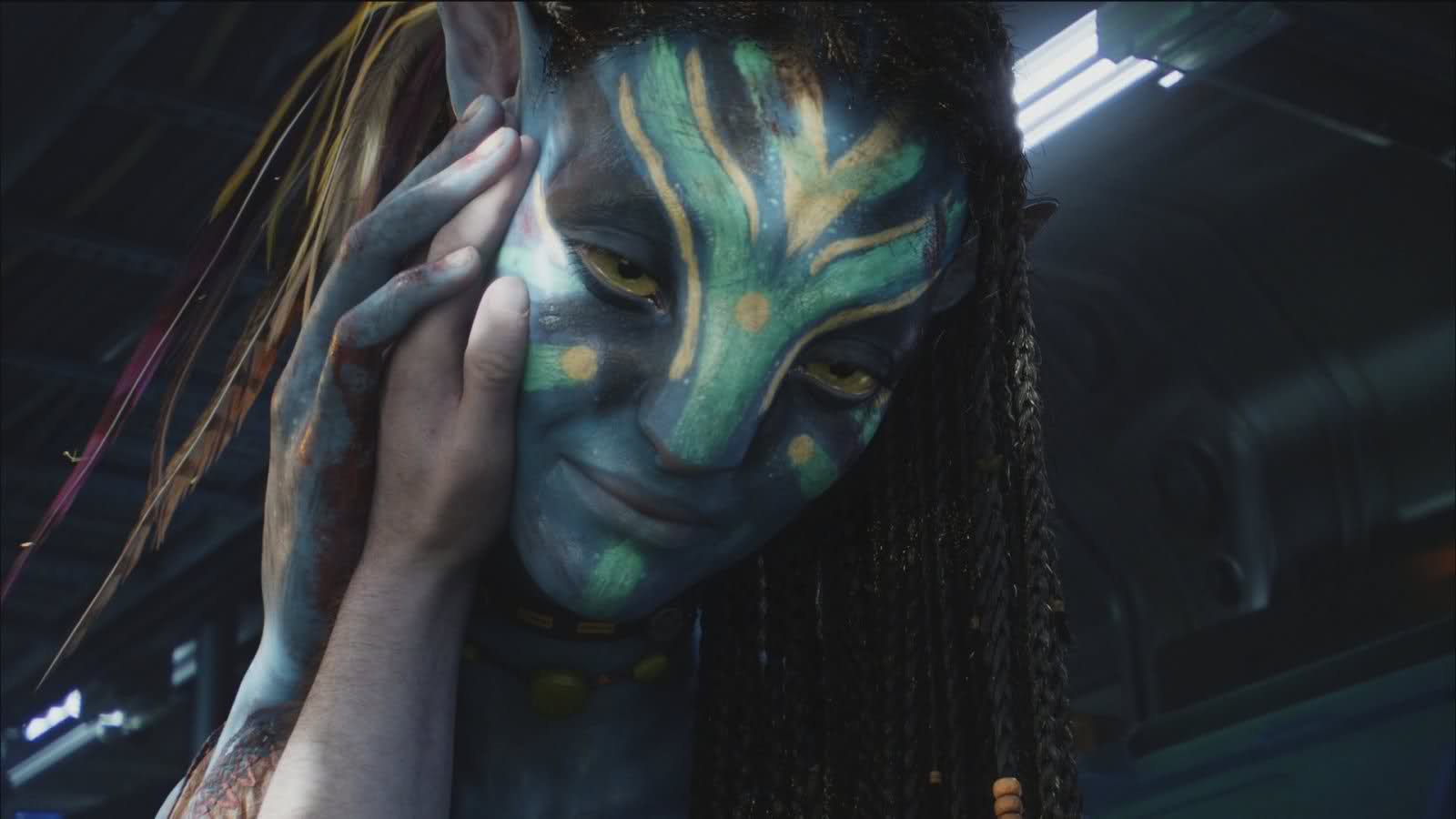
James Cameron didn't just write a script; he basically built a religion around three simple words. When you hear "I see you" in Avatar, it isn't just a greeting. It isn't about optics or biological sight. It's the emotional backbone of the entire Na'vi culture. Honestly, most people who watched the 2009 blockbuster or the 2022 sequel The Way of Water might have missed how deeply these words tie into the actual philosophy of the Omatikaya people.
It’s heavy stuff.
The phrase "Oel ngati kameie" translates literally to "I see you," but the meaning is light-years deeper than a casual "hello." It signifies a total recognition of the person standing in front of you. Not just their face or their blue skin, but their spirit and their connection to Eywa. If you've ever felt truly understood by another human being, you’ve experienced a version of this. Cameron tapped into something primal here. He took a common human longing—to be genuinely perceived—and turned it into the central linguistic pillar of a multi-billion-dollar franchise.
What I See You in Avatar Actually Means
Let’s get into the weeds of the linguistics. Paul Frommer, a professor at USC with a doctorate in linguistics, was the mastermind behind the Na'vi language. He didn't just throw random sounds together. He built a functional syntax. In the Na'vi tongue, there are actually two different ways to say "to see." There is tse'a, which is physical vision—like seeing a rock or a tree. Then there is kame, which is the spiritual "seeing" used in the phrase Oel ngati kameie.
When Neytiri says it to Jake Sully, she’s basically saying she sees his soul. She’s acknowledging his essence despite the fact that he started out as a "dreamwalker" in a manufactured body. This distinction is crucial. It’s the difference between looking at someone and truly witnessing them.
Think about the moment in the first film when Neytiri finally sees Jake’s actual human body for the first time. He’s thin, he’s fragile, and he’s gasping for air in the high-CO2 atmosphere of Pandora. She holds him, and she says it again. "I see you." It’s one of the most powerful scenes in modern cinema because it strips away the 10-foot-tall blue warrior exterior. She sees the man inside.
The Cultural Roots of the Phrase
Critics have often pointed out that James Cameron didn't invent this concept out of thin air. There are real-world parallels that make the Avatar "I see you" feel so familiar and grounded. Many people point to the Zulu greeting "Sawubona." In Zulu culture, Sawubona translates to "I see you," and the response is Shiboka, which means "I am here."
The philosophy is that by "seeing" someone, you bring them into existence.
It’s about community and validation. If no one sees you, do you even exist in a social sense? On Pandora, the Na'vi are interconnected through the Tsaheylu—the bond. When they connect their neural queues to a Direhorse or an Ikran, they are literally sharing thoughts and feelings. But "I see you" is the verbal version of that connection. It’s a way to maintain that intimacy even when they aren't physically "plugged in" to each other or the Great Mother, Eywa.
Why It Became a Pop Culture Phenomenon
Why do we still care about this phrase over a decade later? Well, it’s because our modern world is kind of the opposite of Pandora. We spend all day looking at screens, but we rarely feel seen. We have thousands of followers, yet many feel invisible. When Avatar dropped, that specific sentiment resonated with people who were tired of shallow interactions.
It became a shorthand for deep empathy.
You see it on social media, in fan fiction, and even in therapy sessions. People use the "I see you" Avatar reference to signal that they are listening without judgment. It’s a meme, sure, but it’s a "prestige" meme. It carries the weight of Cameron's world-building.
The Evolution in The Way of Water
In the 2022 sequel, the phrase takes on a new layer of complexity. We see Jake Sully as a father. Now, "I see you" isn't just between lovers; it's between a parent and a child. There’s a specific tension with his son, Lo'ak. Lo'ak feels like an outcast, a "demon blood" kid because he has five fingers like a human. He spends the whole movie desperate for his father’s approval.
When the phrase is finally uttered in that context, it’s about forgiveness and acceptance. It’s Jake acknowledging that his son isn't just a soldier who failed to follow orders, but a person with his own path. The phrase evolved from a romantic discovery into a tool for familial healing.
Misconceptions About the Na'vi Greeting
A lot of people think it’s just a "Na'vi Namaste." While there are similarities—Namaste can be interpreted as "the divine in me bows to the divine in you"—the Na'vi version is a bit more grounded in the immediate relationship. It isn't just a polite way to end a yoga class. In the films, it’s often used in moments of extreme vulnerability or transition.
You don't just say it to the guy selling you fruit in the market—well, maybe you do, but it wouldn't have the same weight. It’s reserved for moments of profound shift.
Another misconception is that it’s purely religious. While Eywa is the center of their world, "seeing" is also a practical social contract. It’s how the tribe stays unified. If you see every member of the tribe as a reflection of yourself, it’s much harder to have the kind of internal conflict that plagues humanity.
How to Apply the Avatar Philosophy to Real Life
You don't need to move to a moon in the Alpha Centauri system to use this. The core lesson of the "I see you" Avatar phenomenon is about active witnessing. Most of us are waiting for our turn to speak rather than actually listening.
To "see" someone like a Na'vi:
- Give them your undivided attention. Put the phone face down.
- Look past the external "avatar" they present to the world—the job title, the clothes, the social media persona.
- Acknowledge their struggle or their joy without immediately trying to fix it or relate it back to yourself.
It’s about presence.
The Na'vi don't have the distractions we have. They don't have TikTok. They have a giant bioluminescent forest and a direct neural link to nature. We have to work a little harder to achieve that level of connection, but the "I see you" mindset is a pretty good starting point.
The Technical Side of the Scene
If you look at the behind-the-scenes footage of Zoe Saldaña and Sam Worthington, you realize how much work went into making those three words land. They were wearing performance capture suits with tiny cameras pointed at their faces. To make "I see you" feel real, the actors had to deliver raw, emotional performances that would then be translated onto their digital characters.
James Cameron is famous (or infamous) for his perfectionism. He reportedly did dozens of takes to get the eye contact just right. Because if the "seeing" didn't look authentic in the digital eyes of the characters, the whole movie would have collapsed. The technology had to be good enough to capture the subtle micro-expressions of a person feeling truly seen.
Understanding the Legacy
As we look toward Avatar 3 and beyond, this phrase will likely remain the heart of the series. It’s the brand's "May the Force be with you," but arguably more intimate. While the Force is about power and cosmic balance, "I see you" is about the person standing three feet away from you.
It’s a reminder that beneath the CGI and the massive box office numbers, Avatar is a story about connection. It's about a guy who was lost and a woman who helped him find himself by simply acknowledging his existence.
Next time you’re watching the film, pay attention to the silence right before the phrase is spoken. There’s always a beat. A moment where the characters drop their guard. That’s the real magic of Pandora. It’s not the floating mountains or the glowing plants; it’s the willingness to be vulnerable enough to be seen.
If you want to dive deeper into the world of Pandora, start by paying attention to the way you interact with the people in your own life. Try to "see" them—not just look at them. You might find that the world looks a little more bioluminescent when you do.
To truly master the spirit of the Na'vi in your own life, practice active empathy. Next time a friend is venting, don't offer advice. Just listen. At the end, tell them you hear them and you understand where they are coming from. That is the real-world equivalent of the "I see you" Avatar moment. It's a small shift that can fundamentally change the quality of your relationships. Focus on the person, not the distraction, and you’ll find your own version of Tsaheylu.