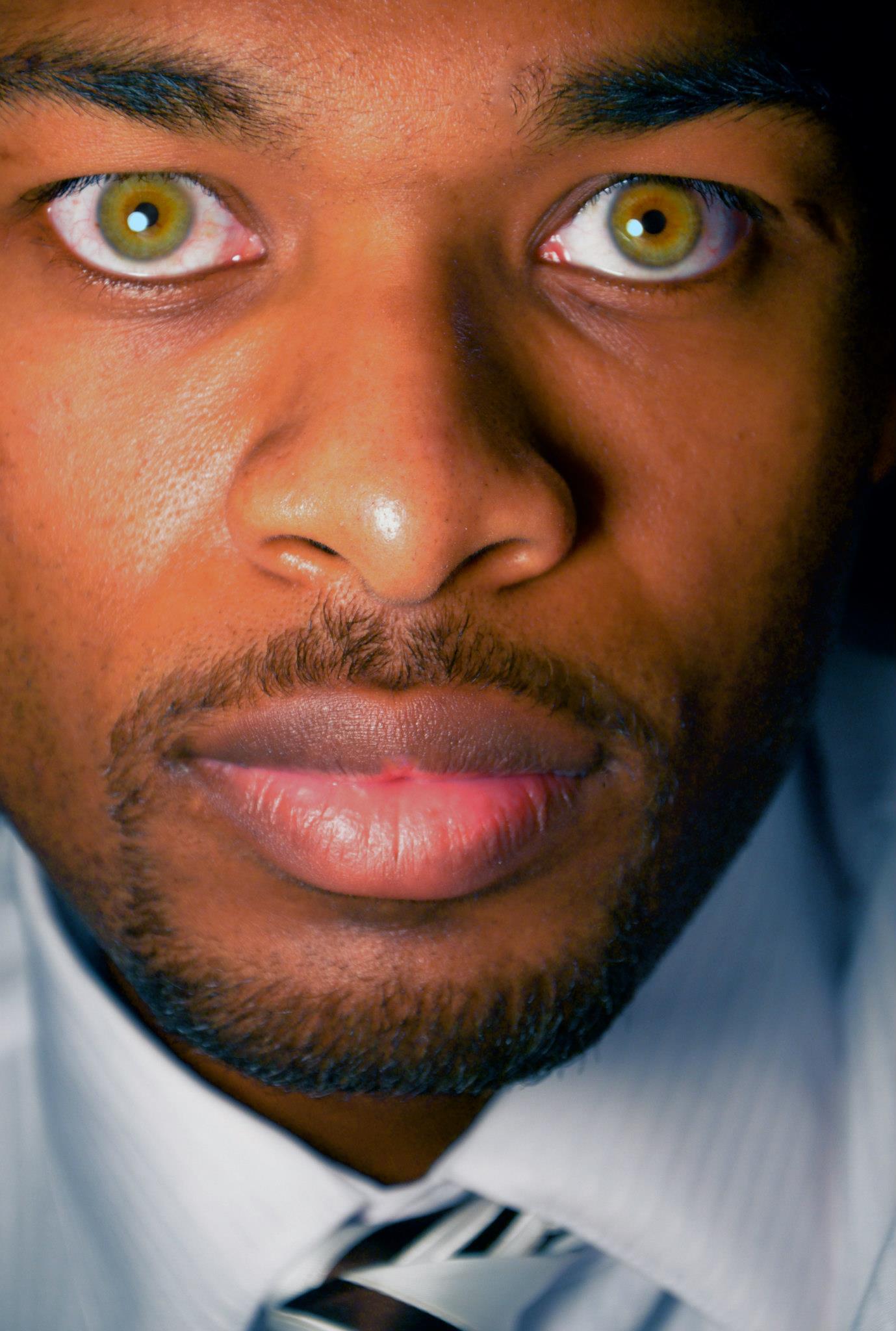
You’ve seen the photos. Maybe you’ve seen it in person—that striking, almost electric contrast of green eyes on black skin. It stops people in their tracks. Some folks online swear it’s all colored contacts or Photoshop tricks, while others dive deep into wild conspiracy theories about ancient civilizations. Honestly? The truth is way more grounded in actual biology and the messy, beautiful way human migration has worked over thousands of years. It isn’t a "glitch" in nature. It's just genetics doing its thing.
Genetic diversity is a lot broader than what we were taught in middle school biology. We usually learn that "brown is dominant" and "blue is recessive," and that’s basically the end of the conversation. But that’s a massive oversimplification. Eye color isn't a single-gene trait; it’s polygenic. This means multiple spots on your DNA determine how much melanin ends up in your iris.
Why green eyes on black skin even happen
Most people assume that if you have dark skin, you must have dark eyes. That's the standard blueprint. However, the OCA2 and HERC2 genes are the real heavy hitters here. These genes regulate the production of melanin. Green eyes are actually the rarest eye color in the world, occurring in only about 2% of the global population. They aren't caused by green pigment—there is no such thing as green pigment in the human eye.
Instead, it’s a mix. You have a little bit of light brown melanin and something called "Rayleigh scattering." That’s the same physics principle that makes the sky look blue. When light hits the iris and scatters against a modest amount of melanin, it creates a green hue. In populations across Africa, particularly in North and West Africa, these genetic variations have existed for millennia.
It's not always about "mixing" with European populations in recent history, either. While the slave trade and colonization definitely introduced different gene pools, some of these traits are indigenous to the African continent. For example, the Mende people of Sierra Leone or certain ethnic groups in South Sudan have long carried genes for lighter eye colors or unique skin tones that don't fit the "Western" stereotype of what an African person looks like.
The Waardenburg Syndrome Factor
Sometimes, a striking eye color isn't just about standard pigment variation. Waardenburg syndrome is a real genetic condition that can cause very pale blue or even green eyes in people with very dark skin. It’s often accompanied by other traits, like a shock of white hair or some level of hearing loss. But it’s a mistake to assume every Black person with light eyes has a medical "condition."
Most of the time, it’s just the luck of the genetic draw. Think about it. If both parents carry a recessive trait for lighter eyes—even if their own eyes are the darkest brown—there is a statistical chance their child will come out with green or hazel eyes. Genetics is a lottery. Sometimes you win the "rare color" jackpot.
Famous examples and the "Stares"
Celebrities have brought more visibility to this. Think of actors like Michael Ealy or Rihanna (who often leans more hazel-green). When people see green eyes on black skin in Hollywood, they assume it’s a "look" curated by a stylist. But for everyday people living with this combination, it can be a bit of a double-edged sword.
I’ve talked to people who deal with "The Stare." It’s that look of confusion or disbelief from strangers. Some people even feel the need to walk up and ask, "Are those real?" It’s invasive. It treats a human being like a museum exhibit. There’s a psychological layer to this—growing up feeling like you don't "match" the societal expectations of your race can be weirdly isolating, even if people are telling you that your eyes are "beautiful." Beauty can be a burden when it makes you feel like an outlier.
Migration, History, and the Sahara
The history of the Sahara desert is a huge piece of this puzzle. Thousands of years ago, the Sahara wasn't a desert; it was a lush, "Green Sahara." People moved freely. Traders from the Mediterranean, the Middle East, and Sub-Saharan Africa mingled for generations.
- Berber populations in North Africa often have light eyes.
- The Tuareg people, known as the "Blue People of the Sahara," carry a massive range of genetic markers.
- Coastal populations in East Africa have centuries of Omani and Indian genetic influence.
When you look at someone with green eyes on black skin, you aren't just looking at a "cool feature." You are looking at a living map of human movement. You're seeing the result of centuries of trade, migration, and survival. It’s a reminder that "race" as we define it is a social construct that biology doesn't always respect.
Debunking the "Contacts Only" Myth
Let’s be real: colored contacts are a multi-million dollar industry. Yes, a lot of what you see on Instagram is a pair of Soloticas. But dismissing every instance of light eyes in the Black community as "fake" is a form of erasure. It denies the actual biological diversity of the African diaspora.
If you're looking to tell the difference, you usually have to look at the limbal ring—that dark circle around the iris. Natural green eyes have depth and shift color depending on the lighting. Contacts often look "flat" or move slightly when the person blinks. But honestly? Who cares? Whether it’s DNA or a box of lenses, the aesthetic is undeniably powerful.
The Science of Melanin Distribution
Melanin comes in two main forms: eumelanin (brown/black) and pheomelanin (red/yellow). The ratio of these two, combined with how they are packed into the iris, determines the final color. In green eyes, there’s a low-to-moderate amount of eumelanin and a bit more pheomelanin than you’d find in blue eyes.
This isn't just "white genes" showing up. It’s a specific calibration of pigment. There are people in the Solomon Islands who have dark skin and natural blonde hair due to a completely different genetic mutation (TYRP1) than the one that causes blonde hair in Europeans. Evolution often finds different paths to similar results. The same logic applies to eye color.
Actionable Takeaways for the Curious
If you’re fascinated by this or perhaps you’re a parent with a child who has this striking combination, here’s what you should actually know:
Respect the person, not just the eyes. If you see someone with this trait, remember they’ve probably heard "your eyes are amazing" ten times today. Talk to them like a person, not a rare bird.
Understand the inheritance. If you have light-eyed ancestors on either side of the family, the trait can skip three or four generations and then suddenly reappear. Don't let "paternity doubt" creep in just because a baby's eyes don't match the parents' eyes immediately.
Eye health matters. People with lighter eyes (green, blue, hazel) are generally more sensitive to UV light. This is because there is less pigment to protect the retina. If you or your child has green eyes, high-quality UV-rated sunglasses aren't just a fashion choice—they’re a medical necessity to prevent long-term damage like macular degeneration.
Celebrate the diversity. Use this as a jumping-off point to learn about the complexities of the African diaspora. It’s a chance to move past the "monolith" view of Blackness and embrace the reality that humans are incredibly varied.
Watch for changes. In infants, eye color usually settles by age three. If you notice a sudden change in eye color in an adult, or if only one eye changes color (heterochromia), see an ophthalmologist. While usually harmless, it can sometimes signal underlying issues like Fuchs' heterochromic iridocyclitis.
Nature doesn't stick to the boxes we draw for it. The existence of green eyes on black skin is a perfect example of how biology is constantly pushing boundaries and creating new versions of "normal." It's a testament to a long, complicated history of human connection that spans continents and eras.