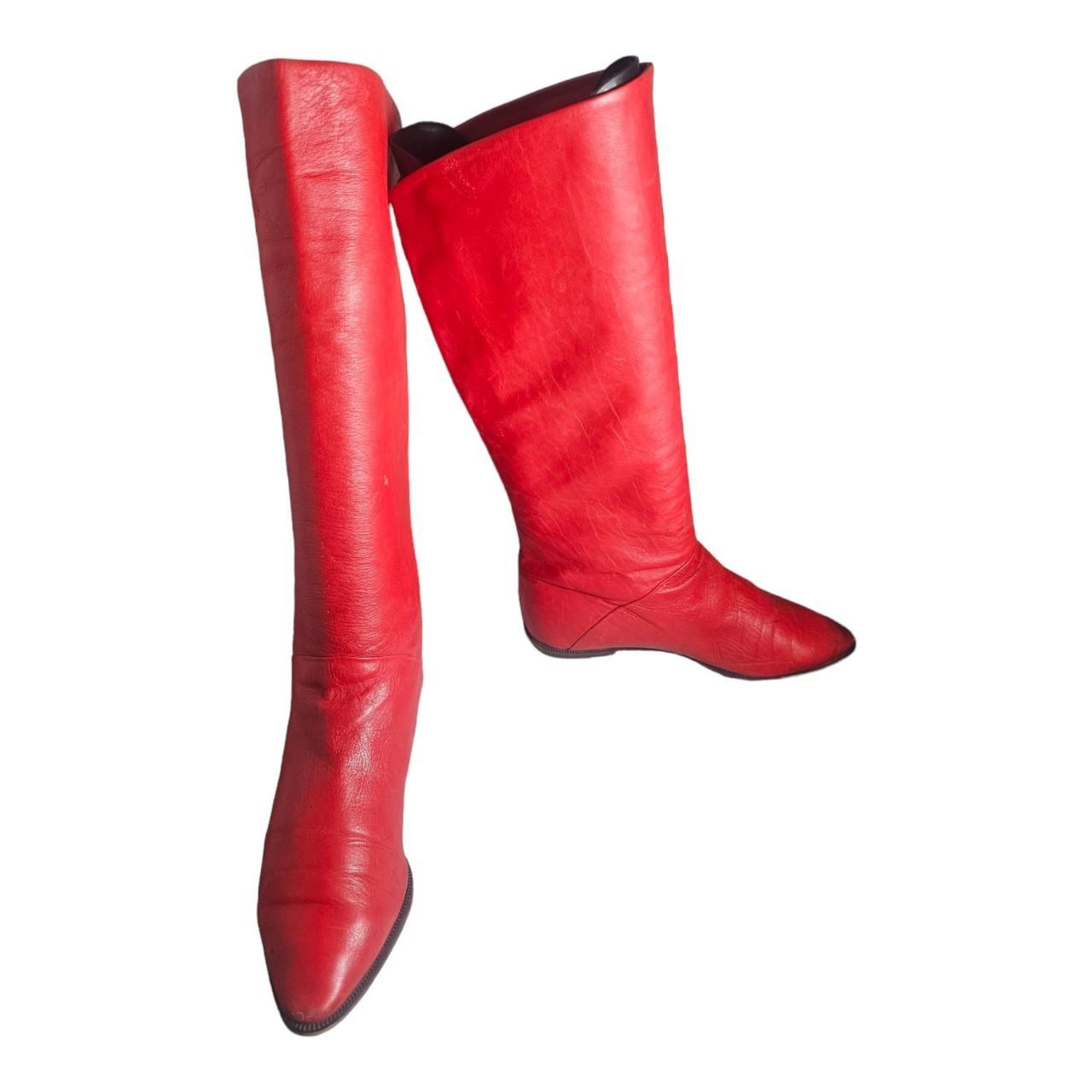
It’s the kind of detail that sticks in your throat. Most people who follow vintage British crime know about the "Brighton Trunk Murders," but they usually get the two cases mixed up. There was the 1934 discovery of a woman’s torso at a railway station, and then, just weeks later, the discovery of Violette Kaye. But the red riding boots? Those belong to the first victim. They represent one of the most frustrating, chilling, and technically "unsolved" aspects of 20th-century forensics.
She was never identified. Not officially. For nearly a century, she’s just been "the girl with the red boots."
If you walk through Brighton today, it’s all neon lights, pebble beaches, and expensive fish and chips. But in June 1934, the city was vibrating with a different kind of energy. The smell of the sea was masked by something much more pungent at the Brighton railway station. A plywood trunk had been left in the cloakroom. When a porter named William Joseph Vinnicombe noticed a "terrible smell" leaking from the bottom of the box, he didn't expect to find the remains of a woman.
She was wrapped in brown paper. She was missing her head and her legs.
But when the police started searching other stations, specifically King’s Cross in London, they found another suitcase. In that one, they found the legs. And on those legs? A pair of red riding boots.
The Forensic Nightmare of the Red Riding Boots
Sir Bernard Spilsbury, the celebrity pathologist of the era, was the one who had to piece this together. Honestly, Spilsbury is a controversial figure today—critics say he had a "God complex"—but back then, his word was law. He looked at the body and determined the woman was about 25 years old and five months pregnant.
The boots were the key. They weren't just random shoes. They were distinct. Stylish. In 1934, having a pair of custom or high-end red riding boots suggested a certain level of income, or at least a very specific social circle.
The police went door-to-door. They checked every cobbler in the country. They looked for women who had vanished while pregnant. It sounds like the plot of a noir novel, but the reality was much grimmer. Because the head was never found, they couldn't use dental records. They couldn't use facial recognition. They had the boots, a cheap plywood trunk, and a massive amount of public fear.
Then things got weird.
While the police were busy hunting for the owner of the red riding boots, they stumbled upon another body in a trunk. This one was Violette Kaye. She had been killed by a man named Toni Mancini. Because the press went into a feeding frenzy over Mancini, the girl in the red boots was shoved into the background. It’s a tragedy of timing. One murder was "solved" (though Mancini was initially acquitted), and the other became a footnote.
What the Investigation Missed
The boots were mass-produced, but the wear patterns told a story. Spilsbury noted that the victim had a slight deformity in her feet, or at least a very specific gait.
Why hasn't DNA solved this?
We’re in 2026. You’d think we could just pull a sample. But the remains were buried in an unmarked grave in the Brighton Borough Cemetery. Over the decades, the records for these "pauper graves" have become a mess. There have been pushes by amateur sleuths and historians to exhume the body, but the legal hurdles are massive. Without a living relative to provide a comparison sample, even a DNA profile might just be a string of data with nowhere to go.
The red riding boots were reportedly destroyed or lost in police archives decades ago. That’s the real kicker. In the mid-20th century, evidence management wasn't exactly what it is today. Items that weren't part of an "active" trial often ended up in the incinerator or simply rotted away in damp basements.
Misconceptions About the Case
Most people think the "Trunk Murders" were the work of a serial killer. They weren't.
It’s almost certain that the woman in the red boots was killed by someone she knew—likely the father of her unborn child. In 1934, the stigma of "illegitimacy" was a powerful motive for murder. If a man in a position of power or a married man got a woman pregnant, the social consequences were ruinous.
- Myth 1: The boots were a gift from a secret lover.
- Reality: There’s no evidence for this. They were just her shoes.
- Myth 2: The killer was the same man who killed Violette Kaye.
- Reality: Toni Mancini was almost certainly not involved in the first case. The methods of dismemberment were different. The "Red Boots" killer was much more clinical, almost surgical.
Why the Identity Remains a Mystery
Think about the geography. The torso was in Brighton. The legs were at King's Cross. This implies the killer used the rail network as a disposal system. They wanted the parts to be far away from each other. They wanted to strip the victim of her identity.
By removing the head and the hands, the killer successfully bypassed every identification method of the 1930s. No fingerprints. No face. Just those boots.
There was a lead once involving a missing dancer from London. She owned similar clothes. Her friends said she was "in trouble" (the 1930s code for pregnant). But when the police tracked her down, she was alive and well in another city, having just "started over."
The red riding boots case represents the "Missing Person" paradox. Sometimes, people don't want to be found, and sometimes, the people who know they are missing are the ones who killed them. If the victim was a runaway or someone who had severed ties with her family, there was no one to report her missing.
Modern Perspectives on the Brighton Trunk Case
When you look at the case through a 2026 lens, the failures are glaring. We see a lack of inter-departmental communication between the Brighton police and Scotland Yard. We see a forensic system that relied too heavily on the "star power" of one pathologist.
But we also see a victim who has become a symbol. In Brighton, she’s a ghost story. In the true crime community, she’s a puzzle.
The boots themselves—red, vibrant, defiant—are the only part of her personality we have left. She liked nice things. She had style. She was someone's daughter, and she was about to be someone's mother.
Actionable Steps for Amateur Historians and Sleuths
If you're interested in the case of the red riding boots, don't just read the Wikipedia page. The real information is buried in local archives and contemporary newspaper reports.
- Access the British Newspaper Archive. Look for the June and July 1934 editions of the Brighton and Hove Herald. The local reporting was much more detailed than the national tabloids, often including descriptions of the clothing found in the trunks that never made it into the official Spilsbury biographies.
- Study the "Mancini" Trial Transcripts. Even though Mancini was tried for the murder of Violette Kaye (the second trunk), the cross-examinations often touched on the first case. The defense used the "Red Boots" mystery to suggest a "maniac" was on the loose, which helped create reasonable doubt for their client.
- Visit the Old Police Cells Museum in Brighton. They hold a significant amount of material related to the city's criminal history. While the original boots are gone, they have period-accurate exhibits that give you a sense of the scale of the trunks used.
- Compare Missing Persons Reports from 1933-1934. Many digital databases now allow you to filter by date. Look for women aged 20-30 who disappeared from the London or South Coast areas in early 1934. Pay attention to those mentioned as having "surgical scars" or specific physical traits mentioned by Spilsbury.
The case of the red riding boots isn't just a "cold case." It’s a reminder of how easily a person can be erased when the system fails to see them as an individual. Every time someone mentions the Brighton Trunk Murders, they are, in a way, keeping the search for her name alive. Maybe one day, a genealogist will find a gap in a family tree that perfectly matches a 25-year-old girl who liked red boots and went to Brighton one summer, never to return.