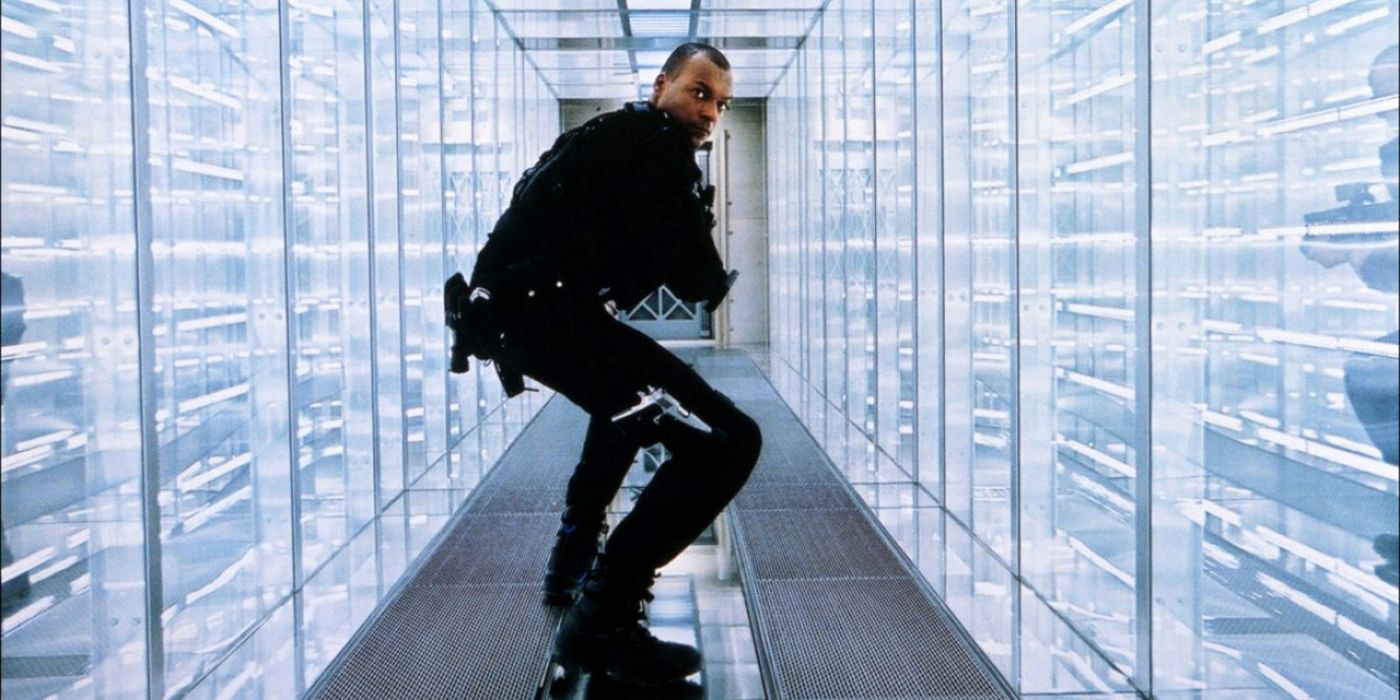
You remember the sound. It’s that high-pitched, digital hum that starts low and builds into a whine that feels like it’s vibrating right inside your skull. Then, the glow. A neon blue grid of light slides down a sterile, white hallway toward a group of commandos who realize, about three seconds too late, that they are trapped in a literal meat grinder.
Honestly, the Resident Evil laser scene shouldn't have worked as well as it did. Paul W.S. Anderson's 2002 film was already taking massive liberties with the Capcom source material, swapping out survival horror atmosphere for Matrix-style slow-motion and industrial metal. But when the Red Queen turned that hallway into a deathtrap, it created a cinematic core memory. It’s the kind of sequence that sticks with you because it’s so clinical. It isn't a messy zombie bite or a jump scare; it’s a math problem solved with light and human anatomy.
The Anatomy of the Resident Evil Laser Scene
The setup is basic. The Umbrella Corporation’s elite tactical team has entered "The Hive," an underground research facility where an AI has gone rogue. They think they’re just rebooting a computer. They’re wrong.
What makes the Resident Evil laser scene so brutal is the pacing. Most action movies would have the lasers move at light speed, over in a flash. Here, they move with a terrifying, rhythmic deliberation. The first pass takes out the medic. It’s a clean decapitation—blink and you miss it. Then the commander, One (played by Colin Salmon), tries to outmaneuver the grid.
He almost makes it.
The choreography here is actually pretty clever. You have a seasoned soldier using every bit of his athletic ability to jump, slide, and contort through a shifting geometry of death. For a moment, the audience believes he’s the hero who beats the machine. Then the grid changes. It becomes a fine mesh, a checkerboard of light that leaves no gaps. There’s no way out. Salmon’s performance in those final seconds—the realization, the stillness—is what sells the horror.
Why the CGI Still Holds Up (Mostly)
Let's be real: 2002 was a weird time for visual effects. We were caught between the practical grit of the 90s and the rubbery "Scorpion King" CGI of the early 2000s. Yet, the Resident Evil laser scene remains visually effective because it leans into the artifice.
The lasers don't need to look "natural." They are digital constructs within the world of the film. By keeping the hallway stark and the blood minimal until the very last "fall apart" moment, the production team avoided the uncanny valley. It’s also worth noting that the "slicing" effect was achieved through a mix of digital overlays and very careful editing. When One finally collapses into a pile of cubes, the impact comes from the sound design—that wet, heavy thud of meat hitting the floor—rather than a hyper-realistic render of his face.
From the Big Screen Back to the Games
It is a rare thing for a movie adaptation to influence the source material in a meaningful way. Usually, it’s the other way around. However, the Resident Evil laser scene was so iconic that Capcom couldn't ignore it.
Three years later, Resident Evil 4 hit the GameCube. When Leon S. Kennedy enters the island laboratory late in the game, he encounters—you guessed it—a hallway with a sliding laser security system.
It was a total fan-service moment.
Players had to perform quick-time events (QTEs) to flip and dive through the beams, mirrors of the movements Colin Salmon did on screen. It’s a fascinating loop of media influence. A movie based on a game created an original scene that was so effective it was retroactively "canonized" into the game universe. Since then, variations of the laser hallway have appeared in Resident Evil: The Umbrella Chronicles, the Resident Evil 4 remake, and even several of the animated films like Resident Evil: Vendetta.
The Red Queen’s Cold Logic
The villain of the Resident Evil laser scene isn't a monster. It’s a child’s avatar representing a cold, logical defense protocol. The Red Queen isn't "evil" in the traditional sense; she’s just doing what she was programmed to do: contain the T-Virus at any cost.
This adds a layer of existential dread. You can’t negotiate with a laser. You can’t scare it. You can't even really fight it. You just wait for the math to run out. This sequence shifted the Resident Evil film franchise away from the "creeping shadows" horror of the 1996 game and toward a more high-tech, clinical brand of sci-fi terror. Some fans hated that shift. Others found it refreshing.
Regardless of where you stand on Paul W.S. Anderson's 15-year tenure with the series, you can't deny the craft of this specific moment. It’s 100 seconds of pure tension that defined the aesthetic of early 2000s action-horror.
Misconceptions About the Scene
People often misremember the gore. Because the scene is so intense, many fans swear it was a "blood bath." If you go back and watch the original 2002 cut, it’s surprisingly bloodless.
The lasers are so hot they cauterize as they cut.
That was a brilliant move by the filmmakers. It allowed them to keep an R-rating without veering into the "torture porn" territory that would later define the mid-2000s. The horror is in the idea of what's happening to the human body, not necessarily the mess. It’s the "sushi" effect—clean, precise, and deeply unsettling.
The Cultural Legacy of the Grid
We see echoes of the Resident Evil laser scene everywhere now. It’s in Final Destination 5. It’s in the Cube sequels. It’s even parodied in comedies and referenced in music videos. It became a shorthand for "inescapable high-tech trap."
When we talk about "iconic" horror moments, we usually talk about the shower scene in Psycho or the chestburster in Alien. The laser hallway deserves a spot on that secondary tier. It represents a specific era of filmmaking where we were obsessed with the "system" turning against us, using the very technology we built to protect ourselves to dismantle us—literally.
If you’re looking to revisit this moment or understand its impact, there are a few things you should actually do rather than just reading about it:
- Watch the 'Making Of' Featurettes: The behind-the-scenes footage of how they used wires and physical markers to guide the actors' eyes during the laser sequence is a masterclass in low-budget problem-solving.
- Play the Resident Evil 4 Remake: Compare how the modern game handles the laser hallway versus the 2005 original. The remake adds a layer of grit and speed that feels like a modern tribute to the film.
- Check the Sound Design: Listen to the scene with high-quality headphones. The way the sound pans from left to right as the lasers pass is a huge part of why the tension feels so physical.
The Resident Evil laser scene remains a benchmark because it understands a fundamental truth about horror: the most frightening thing isn't always a monster in the dark. Sometimes, it’s a brightly lit room where the exit is blocked by a sequence of light you can't outrun.
It’s simple. It’s clean. It’s permanent.
Next time you’re watching a modern sci-fi thriller and a character enters a long, suspicious-looking hallway, notice how you hold your breath. That’s the legacy of the Red Queen. That’s the lasting power of a well-executed idea that turned a simple visual effect into a nightmare.