You remember that feeling when the training wheels finally come off? That’s basically the entire vibe of The Rookie season 1 episode 14, aptly titled "Plain Clothes Day." It’s an episode that fans still talk about because it shifts the power dynamic of the entire series. Up until this point, Nolan, Chen, and West have had their Training Officers (TOs) as safety nets. In this hour, those nets are shredded.
The premise is simple but brutal. For one shift, the rookies ditch their uniforms for civilian clothes. Their TOs? They’re just "shadows." They can’t speak. They can’t intervene. They can’t even give a helpful "maybe don't do that" glance. If a rookie messes up, it's on them, and the stakes are their entire careers. Honestly, it’s one of the most stressful episodes of the first season because it forces us to see these characters not as students, but as actual cops—or at least people trying to convince us they are.
The Mental Game of the Shadow
John Nolan, played by Nathan Fillion, usually relies on his life experience to bridge the gap between his age and his lack of police seniority. But in The Rookie season 1 episode 14, that age actually works against him. Sgt. Grey doesn't make it easy. He never does. Nolan is paired with Talia Bishop, who takes the "silent shadow" rule to an extreme. It’s awkward.
Imagine trying to handle a domestic dispute or a traffic stop while your boss stands three feet behind you, stone-faced and silent, taking notes on every stutter and hesitation. Nolan's biggest hurdle in this episode isn't a gunman; it's his own tendency to overthink. He’s a "pleaser" by nature. Without Bishop’s verbal guidance, he starts second-guessing his instincts. This episode highlights a specific reality of police training: the transition from "learning the law" to "executing the law" is a massive psychological leap.
Jackson West and the Pressure of Legacy
Then you've got Jackson West. Poor Jackson. He’s the legacy hire, the son of the head of Internal Affairs. He’s supposed to be the best. In The Rookie season 1 episode 14, he tries to run his shift like a military operation. He wants to prove he's better than Nolan and Chen. But here’s the thing—policing isn’t just about the manual. It’s about people.
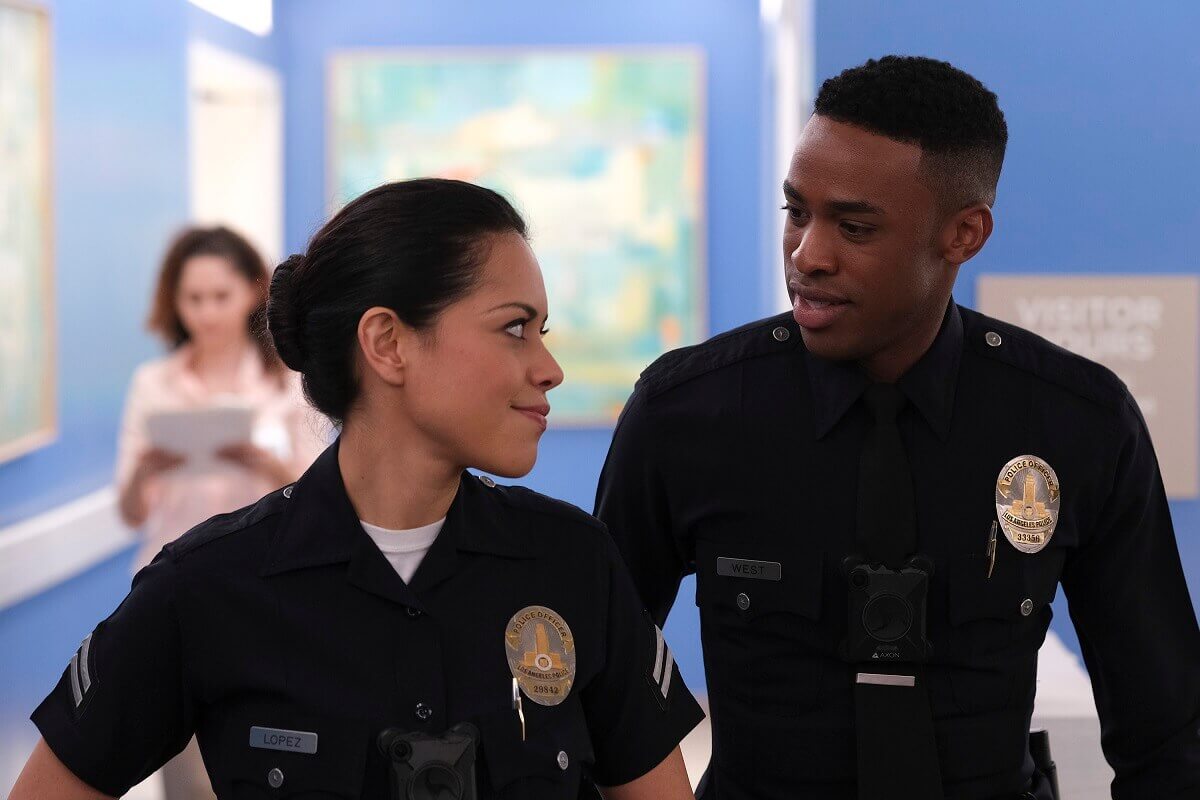
West spends so much time trying to be the "perfect" cop on Plain Clothes Day that he misses the nuances of human interaction. His TO, Angela Lopez, watches him struggle with the realization that you can’t just "stat" your way through a shift. It’s a humbling moment for a character who, frankly, needed a little bit of a reality check at that point in the season.
Lucy Chen’s Trial by Fire
Lucy Chen probably has the hardest time of the three, mostly because Tim Bradford is her TO. If you know anything about "The Rookie," you know Bradford's version of a "Plain Clothes Day" is basically psychological warfare. He doesn't just watch; he actively tries to trip her up through his silence.
Chen has to deal with a series of escalating calls, including a particularly tense situation involving a suspected kidnapping. There’s a specific scene where she has to make a split-second decision about entering a property. You can see the panic in her eyes—the "Am I allowed to do this?" look. But Bradford just stands there. Watching. It’s a masterclass in tension. It also cements the "Chenford" dynamic that would eventually take over the fandom, though back then, it was purely about the grueling mentor-student relationship.
Why This Episode Matters for the Series Arc
Television shows usually hit a "mid-season slump" around episode 12 or 13. They start spinning their wheels. The Rookie season 1 episode 14 avoids this by resetting the stakes. It reminds the audience that these people are still very much in danger of failing.
In real-life police departments, like the LAPD which the show is loosely based on, the Field Training Officer (FTO) program is a multi-phase process. "Plain Clothes Day" is a dramatized version of the "check ride" or "final phase" evaluations. While real FTOs might not be as dramatic as Tim Bradford, the isolation is real. You are expected to be the primary officer. You handle the radio. You handle the paperwork. If you can’t cut it, you’re out. No second chances.
The episode also weaves in a subplot with Sgt. Grey and his wife, which adds some much-needed emotional depth. It’s not all just sirens and handcuffs. We see the toll the job takes on the veterans, which contrasts sharply with the rookies’ desperate desire to join those ranks. It makes you wonder why they want it so bad in the first place.
Tactical Realism vs. TV Drama
Let's be real for a second: The Rookie isn't a documentary. It's a procedural drama. In The Rookie season 1 episode 14, the density of high-stakes calls in a single shift is statistically improbable. Most rookie shifts involve a lot of driving around, writing tickets for expired tags, and waiting for tow trucks.
However, the episode gets the feeling right. That specific brand of rookie anxiety—the fear of "washing out"—is a real thing in every academy and every precinct.
- Communication: Notice how Nolan struggles with the radio codes when he's stressed. That’s a real phenomenon. Under high cortisol, your brain's "language center" can actually stumble.
- Command Presence: This is what West lacks in this episode. You can know the law, but if you don't look like you're in charge, the situation will spiral.
- The Shadow Effect: There is a real psychological impact when an evaluator is present. It’s called the Hawthorne Effect, where individuals modify their behavior in response to being observed.
How to Re-watch (or Watch for the First Time)
If you’re going back to watch The Rookie season 1 episode 14, pay attention to the background. This episode uses a lot of "shaky cam" and tight close-ups to heighten the claustrophobia of the rookies being "watched." It’s a stylistic choice that makes the viewer feel just as trapped as Nolan or Chen.
Also, look at the body language of the TOs. Bishop, Lopez, and Bradford aren't allowed to speak, so their entire performance is in their eyes and their posture. It’s some of the best acting in the first season. You can see Bradford's internal struggle between wanting to help Chen and knowing he has to let her fail to see if she'll survive.
Takeaways for the Dedicated Fan
By the time the credits roll on "Plain Clothes Day," the power balance has shifted. The rookies aren't just students anymore; they’ve had a taste of what it means to be the "only" cop on the scene.
- Nolan's Growth: He realizes that his age is an asset, but only if he stops trying to act like he's 22.
- Chen's Confidence: Surviving a shift under Bradford's silent gaze is like passing a Bar exam while someone screams at you. It changes her.
- West's Reality Check: He learns that being a "Top Cop" on paper doesn't mean anything if you can't talk to a person on the street.
Actionable Insights for Viewers
If you're following the series for the first time or doing a deep-dive rewatch, keep these points in mind to get the most out of the experience:
- Track the "Scoring": Try to keep your own tally of the rookies' mistakes as the TOs do. It makes the final "debrief" scenes much more satisfying.
- Compare to Later Seasons: Watch this episode and then immediately watch an episode from Season 5 or 6. The contrast in how Nolan carries himself is staggering. It shows the long-term character development the writers actually stuck to.
- Check the Realism: Research the LAPD "Manual of Policy and Procedures" regarding field training. You'll find that while the "plain clothes" aspect is a bit of a "TV-ism," the evaluation criteria are surprisingly accurate to real-world standards.
The beauty of this episode is that it doesn't end with everything perfectly resolved. It ends with the realization that the training is far from over. The rookies passed the day, but the career is a marathon, not a sprint. This is the moment the show stopped being about "the old guy at the academy" and started being a serious look at the cost of the badge. For anyone tracking the evolution of the series, The Rookie season 1 episode 14 is the essential bridge between the pilot and the high-stakes drama the show eventually became.