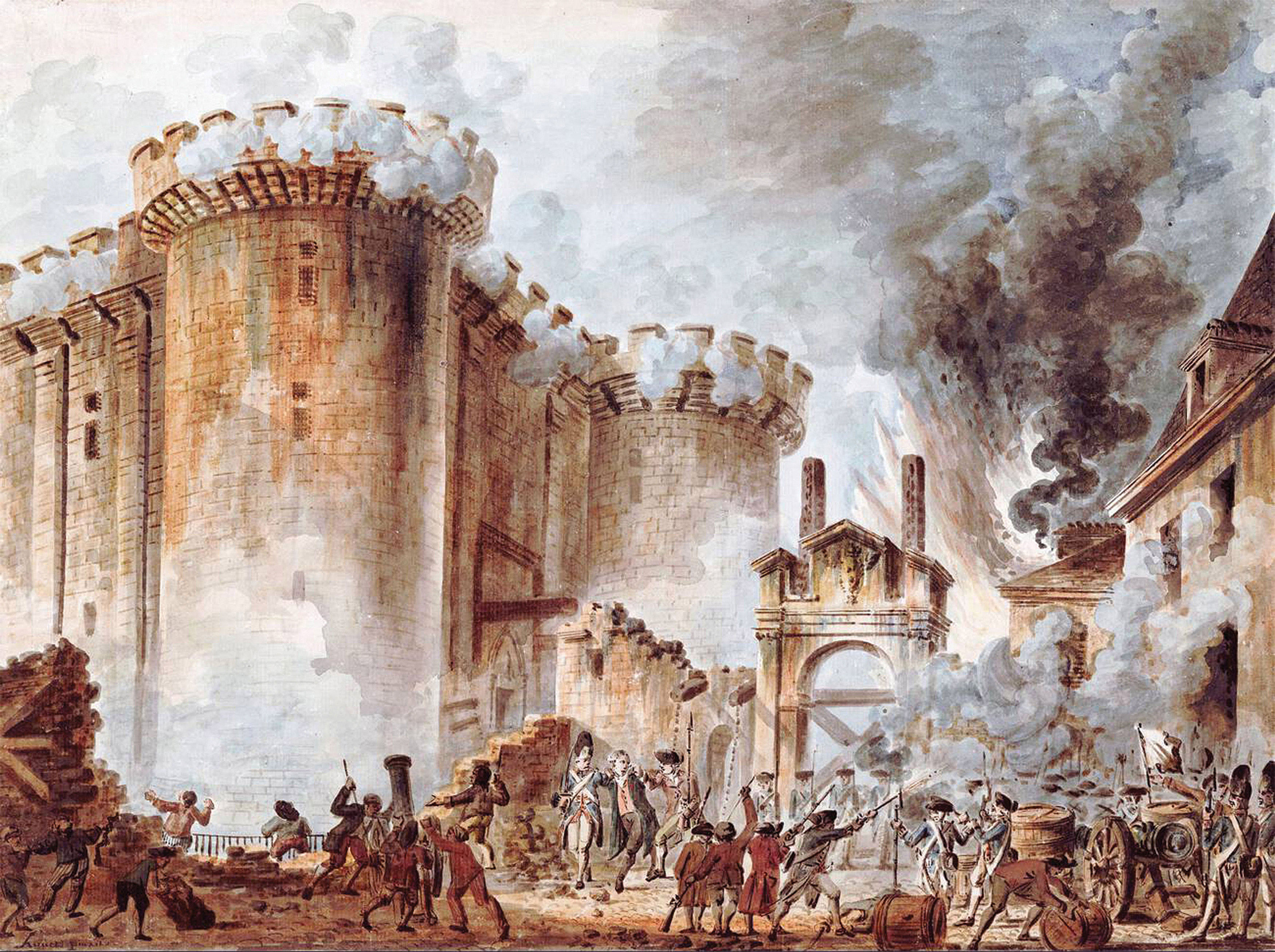
If you look at the paintings, the Storming of the Bastille looks like a scene out of a modern blockbuster. Thousands of people, smoke everywhere, and a giant stone fortress crumbling under the weight of "liberty." It’s basically the ultimate symbol of the French Revolution. But if we’re being honest, the reality of July 14, 1789, was a lot messier, weirder, and surprisingly more bureaucratic than your high school history teacher probably let on.
It wasn't just about "freedom." People were hungry. They were terrified. King Louis XVI had been moving troops around Paris, and the city was a tinderbox. When the crowd finally surged toward that medieval prison, they weren't actually there to free hundreds of political prisoners. They were looking for gunpowder. Tons of it.
Why the Bastille became the target
Paris was a disaster zone in 1789. Bad harvests had sent bread prices through the roof, meaning most people were spending about 80% of their income just to not starve. Imagine paying $40 for a loaf of sourdough. That’s the vibe in Paris.
When the King fired Jacques Necker—his finance minister who was actually liked by the people—Paris lost its collective mind. Camille Desmoulins, a journalist with a bit of a stutter but a lot of charisma, jumped onto a table at the Café de Foy and told everyone to arm themselves. This wasn't some organized military maneuver. It was a riot that turned into a revolution.
First, they hit the Hôtel des Invalides. They walked away with roughly 30,000 muskets. There was just one problem: they had zero gunpowder. And guess where the city's massive stash of powder had just been moved for "safekeeping"? The Bastille.
The myth of the prisoners
We love the idea of a heroic jailbreak. But the Storming of the Bastille only resulted in the release of seven people. That’s it. Seven.
- Four were forgers who had been caught messing with bills of exchange.
- Two were deemed "mentally ill" (one of whom thought he was Julius Caesar).
- One was a "deviant" aristocrat, the Count of Solages, whose family was actually paying for him to be kept there.
The Marquis de Sade, the guy who gave us the word "sadism," had been moved out just ten days earlier because he kept screaming through a makeshift megaphone that the guards were murdering the prisoners. If he’d stayed another week, he would have been the face of the revolution. Instead, the "oppressed masses" being liberated were mostly just a few guys who were probably very confused by the noise.
What actually went down that afternoon
Bernard-René de Launay was the guy in charge of the Bastille. He wasn't some bloodthirsty tyrant; he was mostly just a career bureaucrat who was way out of his depth. He had about 114 soldiers—most of whom were invalides, basically retired veterans who weren't exactly in fighting shape—and a few Swiss Guards.
Negotiations started around 10:00 AM. They dragged on for hours. De Launay even invited the leaders of the mob in for lunch. He was trying to be reasonable, but the crowd outside was growing by the minute. They were hot, they were tired, and they were convinced they were being tricked.
Things got real when a few guys climbed onto a perfume shop next to the wall and dropped the drawbridge. It crushed one of the attackers. Suddenly, everyone started firing. This wasn't a tactical siege. It was chaos.
The turning point
The mob would have probably failed if it weren't for the French Guards (Gardes Françaises). These were professional soldiers who decided to ditch the King and join the people. They showed up with five cannons they’d pinched from the Invalides.
Once the cannons were leveled at the main gate, De Launay knew it was over. He threatened to blow up the entire fortress—and the neighborhood with it—by igniting the 250 barrels of gunpowder in the basement. His own men stopped him. They forced him to surrender.
He was promised safe passage. He didn't get it.
The crowd dragged him toward the Hôtel de Ville. On the way, he was beaten, stabbed, and eventually killed. His head ended up on a pike. This set a pretty grim precedent for how the rest of the French Revolution would handle "enemies of the people."
The King’s reaction was... underwhelming
You might think the King would have been alerted immediately. Nope. Louis XVI was at Versailles, hunting. In his diary for July 14, 1789, he wrote one word: "Rien" (Nothing).
He was talking about his hunting bag. He didn't catch any deer that day, so to him, nothing happened. It wasn't until the Duke of Liancourt woke him up in the middle of the night that he realized the world had changed.
"Is it a revolt?" Louis supposedly asked.
"No, Sire," the Duke replied. "It is a revolution."
Why the Bastille doesn't exist anymore
If you go to Paris today looking for the Bastille, you’ll find a massive column (the July Column) and a busy metro station. But you won't find the fortress.
Almost immediately after the Storming of the Bastille, a guy named Pierre-François Palloy started tearing it down. He was a savvy businessman. He hired 800 men to dismantle the thing stone by stone.
He didn't just throw the stones away, though. He turned them into souvenirs. He carved mini Bastilles out of the rocks and sent them to every department in France. He turned the chains into medals. He basically monetized the revolution.
Even the main key to the Bastille isn't in France. It’s in Virginia. The Marquis de Lafayette gave it to George Washington in 1790 as a "token of victory by Liberty over Despotism." You can still see it today hanging in the hallway at Mount Vernon.
Misconceptions that still stick around
People often think the Bastille was full of people being tortured in iron masks. By 1789, it was actually one of the "nicer" prisons. Some inmates had their own furniture, pets, and even libraries.
The real reason people hated it wasn't the conditions inside. It was what it represented: lettres de cachet. These were secret warrants signed by the King that allowed someone to be imprisoned indefinitely without a trial. You couldn't argue. You couldn't appeal. You just disappeared.
The Storming of the Bastille was a strike against that specific kind of unchecked power. It was the moment the "Third Estate"—the common people—realized that the King’s authority wasn't divinely protected. If they could take the King's fortress, they could take his crown.
Lessons from the rubble
The fall of the Bastille teaches us that symbols matter more than military utility. Strategically, the building was a dinosaur. Tactically, it was a mess. But psychologically? It changed everything.
It forced the King to recognize the National Assembly. It led directly to the Declaration of the Rights of Man and of the Citizen. It proved that a hungry, disorganized crowd could dismantle a thousand-year-old monarchy if they were desperate enough.
Practical takeaways for history buffs
If you're looking to dig deeper into the actual documents and avoid the romanticized fluff, here are some actionable steps:
- Check the Primary Sources: Look for the letters of Gouverneur Morris, an American in Paris at the time. His firsthand accounts are far more grounded and cynical than later history books.
- Visit Mount Vernon (Virtually or In-Person): Seeing the actual key to the Bastille helps bridge the gap between the American and French Revolutions. They weren't isolated events; they were a conversation.
- Trace the Stones: If you're ever in Paris, walk to the Pont de la Concorde. Much of the bridge was built using the stones from the Bastille. When you walk across it, you’re literally walking on the ruins of the Old Regime.
- Re-evaluate the "Mob": Look at the listes des vainqueurs de la Bastille (the list of winners). It wasn't just "peasants." It was clockmakers, wine merchants, and carpenters. It was the middle class.
The Storming of the Bastille wasn't the end of the revolution—it was just the spark. Within years, the guillotine would be working overtime, and the very people who stormed the gates would find themselves looking over their shoulders. But for one afternoon in July, the people of Paris felt like they finally owned their city. That feeling is why we still talk about it nearly 250 years later.