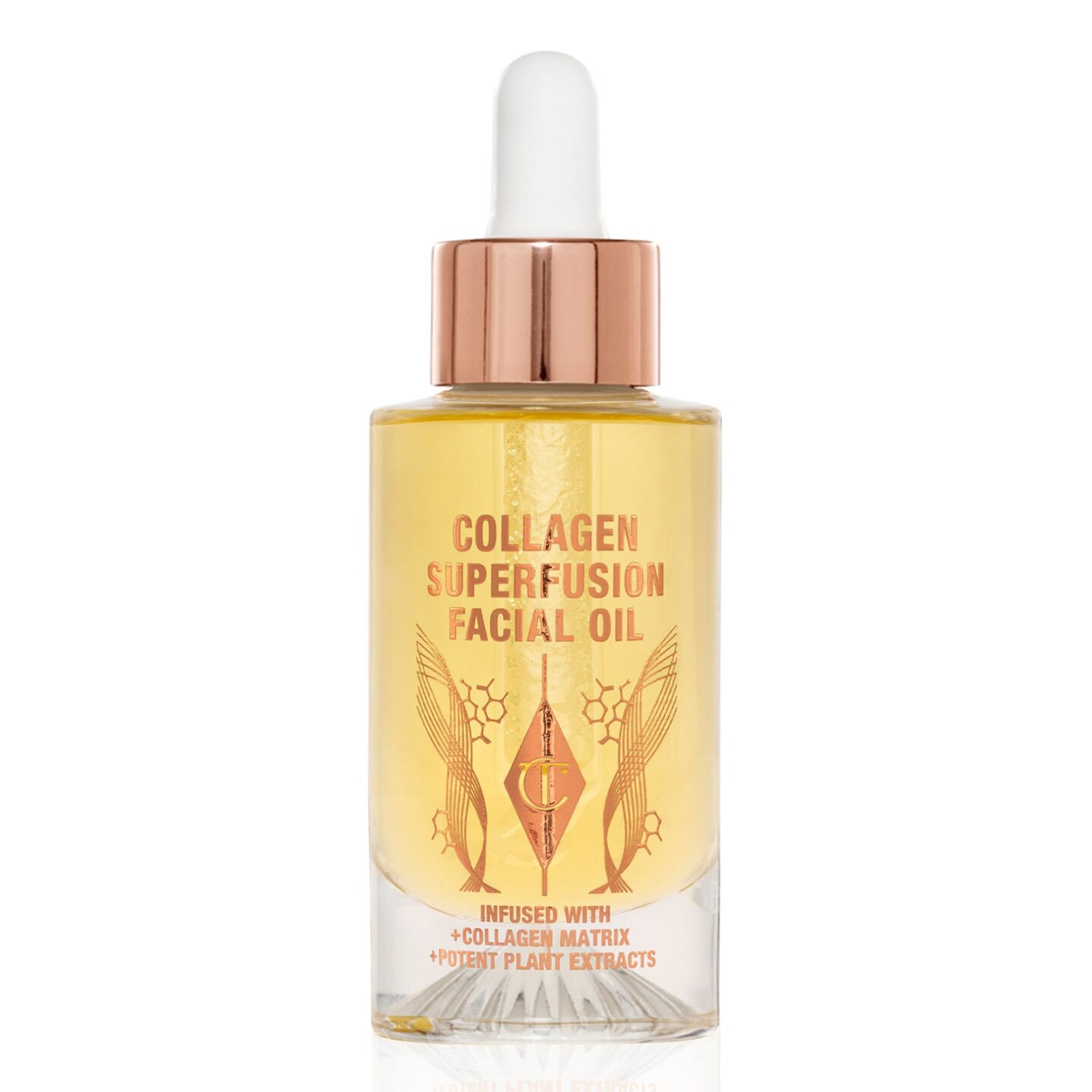
You've probably seen that gold-capped bottle everywhere. It looks expensive. It feels expensive. But when you’re staring at a bottle of Collagen Superfusion Facial Oil, the first thing you’re likely wondering is whether "collagen" in a face oil is even a real thing or just clever marketing fluff. Honestly? It's a bit of both, but not in the way most people think.
Let's get the big elephant out of the room first. You cannot simply rub collagen into your skin and expect it to magically knit itself into your dermis. The molecules are too big. They just sit there. However, Charlotte Tilbury—who is basically the queen of making skin look like it’s been filtered by a professional lighting crew—didn't just toss standard collagen into a jar. This formula uses a matrix of plant-based collagen and high-performance oils designed to mimic the skin's lipid barrier. It’s less about "replacing" your collagen and more about tricking your skin into acting like it’s younger and more hydrated.
I’ve spent years looking at ingredient decks. Most oils are just... oils. This one is trying to be a treatment.
What’s actually inside the Collagen Superfusion Facial Oil?
If you flip the bottle over, you aren’t just seeing one or two ingredients. It’s a massive list. The heavy lifter here is something called Cocoyl Hydrolyzed Collagen. This is a plant-derived collagen hydroxyproline complex. It’s essentially a fragmented version of collagen that can actually interact with the skin surface more effectively than the massive, unbroken proteins found in cheap supplements.
But the oil base is where the texture comes from. We’re talking about a "superfood" blend.
- Avocado Oil: Rich in essential fatty acids. It’s heavy, yes, but great for barrier repair.
- Olive Oil: A classic emollient that people either love or fear depending on their pore-clogging history.
- Babassu Oil: This is the secret weapon for glow without the grease.
- Raspberry Seed Oil: High in Vitamin E.
- Blueberry Seed Oil: Great for skin elasticity.
- Evening Primrose Oil: Often used to calm redness and hormonal skin freak-outs.
The scent is very "spa day." It’s got lavender, rose absolute, and neroli. If you have super sensitive skin or you hate fragrance in your skincare, this might be a dealbreaker for you. It’s not subtle. It smells like a luxury hotel lobby in London.
Why the "Superfusion" part matters
The "Superfusion" name comes from the way these oils are blended with the active ingredients. Usually, you have your "actives" (the stuff that does the work) in a serum and your "occlusives" (the stuff that locks it in) in an oil. This product tries to do both. It uses a technology called Collagen Matrix which aims to create a barrier that prevents trans-epidermal water loss (TEWL).
Basically, it stops your face from drying out while you sleep.
The big misconception: Oil vs. Hydration
People often use Collagen Superfusion Facial Oil incorrectly. They put it on dry skin and then wonder why they feel greasy but still "tight."
Oil is not hydration. Water is hydration. Oil is nourishment and protection.
To make this product actually work, you need to apply it over something damp. Use a hyaluronic acid serum or even just a mist of water. When you apply the oil on top of moisture, you’re sealing that water into your skin cells. If you apply it to bone-dry skin, you’re just coating the surface in fat.
It’s the difference between a sponge that’s been soaked and then wrapped in plastic versus a dry sponge wrapped in plastic. The first one stays soft. The second one stays a hard brick.
Who is this actually for?
If you have oily, acne-prone skin, stay away. I’m being serious. With avocado and olive oil high on the list, this is a recipe for congestion if your pores are already struggling to breathe.
However, if you are:
- Over 35: Your natural oil production is starting to drop. You need the lipids.
- Living in a cold climate: Central heating is a skin killer. This is a shield.
- A "Glow" seeker: If you want that "glass skin" look under your makeup, a drop of this mixed into your foundation is a legitimate game-changer.
Clinical claims vs. Reality
The brand claims that skin looks 300% more elastic in eight weeks. Take that with a grain of salt. "300% more" is a wild statistic that usually comes from very specific, small-group clinical trials where users are often using a full regimen of products. Does it make skin look better? Yes. Is it a surgical facelift in a bottle? No.
What it does do is improve the "bounce." When your skin is saturated with the right fatty acids, it reflects light better. This creates the illusion of fewer wrinkles. It’s physics, not just biology.
How to use it without looking like a grease ball
Don’t use a full dropper. That is way too much product. You only need two or three drops.
Warm them up in your palms. Don't just smear it on; press it into your skin. Start at your cheekbones—the driest part of most faces—and work your way inward. Whatever is left on your hands goes on the neck and chest.
If you use it in the morning, wait at least five minutes before putting on sunscreen. If you don't wait, the oil can actually break down your SPF, making it less effective. Nobody wants that.
The competition: How does it stack up?
There are a lot of oils on the market. You’ve got the Vintner’s Daughter Active Botanical Serum (which is much more expensive and leans heavily into essential oils) and the Augustinus Bader The Face Oil (which uses TFC8 technology).
Compared to those, the Collagen Superfusion Facial Oil sits in a middle ground. It’s cheaper than the ultra-luxury brands but more sophisticated than a basic rosehip oil you’d find at a health food store. It’s specifically designed to work well under makeup, which is Charlotte’s whole brand DNA. Most facial oils pill or make foundation slide off your nose. This one plays nice with others.
The sustainability and ethics check
Charlotte Tilbury Beauty is Leaping Bunny certified cruelty-free. The bottle is glass and recyclable, though the dropper assembly usually has to go in the trash depending on your local recycling rules. The ingredients are largely plant-based, which is a plus for those looking to avoid animal-derived collagen (which is often sourced from bovine or fish remains).
Is it worth the price tag?
Let's be real. You’re paying for the branding, the scent, and the specific "dry oil" finish. You can get the benefits of facial oils for $20. But you aren't getting this specific texture. If you have the budget and you want a sensory experience that actually makes your skin look plumped by morning, it’s a solid investment. If you’re on a budget, buy a high-quality Marula oil and call it a day.
Actionable Steps for Better Results
If you decide to pick up a bottle, here is how to get your money's worth:
- The Night Sandwich: Apply your moisturizer, then two drops of the oil, then a tiny bit more moisturizer on top. This "sandwiches" the oil and helps it penetrate deeper without leaving a film on your pillowcase.
- The Foundation Hack: If you have a matte foundation that looks too heavy, mix one tiny drop of the oil into the foundation on the back of your hand before applying. It turns any heavy base into a dewy tint.
- Don't Forget the Cuticles: If you find the scent too strong for your face, or you have a bit left on your hands, rub it into your cuticles. The collagen hydroxyproline is actually great for nail bed health.
- Check the Date: Because this contains a lot of natural seed oils (blueberry, raspberry), it can go rancid faster than synthetic serums. Use it within 6-9 months of opening. If it starts to smell like old crayons, toss it.
The bottom line is that while "Collagen" is the headline, the "Superfusion" of plant oils is the actual star. It’s a barrier-repair powerhouse that happens to smell like a dream. Just remember: damp skin first, oil second. Your face will thank you.