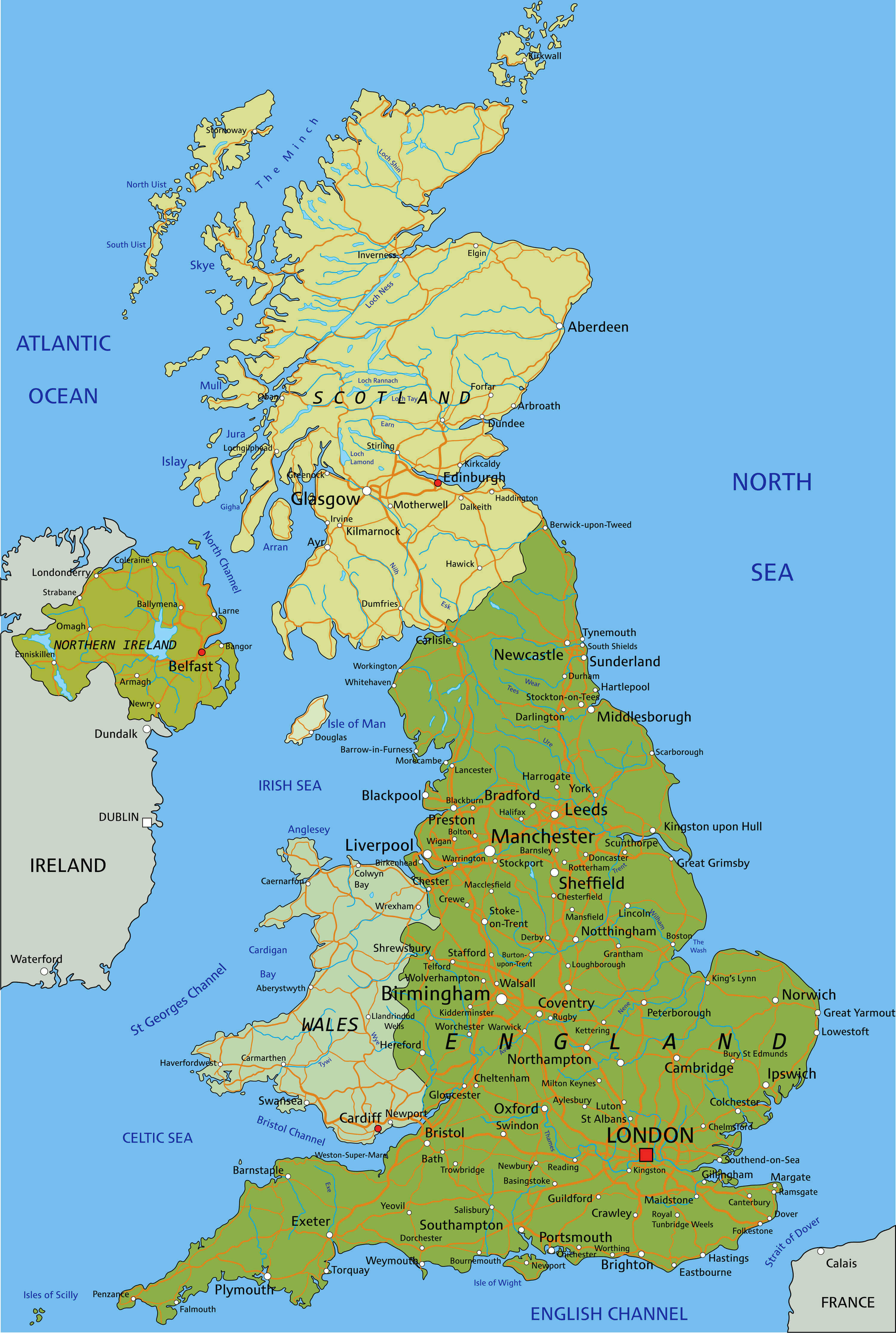
You’re looking at a map. You see an island. Then you see a smaller bit of an island to the west. You call the whole thing "England."
Stop.
Honestly, if you do that in a pub in Glasgow or a cafe in Cardiff, you’re gonna get some side-eye. Or a very long, very polite lecture on why the United Kingdom Great Britain map is actually way more complicated than a simple GPS coordinate. It’s a mess of overlapping borders, historical grudges, and legal definitions that even some people living there struggle to explain after a pint.
Maps aren't just paper and ink. They're political statements.
When we talk about the United Kingdom Great Britain map, we are dealing with two very different things that happen to share the same damp, windy space in the North Atlantic. Great Britain is a piece of rock. The United Kingdom is a political agreement. Understanding the difference is basically the "Level 1" requirement for traveling there without sounding like a total tourist.
Geography vs. Politics: The Great Britain Split
Geography is easy. Great Britain is the largest island in the British Isles. That’s it. It’s the physical landmass containing England, Scotland, and Wales. If you’re standing on the dirt in London, Edinburgh, or Swansea, you’re on Great Britain.
The United Kingdom? That’s the "United Kingdom of Great Britain and Northern Ireland."
You’ve gotta include that last bit.
Northern Ireland sits on the neighboring island of Ireland, which it shares with the Republic of Ireland. So, when you look at a United Kingdom Great Britain map, you’re seeing one whole island (Great Britain) and about one-sixth of the island next door. It’s a bit like a jigsaw puzzle where some pieces belong to a different box entirely.
People often forget that the "British Isles" is a purely geographical term. It includes the UK, the Republic of Ireland, and over 6,000 smaller islands like the Isle of Wight or the Hebrides. But don't call an Irishman "British" unless you're looking for an argument. The map tells you where the land is; history tells you who owns it.
The Four Nations: Why the Borders Matter
If you’re driving from London to Edinburgh, you won't see a passport control. There are no armed guards. But you’ll see the signs change. You’ll see the "Welcome to Scotland" sign, often with Gaelic underneath.
England is the big player. It takes up about 50,000 square miles and holds the vast majority of the population. Most people looking for a United Kingdom Great Britain map are actually just looking for a map of England, but they don’t realize they’re ignoring three other distinct cultures.
Scotland covers the northern third of Great Britain. It’s got the Highlands, the Lochs, and a legal system that’s actually different from England's. Wales sits to the west, a rugged, mountainous country where the road signs are bilingual and the "L" sounds like you’re trying to clear your throat. Then there’s Northern Ireland, separated by the Irish Sea, with its own complex history and the vibrant city of Belfast.
These aren't just provinces. They are countries.
Think of it like a family living in one house. England has the master bedroom because it’s the biggest, but Scotland definitely has its own room and locks the door sometimes. Wales and Northern Ireland have their own spaces too. They all share the kitchen (Parliament in Westminster), but they don’t always agree on what’s for dinner.
The Weird Bits: Crown Dependencies and Overseas Territories
Here is where the United Kingdom Great Britain map gets truly weird.
Have you heard of the Isle of Man? Or Jersey and Guernsey?
They show up on the map right there in the middle of the sea. You’d assume they’re part of the UK. Nope. They are "Crown Dependencies." They have their own parliaments, their own taxes, and even their own versions of the Pound Sterling (which, fun tip, can be a pain to spend in a London corner shop even though it’s technically legal tender).
Then you have the British Overseas Territories. We’re talking Gibraltar, the Falkland Islands, and Bermuda. They aren't in the UK. They aren't in Great Britain. But they fall under the jurisdiction and protection of the UK. If you tried to fit all of this onto a single United Kingdom Great Britain map, the scale would be a nightmare. You’d have a tiny cluster of islands in Europe and then random dots scattered across the entire globe from the South Atlantic to the Caribbean.
Why the Map Keeps Changing (Sorta)
Maps feel permanent. They aren't.
The border between England and Scotland moved back and forth for centuries. Berwick-upon-Tweed, a town on the border, changed hands 13 times before finally settling in England. There’s a local joke that they’re still technically at war with Russia because of how they were listed in old declarations, but that’s mostly a myth.
Even today, the map is under pressure. After the 2014 Scottish Independence referendum, there was a real possibility that the United Kingdom Great Britain map would need a literal redrawing. If Scotland had left, the "UK" would have become a very different shape. For now, the borders stay where they are, but the political lines are always vibrating.
And don't even get me started on "The Wash" or the shifting sands of the East Anglian coast. The physical map of Great Britain is actually shrinking in some places and growing in others due to coastal erosion and silt deposition. The village of Dunwich in Suffolk is mostly underwater now. If you used a map from the 1400s, you’d be driving your car straight into the North Sea.
Reading the Terrain: It’s Not All Rolling Hills
People think the UK is just green fields and sheep.
Well, it is. But it’s also much more.
If you look at a topographical United Kingdom Great Britain map, you’ll notice a "spine" running down the middle of Northern England. Those are the Pennines. They’re why it rains so much in Manchester and stays (slightly) drier in York. The clouds hit the mountains, dump their water, and move on.
The north and west are highland zones—ancient, hard rock, mountains, and thin soil. The south and east are lowland zones—younger rock, flatter land, and the "breadbasket" of England. This split has dictated everything from where the Industrial Revolution started (near the coal and iron in the north) to where the capital sits today.
Navigation Tips for the Modern Traveler
- Postcodes are King: In the UK, a postcode is hyper-specific. It doesn't just tell you the town; it often tells you the exact side of the street. If you have a postcode, you don't really need a map.
- The "A" and "B" Roads: Motorways (M-roads) are the big arteries. A-roads are the main routes, and B-roads are the scenic, "oh-no-there’s-a-tractor-in-front-of-me" routes.
- The North-South Divide: It’s a real thing, culturally and economically. Roughly, if you draw a line from the Severn estuary to the Wash, you’ve split the country.
Practical Next Steps for Your Journey
If you’re planning to explore using a United Kingdom Great Britain map, start by picking one region. Don’t try to see London, Edinburgh, and Cardiff in four days. You’ll spend the whole time on a train or stuck on the M6 motorway.
Instead, download an offline mapping tool like OS Maps (Ordnance Survey). It’s the gold standard for British geography. Unlike Google Maps, OS Maps show every public footpath and stone wall, which is essential if you want to actually see the landscape rather than just the highway.
Invest in a decent rail map too. The UK rail network is a spiderweb that doesn't always make sense—sometimes it’s cheaper to fly from London to Edinburgh than to take the train, which is a tragedy for the environment but a reality for your wallet. Check sites like National Rail or Trainline to see how the physical map translates into travel time.
Finally, remember that the map is just a guide. The best parts of the UK are the bits that don't look like much on paper—the tiny pub in the Cotswolds, the hidden cove in Cornwall, or the misty glen in the Highlands. Use the map to get your bearings, then put it away and get lost for a bit.