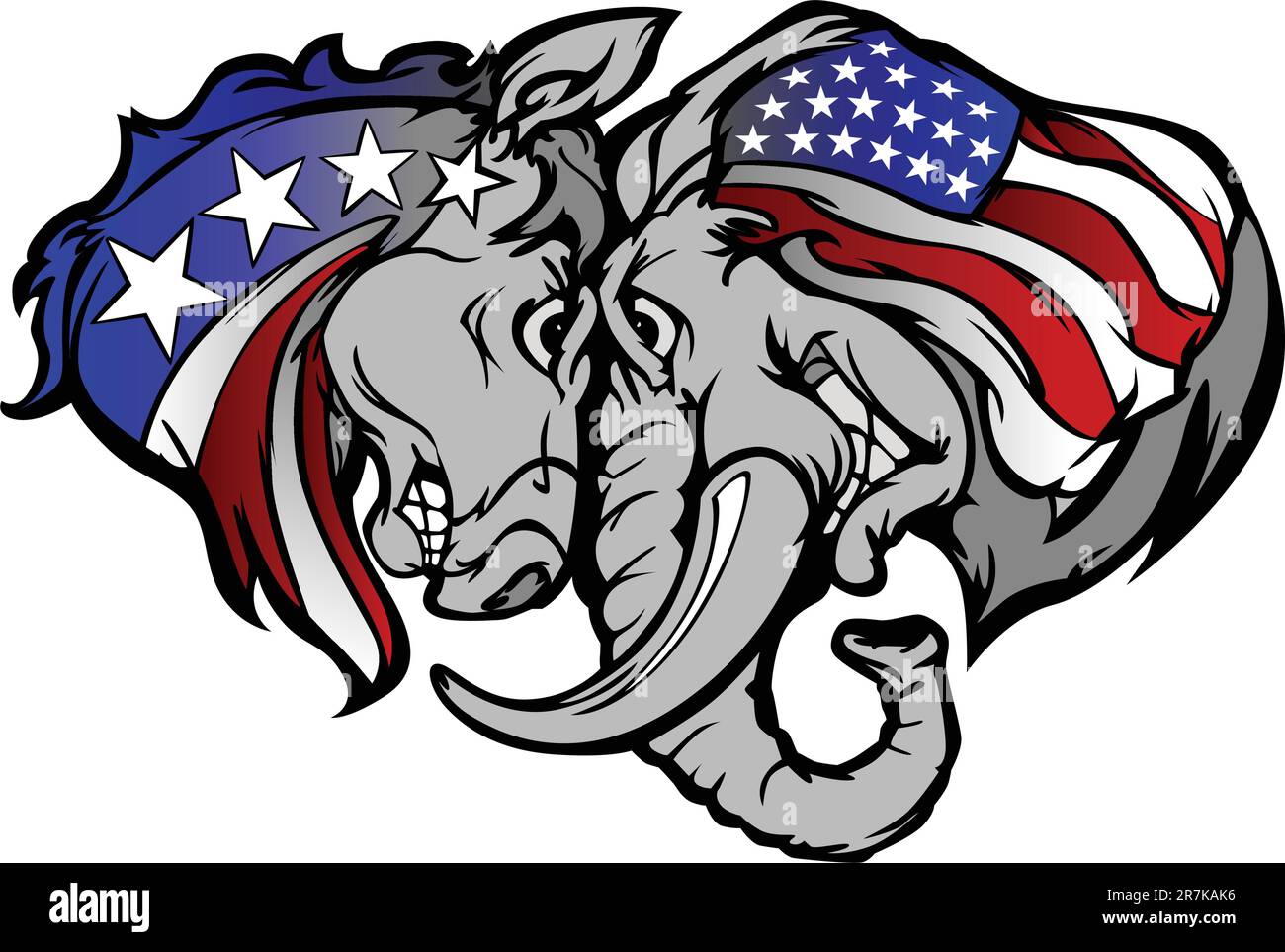
Ever wonder why two of the most powerful political organizations on the planet are represented by a stubborn farm animal and a giant gray mammal that never forgets? It’s kind of a bizarre choice when you think about it. Most countries go with lions, eagles, or dragons—symbols of raw power or majestic grace. But here in the States, we’ve got a donkey and an elephant. And honestly, neither started out as a compliment.
If you’re looking into how did the donkey and elephant become political mascots, you won't find a grand decree from a committee or a focus group of marketing geniuses. Instead, you'll find a cranky, brilliant, and incredibly influential cartoonist named Thomas Nast. He basically bullied these symbols into existence.
It started with insults. It ended with branding that has lasted over 150 years.
The Donkey: Born From a "Jackass" Remark
The Democratic donkey actually predates the Republican elephant by quite a bit. It goes back to the 1828 presidential campaign of Andrew Jackson. Jackson was a populist, a war hero, and, to his enemies, a total loose cannon. His opponents started calling him a "jackass" because they thought he was stubborn, loud, and generally unfit for high office.
Most people would have been offended. Jackson wasn't most people. He thought the comparison was actually pretty great. To him, a donkey represented the common man—hardworking, resilient, and not part of the snooty "aristocracy" his opponents belonged to. He even put the animal on his campaign posters for a short time.
But it didn't really stick as a permanent fixture. It sort of faded into the background of political ephemera for a few decades until Thomas Nast got his hands on it.
Thomas Nast and the Power of the Pen
Nast was a German-born illustrator for Harper’s Weekly. This guy was the 19th-century version of a viral YouTuber, but with way more political clout. He’s the reason we have our modern image of Santa Claus and Uncle Sam. He was also a staunch Republican.
In 1870, Nast drew a cartoon called "A Live Jackass Kicking a Dead Lion." The "lion" was Edwin Stanton, Abraham Lincoln’s Secretary of War who had recently died. The "jackass" was a group of Northern Democrats (often called Copperheads) who Nast believed were dishonoring Stanton’s legacy.
By the time he was done, the donkey wasn't just a one-off joke. It became the visual shorthand for the Democratic Party. Nast portrayed the donkey as fickle, easily spooked, and—this is the part that really stuck—stubbornly contrary.
It’s fascinating that the Democrats never officially adopted the donkey as their logo. The Republicans have the elephant on their official letterhead, but the Democrats just... sort of let it happen. They embraced the "hardworking and humble" spin, but it remains an unofficial mascot to this day.
The Elephant: A Panic in the Zoo
The Republican elephant has an even weirder origin story. It didn't start as a symbol of strength. It started as a symbol of a panicked, clumsy beast that was about to fall into a pit.
In 1874, the New York Herald—a paper that leaned Democratic—started running articles claiming that President Ulysses S. Grant was a "Caesarist." This was a fancy way of saying he wanted to become a dictator by running for a third term. Around the same time, the Herald also ran a hoax story about animals escaping from the Central Park Zoo.
Nast saw an opportunity to mock the Herald for its fear-mongering.
He drew a famous cartoon titled "Third Term Panic." In it, he depicted the Herald as a donkey wearing a lion’s skin, scaring away all the other animals in the "forest" (the various interest groups and parties). One of those animals was a massive, stumbling elephant labeled "The Republican Vote."
The elephant was teetering on the edge of a pit filled with inflation and chaos. Nast was trying to show that the Republicans were large and powerful but also dangerously close to being spooked by false rumors.
Why the Elephant Stayed
Even though Nast was a Republican, he wasn't always kind to his own party. He used the elephant to represent the GOP's size and strength, sure, but also its tendency to be slow-moving and unmanageable.
Yet, the symbol resonated. Republican voters liked the idea of being the "big" party. They saw the elephant as dignified, intelligent, and strong. By the 1880s, other cartoonists had picked up the image, and the GOP eventually leaned into it. Unlike the donkey, the elephant was officially adopted by the Republican National Committee.
Why These Symbols Refuse to Die
It’s been over a century. We live in a world of digital ads, high-speed internet, and 24-hour news cycles. Why are we still using 19th-century ink drawings to identify our political tribes?
Honestly, it’s because they work.
They are incredibly efficient. In a split second, a voter can look at a political cartoon or a mailer and know exactly which "team" is being discussed. They’ve become cultural shorthand.
- Recognition: Even a child knows which animal goes with which party.
- Adaptability: Both parties have learned to flip the script. Republicans call the elephant "strong and stable"; Democrats call it "clunky and stuck in the past." Democrats call the donkey "stubbornly for the people"; Republicans call it "stubbornly obstinate."
- Legacy: Political parties are old-fashioned institutions. They value tradition, even when that tradition started as a mean joke in a weekly magazine.
There’s also the psychological element. We like belonging to a "herd" or a "pack." Having a mascot makes the abstract concept of a political platform feel more like a tangible identity. You’re not just voting for tax policy; you’re an Elephant or a Donkey.
The Lessons of Political Branding
Understanding how did the donkey and elephant become political mascots tells us a lot about how branding actually works. It’s rarely about what you say about yourself. It’s usually about what your critics say and how you choose to respond to it.
If Andrew Jackson had fought the "jackass" label, it probably would have been used against him until it faded away. By claiming it, he took the power out of the insult. He turned a weapon into a tool.
The GOP did the same thing with the elephant. They took an image of a panicked, clumsy beast and reframed it as a symbol of "The Grand Old Party"—stately, wise, and immovable.
Insights for the Modern Age
If you’re looking at these symbols today, there are a few things to keep in mind about how they influence us:
- Don't ignore the satire. These mascots were born from satire, and they are still most effective when used that way. If you see a political ad using these animals, look at the context. Is the animal being portrayed as the hero or the buffoon?
- Visuals overrule words. Most people can't name the platform of the Whig Party (which used to be a major U.S. party), but they know the elephant and donkey. Visual branding is stickier than policy.
- The "Opponent's Invention" Rule. Many of our strongest cultural identifiers come from our enemies. The term "Big Bang Theory" was actually coined by a scientist who hated the idea and was trying to mock it. Same with the donkey.
Next time you see those red and blue icons on a news broadcast, remember that they weren't the result of a fancy branding agency. They were the result of a 19th-century artist with a sharp pen and a sense of humor, poking fun at the chaos of his time.
Politics hasn't changed all that much, has it?
What to Do Next
If you want to dive deeper into the visual history of American politics, your next move should be to look up the original Thomas Nast archives. Many are digitized by the Library of Congress.
Specifically, look for the "Tammany Tiger" cartoons. Nast didn't just stop at the donkey and elephant; he also created a tiger to represent the corrupt political machine of Tammany Hall in New York. While the tiger didn't survive as a national party mascot, seeing it alongside the donkey and elephant gives you a much better "vibe" for how vicious—and creative—political messaging used to be.
You can also check out local library archives for 19th-century copies of Harper’s Weekly. Seeing the physical paper and the scale of the illustrations puts the power of Nast’s work into perspective. These weren't just "comics." They were the primary way people understood the news.
Finally, keep an eye on modern political memes. We are currently living through the birth of new symbols that might last just as long as the donkey and elephant. Only time will tell if they have the same staying power.